Head Office
117, Grand Trunk Road, Salkia Howrah-700013, Kolkata, India
 Hitesh PathakThu, Apr 10, 2025
Furniture and cabinet production begins with correctly sized panels. If a plywood, MDF, particle-board, or laminated sheet is cut out of square, chipped along the decorative face, or sized inconsistently, every downstream operation becomes more difficult. Edge banding, drilling, joinery, hardware fitting, and final assembly all depend on the quality of the first sizing cut. A panel saw machine provides broad support and guided movement for this critical stage.
The Panel Saw Machine from Pathak Industries is available in PPS-300 and PPS-150 configurations. Both use a main blade and scoring blade, while their sliding-table dimensions, rip capacities, blade speeds, and main-motor data differ. This guide explains how a sliding panel saw works, why scoring matters on laminated boards, how the two models compare, and which setup, extraction, inspection, safety, and maintenance practices support reliable cutting.
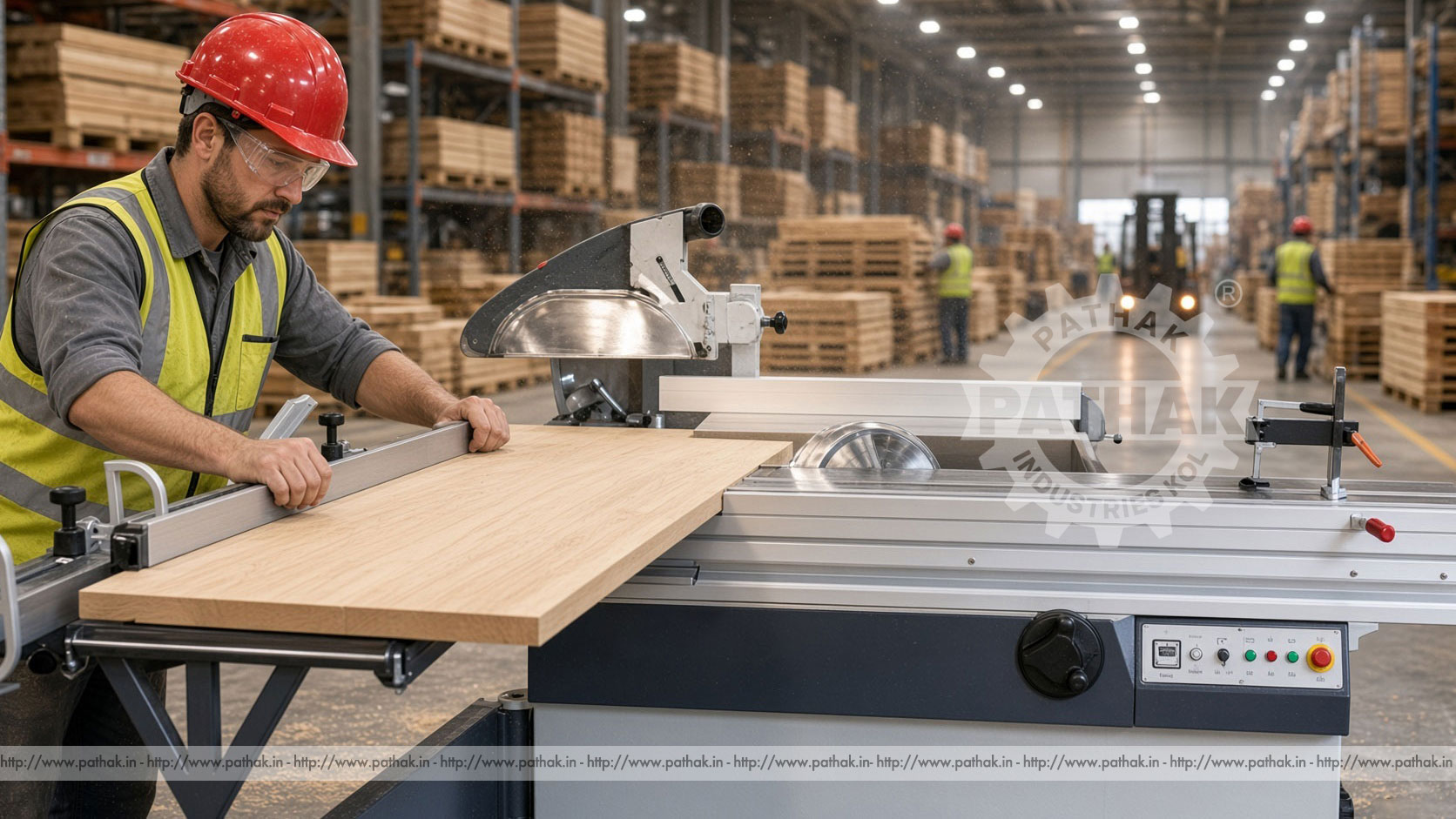
A panel saw is a woodworking machine designed to size large sheet materials into straight rectangular components. On a sliding-table arrangement, the operator places the panel against fences or stops and moves the supported table through the blade. The sliding action guides the work along a controlled path while reducing the need to push a large sheet directly across a fixed table.
The machine is suited to materials such as plywood, MDF, particle board, and suitable laminated panels. Blade selection and operating settings must match the exact material, thickness, coating, and finish requirement. Solid timber or specialized composite sheets may require different tooling and procedures.
A panel saw is primarily a sizing machine. It can establish length, width, parallel edges, and square corners for components that later move to edge processing, drilling, routing, assembly, or finishing.
The panel rests on the sliding table and supporting surfaces. A fence, crosscut stop, or rip setting establishes the required dimension. Once the work is positioned and secured according to the operating procedure, the table and panel move past the rotating blades.
The scoring blade works ahead of the main blade on the lower face of the panel. It makes a shallow cut through the decorative layer so the main blade can complete the separation with less breakout at the underside. Correct alignment between scoring and main cuts is essential; if their kerfs do not correspond, the edge may show a step or chip.
The main blade performs the full-depth cut. Blade diameter, tooth geometry, height, speed, condition, and feed all affect cutting behavior. The work must remain against its reference surfaces throughout the stroke, and offcuts need enough support to avoid twisting into the blade.
PPS-300 has a published sliding-table size of 3000 × 375 mm and rip capacity of 1250 mm. PPS-150 uses a 1500 × 310 mm sliding table with 900 mm rip capacity. This difference affects the panel dimensions and support arrangement each model can accommodate during a guided cut.
Both machines list a maximum cutting height of 70 mm and a main-saw size of 300 × 30 mm. PPS-300 provides published main-blade speeds of 4500 and 6000 RPM, while PPS-150 is listed at 6000 RPM.
Both models use a 120 × 20 mm scoring blade running at a published 8000 RPM. The scoring-saw motor is listed at 0.75 kW on each. PPS-150 has a documented 3 kW main-saw motor. The legacy PPS-300 table records “4LW” for its main motor; buyers should confirm the correct current power value from the approved technical sheet instead of assuming that entry means 4 kW.
Specifications establish the machine envelope but do not guarantee the quality of every material. Blade choice, scoring alignment, sheet support, fence setting, extraction, feed consistency, and material condition remain part of the result.
Large boards are awkward to guide accurately if they are supported only near the blade. A sliding table carries the panel along a defined path, allowing the operator to reference the sheet and move it through the cut with broad support.
The longer PPS-300 table is intended for larger panel-handling needs, while PPS-150 provides a more compact arrangement for appropriately sized work. Selection should account for the full sheet, not only the finished component. The operator needs safe support during loading, alignment, cutting, and offcut removal.
Sliding accuracy depends on clean guideways, correct adjustment, and controlled loading. Chips or damage on reference surfaces can shift a panel. Excessive force or side loading can also affect the movement and should be avoided.
The main blade removes most of the material and determines the primary kerf. Its tooth count and geometry should suit the board. A blade selected for rough timber ripping may not provide the desired edge on a coated panel, while a fine blade used incorrectly can overheat or load with debris.
The scoring blade is smaller and cuts only deep enough to separate the bottom decorative layer along the main kerf. Its lateral position and width must match the main blade. A scorer set too narrow can leave chipping; one set too wide can leave a visible ledge.
Both blades should be clean, sharp, correctly mounted, and suitable for the listed speed. Damaged teeth, resin buildup, runout, or an incorrect flange condition can affect finish and safety. Blade service should follow the tool and machine instructions.
Inspect the sheet before loading. Identify the decorative face, grain or pattern direction, damaged corners, bow, contamination, and any embedded foreign material. Confirm the cutting list and allow for kerf and trimming where the production plan requires it.
The panel should sit flat enough for reliable support. Severe bow or twist can alter contact with the table and scoring blade. Dust, chips, or offcuts beneath the material can also change its position, so working surfaces should remain clean.
Plan the sequence to produce stable reference edges before final dimensions. For repeated components, stops should be verified with a first-off piece rather than relying only on a scale indication.
A panel component usually depends on square and parallel edges. The crosscut fence should maintain the intended relationship to blade travel, and rip settings should establish a consistent distance from the blade. Worn, damaged, or contaminated fence faces can prevent proper seating.
Use an appropriate test method to verify squareness over a meaningful length. A short square alone may not reveal a small angular error that becomes significant on a large panel. Repeated diagonal or multi-cut checks can help identify fence adjustment issues according to workshop procedure.
Stops should lock securely without deflecting under panel contact. Operators should bring the material to a stop consistently, without impact that could shift an adjustment.
Chipping, burning, saw marks, an uneven edge, or dimensional variation can come from several sources. Before changing machine settings, inspect the blade and scorer, material support, fence, table movement, extraction, feed behavior, and panel condition.
Feed should be steady and appropriate to the material and blade. Forcing the panel can deflect the cut or overload the blade; moving too slowly may increase heat or marking. The blade should reach its operating condition before entering the work.
On laminated panels, scorer alignment deserves separate attention. The lower and upper faces may show different symptoms, helping the operator distinguish scorer problems from main-blade or support problems.
Panel saw machines are relevant to furniture factories, cabinet shops, modular-furniture production, kitchen manufacturers, office-furniture plants, interior fit-out workshops, door and partition production, and general woodworking facilities.
Common components include cabinet sides, shelves, backs, doors, drawer parts, partitions, worktop substrates, furniture panels, and blanks for later routing or drilling. Suitability depends on the board material, dimensions, thickness, finish, blade tooling, and required production standard.
In a production cell, the panel saw often feeds edge banders, boring machines, routers, assembly stations, or finishing processes. Consistent labeling and part identification reduce the risk of mixing similar-looking panels after cutting.
Start with the largest sheet and longest guided cut handled regularly. Compare that requirement with the 3000 × 375 mm PPS-300 or 1500 × 310 mm PPS-150 sliding table. Then compare required rip width with the published 1250 mm and 900 mm capacities.
Both models list 70 mm cutting height, but the maximum headline value should not be used without considering blade, material, cut quality, guarding, and operating procedure. Review expected sheet volume, loading space, offcut handling, available power, dust extraction, blade-speed needs, floor area, and operator training.
PPS-300 may suit workshops handling larger panels and requiring its longer sliding table and wider rip capacity. PPS-150 offers a smaller platform for work that fits its published envelope. Share representative sheets, cutting lists, and material types with Pathak Industries before confirming a model.
Wood and board cutting produces dust and chips that can affect health, visibility, machine movement, finish, and fire risk. The machine should be connected to an extraction system designed for the material and cutting duty. Ducting, airflow, collection, and disposal need regular inspection.
Fine dust can accumulate inside guards, around motors, on guideways, and in electrical areas. Cleaning should follow an approved method that avoids creating a suspended dust cloud or exposing personnel to moving blades. Dust should not be cleared with hands while the machine is operating.
Some composite boards and coatings require material-specific exposure controls. Review supplier information and workshop requirements before cutting unfamiliar material.
A circular saw blade can cause severe injury, and the large workpiece can introduce trapping and handling hazards. Only trained operators should use the machine. Guards, riving or protective devices where provided, extraction, stops, fences, and emergency controls must be in place and functional.
Keep hands away from the cutting line and never reach over or behind an exposed rotating blade. Use approved push or handling aids where the procedure requires them. Support both the main panel and offcut so neither falls, rotates, or closes unpredictably on the blade.
Stop and isolate the machine before changing blades, adjusting the scoring system, cleaning near the cutting area, or servicing moving parts. Large sheets may require two-person or mechanical handling, but roles must be clear so no helper pulls the work off line or enters the hazard zone.
Keep the sliding table, fences, stops, guides, and reference surfaces clean. Inspect table movement for play or damage, and verify fence alignment at scheduled intervals. Lubricate only where and with what the machine documentation specifies; excess lubricant can attract abrasive dust.
Inspect main and scoring blades, arbors, flanges, belts or drives, motors, guards, switches, cables, extraction connections, and emergency devices. Blade mounting surfaces should be clean and undamaged. Unusual noise, vibration, heat, or cut behavior should be investigated before production continues.
Maintain a record of blade changes, alignment checks, repairs, and recurring cut-quality observations. Dimensional trends can reveal developing wear before it creates a batch of incorrect panels.
It sizes suitable plywood, MDF, particle board, laminated sheets, and related panels into straight rectangular components for furniture, cabinetry, interiors, and woodworking production.
PPS-300 has a 3000 × 375 mm sliding table and 1250 mm rip capacity. PPS-150 has a 1500 × 310 mm table and 900 mm rip capacity. Their main-blade speed and motor entries also differ.
The scoring blade makes a shallow cut on the lower decorative face before the main blade completes the cut, helping reduce underside chipping when correctly aligned.
Both models list a 70 mm cutting height. Actual material suitability must also account for blade choice, guarding, cut quality, and the approved operating process.
PPS-300 and PPS-150 both list a 300 × 30 mm main blade and a 120 × 20 mm scoring blade.
Use suitable sharp blades, align the scoring kerf with the main blade, support the panel properly, maintain a steady feed, keep the machine clean, and verify settings with a test component.
Provide sheet dimensions, materials, thicknesses, coatings, cutting lists, daily volume, edge-quality expectations, available power, extraction system, loading space, and required rip capacity.
A Panel Saw Machine combines broad sheet support, guided table movement, fence control, a main blade, and scoring blade to create consistent blanks for downstream woodworking. PPS-300 and PPS-150 provide different table lengths and rip capacities for different workshop requirements.
Reliable sizing depends on more than machine capacity. Correct blades, scorer alignment, square references, clean support, steady handling, dust extraction, inspection, and maintenance must work together. When those elements are controlled, the panel saw becomes a dependable first stage for furniture and cabinet production.