Head Office
117, Grand Trunk Road, Salkia Howrah-700013, Kolkata, India
 Hitesh PathakWed, Aug 5, 2026
Sand used for masonry, plastering, concrete preparation, landscaping, and other construction tasks often arrives with oversized particles, stones, debris, or compacted lumps. Screening separates material according to the selected opening so the usable fraction can move to the next process. A Rotary Sand Screening Machine replaces repeated hand sieving with a continuously rotating screening action.
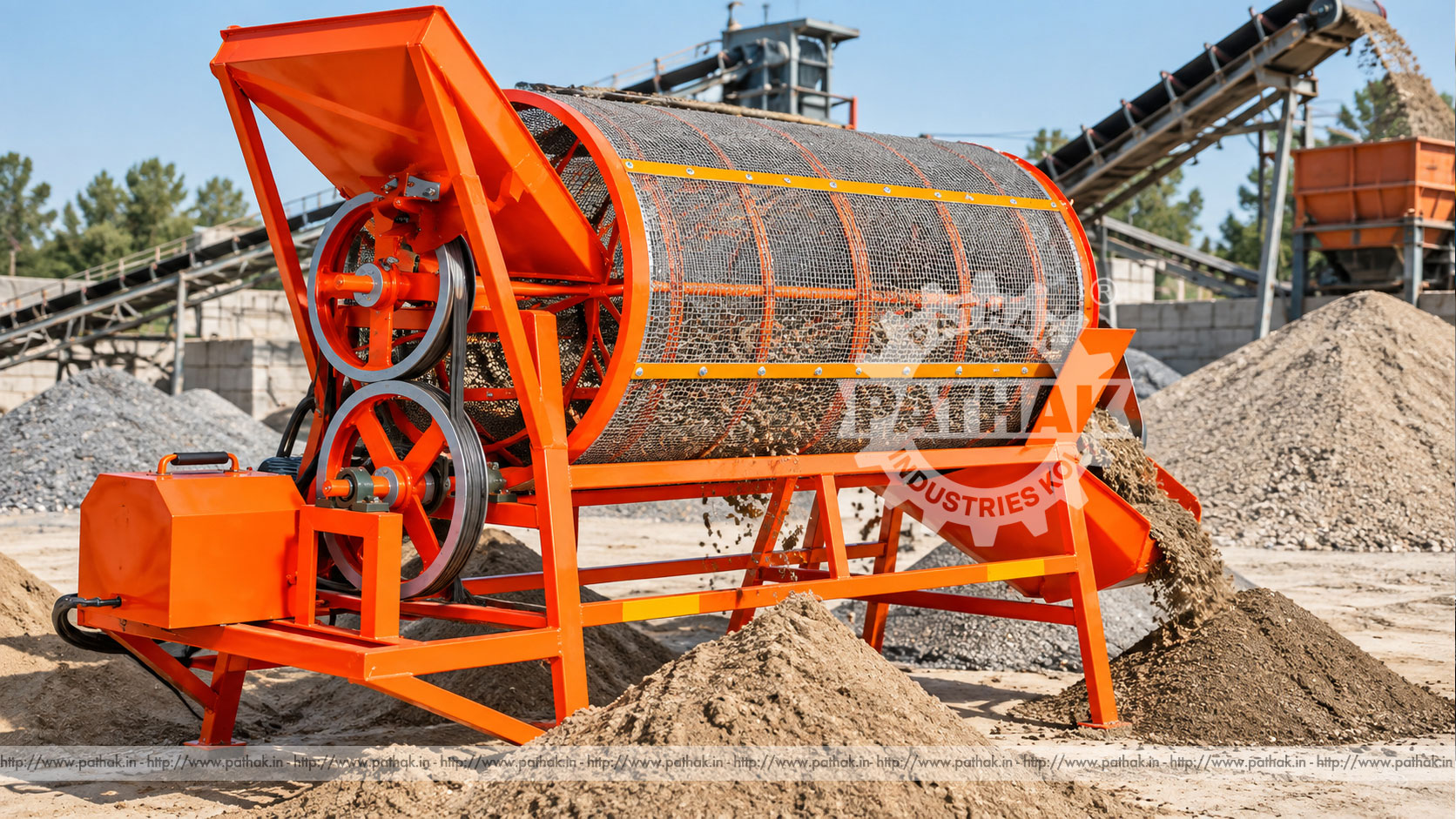
The Pathak Industries PRSS model uses a rotary shell listed at 4 × 2.5 feet, a pulley drive, and a single-phase motor arrangement. Its published approximate weight is 110 kg. This compact configuration can support construction-material preparation where controlled feeding, suitable screen selection, planned discharge, and routine cleaning are provided.
Rotary screening uses a cylindrical or drum-like screen that turns around its axis. Feed material enters at one end or through a designated loading point. As the shell rotates, the material lifts, rolls, and travels across the screening surface. Particles smaller than the selected openings pass through, while oversize pieces continue toward a separate discharge.
The process combines conveying and separation in one rotating element. It is well suited to free-flowing or properly conditioned granular material. Actual performance depends on moisture, particle-size distribution, feed consistency, screen opening, rotational behaviour, drum loading, and the cleanliness of the mesh.
The motor transfers power through the pulley-drive arrangement to rotate the screening shell. Prepared sand is introduced at a controlled rate. Rotation continually exposes fresh material to the screen surface, allowing acceptable particles to fall through while larger contaminants or agglomerates remain inside until they reach the oversize outlet.
Material should never be dumped faster than the shell can distribute it. Overfeeding creates a thick bed that prevents smaller particles from reaching the openings. A steady feed generally produces more consistent separation and reduces sudden loads on the drive.
The product record identifies the model as PRSS and lists a 4 × 2.5 ft shell, pulley drive, single-phase motor arrangement, and approximately 110 kg weight. These details describe the base machine, but the screen opening and final grading requirement should be confirmed for the intended material before ordering.
Screen selection is central to the application. A machine can rotate correctly and still produce unsuitable material if the opening does not match the required grading. Buyers should provide a representative feed sample, desired undersize fraction, acceptable oversize, moisture condition, and expected hourly demand.
Screening improves consistency by removing particles that exceed the selected opening. More uniform feed can help downstream batching, mixing, finishing, or packing. It can also reduce interruptions caused by stones and debris entering equipment designed for finer material.
Screening does not wash sand, change its mineral composition, or guarantee suitability for a structural application. Material quality must still be evaluated through the appropriate inspection and testing process. The machine provides size separation, not complete material certification.
A rotary sand screening machine may be useful in:
Each application should be reviewed independently. Abrasiveness, contamination, moisture, temperature, bulk density, and particle shape can affect wear and screening behaviour.
The screen opening determines which particles can pass. Smaller openings produce a finer undersize fraction but may reduce throughput and block more easily. Larger openings pass more material but allow larger particles into the product. The correct choice is based on downstream process needs rather than on maximum output alone.
Opening shape and usable screen area also matter. Woven mesh, perforated material, or another suitable screening surface can behave differently with elongated or flaky particles. Pathak Industries should confirm the supplied screen arrangement against the sample and required cut size.
Dry, free-flowing material usually separates more readily than sticky sand. Excess moisture can cause fine particles to adhere to larger pieces or blind the openings. If the feed contains compacted lumps, controlled preconditioning may be required before screening.
Feed should be checked for metal, timber, fabric, or other debris that could damage or wrap around moving components. Large objects outside the machine's intended feed range should be removed before loading. A feed hopper or controlled manual method should distribute material without exposing workers to rotating parts.
The PRSS uses a pulley drive to transfer motor power to the rotary assembly. Belt tension and pulley alignment influence smooth operation. A loose belt can slip and reduce shell speed, while excessive tension can increase bearing and shaft loads.
Drive guards must remain fitted during operation. Belts, pulleys, keys, fasteners, and bearings should be inspected only after power isolation and confirmation that all movement has stopped. Replacement components should match the specified type and size.
A productive installation keeps three streams organised: unscreened feed, accepted undersize, and rejected oversize. These paths should not cross in a way that causes remixing. Containers, chutes, stockpile locations, or conveyors must fit the outlet positions and expected volume.
Enough clearance is needed to remove collected material and clean around the machine. If screened sand accumulates beneath the shell until it touches the screen, separation will deteriorate. Planned removal prevents congestion and keeps access routes safer.
Wet or sticky fines may coat the screen and reduce open area. The acceptable moisture range should be established through trials using representative feed.
A uniform feed gives particles time to contact the screen. Sudden surges can overload the shell and carry usable material into the reject stream.
Blocked, stretched, damaged, or incorrectly fitted screening surfaces change the cut and reduce efficiency. Routine visual inspection is essential.
Feed containing a high proportion close to the opening size can be harder to separate than material with clearly different fine and coarse fractions.
A firm, correctly prepared installation supports smooth rotation and predictable travel. Loose supports or an uneven base can introduce vibration and poor material flow.
Rotating shells and pulley drives create entanglement and pinch hazards. Guards, barriers, and covers must remain in place. Loose clothing, jewellery, hair, hands, and tools must be kept away from the feed opening and all moving parts.
Dust exposure should be assessed for the processed material. Suitable extraction, suppression, housekeeping, and personal protective equipment may be needed. The machine must be isolated from electrical and mechanical energy before clearing a blockage, cleaning the screen, adjusting the drive, or performing maintenance.
At the end of production, stop feed and allow the shell to discharge normally before shutdown. Once isolated, remove retained material with approved tools. Do not strike or distort the screen. Inspect for broken wires, enlarged openings, loose clamps, and material packed around supports.
Routine maintenance should include belt condition and tension, pulley alignment, bearings, fasteners, electrical cable, motor ventilation, guards, frame condition, and shell alignment. Lubrication should follow the supplied schedule because both insufficient and excessive lubrication can create problems.
Screened product should be sampled at planned intervals. A simple grading check can show whether oversize material is passing or useful fines are being lost to rejection. Results should be linked to the feed source, screen used, date, and operating conditions.
A sudden change may indicate damaged mesh, blockage, altered moisture, excessive feed, or changed source material. Finding the cause early prevents a large quantity of off-target product from reaching the next process.
Define the feed material, maximum lump size, desired product size, moisture range, contamination, daily quantity, loading method, and discharge arrangement. Confirm that the 4 × 2.5 ft PRSS shell and selected screen are suitable for those conditions. Requested output should be based on sample trials or application review rather than shell dimensions alone.
Also consider available power, operating location, dust controls, mobility needs, foundation, labour, spares, cleaning access, and integration with conveyors or stockpiles. A well-matched compact machine is often more useful than a larger unit that cannot be fed or cleared consistently.
The product page identifies the Pathak rotary sand screening machine as model PRSS.
The PRSS shell is listed as 4 × 2.5 feet. Application suitability also depends on screen opening, feed condition, and required output.
The machine uses a pulley drive powered by a listed single-phase motor arrangement.
The published approximate machine weight is 110 kg. Installation and handling plans should be confirmed against the supplied unit.
Moisture can make sand adhere and block screen openings. Suitability should be established by reviewing the material and, where necessary, conducting a representative trial.
No. Rotary screening separates by particle size. Washing or removing adherent fine contamination requires a separate suitable process.
Select the opening from the required undersize product, feed distribution, particle shape, moisture, and downstream use. Confirm the supplied screen specification before ordering.
Keep the screen clear, inspect it for damage, maintain belt tension and pulley alignment, check bearings and fasteners, clean the motor ventilation area, and retain all guards.
The Pathak Industries PRSS provides a compact rotary method for separating sand and other suitable granular feed by size. Its 4 × 2.5 ft shell, pulley drive, single-phase motor arrangement, and approximately 110 kg construction support straightforward installation for appropriate workloads. Consistent results depend on choosing the correct screen, controlling moisture and feed rate, organising both discharge streams, and maintaining the screen and drive system.