Head Office
117, Grand Trunk Road, Salkia Howrah-700013, Kolkata, India
 Hitesh PathakMon, Jul 20, 2026
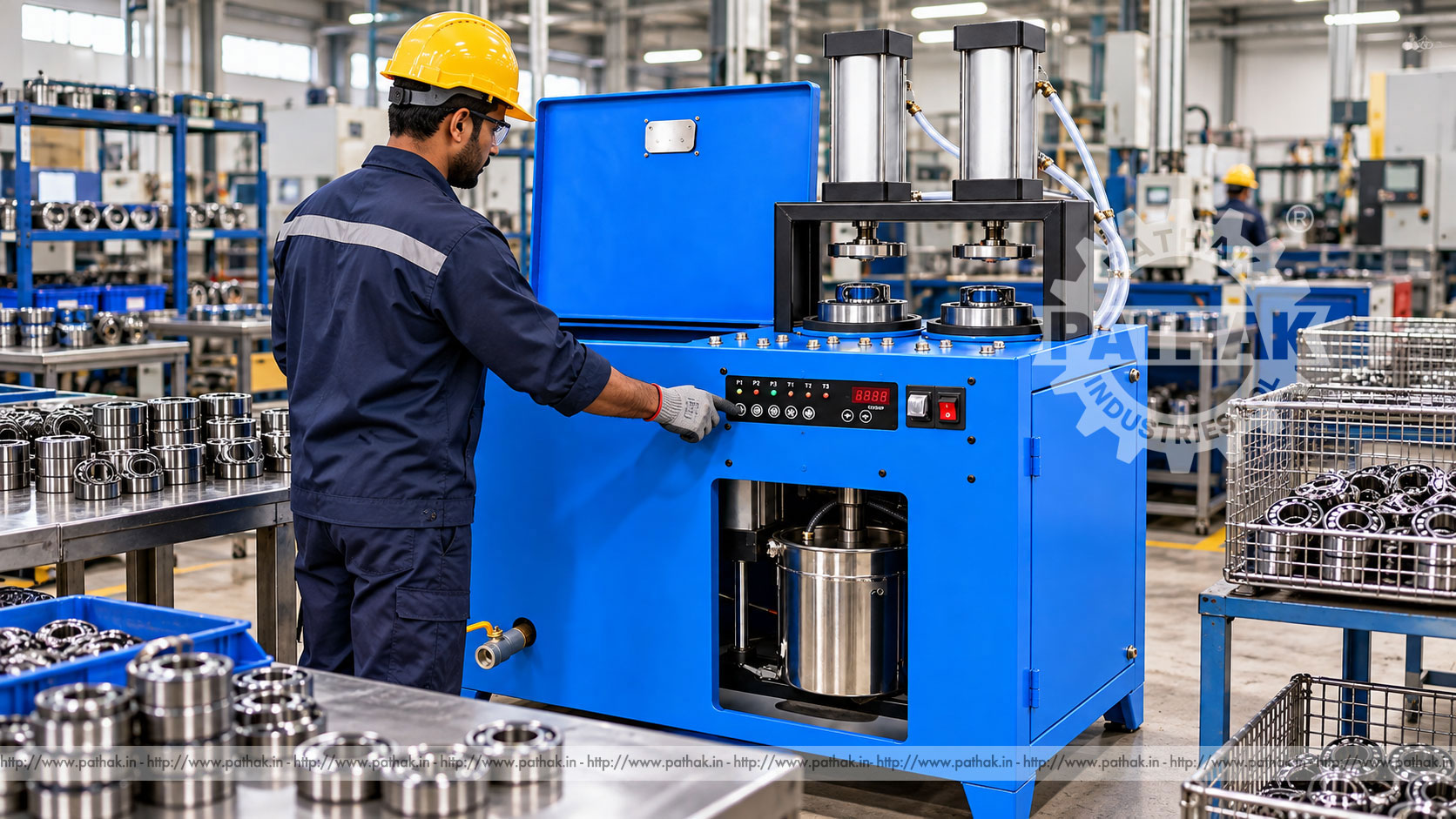
Bearing service work depends heavily on cleanliness. Old lubricant, fine wear particles, dust, moisture, and workshop contamination can remain inside a bearing if cleaning is rushed or performed with unsuitable methods. A Bearing Oil Filling and Cleaning Machine provides a dedicated station for controlled cleaning and subsequent oil filling of compatible bearings.
The Pathak Industries TLPBFC-1 has a published cleaning aperture range of 20–180 mm and an oil-filling aperture range of 45–180 mm. The listed cleaning time is 4–6 minutes, with a heating temperature of 60°C and a separate refuelling heating temperature of 40°C. Voltage options are 220 and 380 V. Because the source record does not identify the cleaning fluid, oil specification, dosing volume, or precise circulation method, those details must be selected and confirmed for the actual bearing and service procedure.
This machine combines two related maintenance operations at one organised workstation. First, it supports the removal of old oil and contaminants from bearings within its stated cleaning range. Second, compatible cleaned bearings can receive the specified oil under a controlled filling process.
The objective is not merely to make the bearing look clean. Internal rolling elements, raceways, cages, and accessible spaces need a process that avoids introducing new debris or damaging precision surfaces. The correct oil must then be applied in the quantity and condition required by the bearing or assembly documentation.
Bearings separate moving surfaces through precise geometry and a thin lubricant film. Hard particles can indent raceways or rolling elements, while moisture may encourage corrosion. Degraded or incompatible lubricant can alter friction, temperature, and service behaviour.
A contaminated bearing may rotate after reassembly but still experience accelerated wear. Cleaning, inspection, and refilling should therefore form part of a controlled maintenance procedure. The machine improves organisation, but the outcome still depends on fluid cleanliness, correct handling, inspection, and lubricant selection.
The cleaning function is listed for bearing apertures from 20 to 180 mm. The oil-filling function begins at 45 mm and extends to 180 mm. This means some smaller bearings may fall within the cleaning range but outside the published filling range.
Aperture alone does not prove full compatibility. Outer diameter, width, bearing type, seals, cage, internal geometry, mass, fixture contact, and access for cleaning or filling must also suit the machine. Buyers should provide representative bearing references or samples when confirming the working scope.
Begin by identifying the bearing and recording its service condition. Remove loose external dirt in a way that prevents it from entering the machine or internal surfaces. Confirm that the bearing is suitable for cleaning and that seals, shields, or other components are handled according to the service instructions.
Place the bearing in the correct fixture or working position and establish the approved cleaning cycle. The product data lists 4–6 minutes, but the selected duration should reflect bearing condition and the documented process. After cleaning, allow the fluid to drain or complete the prescribed drying stage before inspection and oil filling.
The machine lists a cleaning heating temperature of 60°C. Heating can reduce fluid viscosity and help loosen certain lubricant residues, but temperature must remain compatible with the bearing, seals, cage material, cleaning medium, and safety procedure.
The set value and actual working temperature should be monitored using the machine’s provided controls. Operators should not raise heat to compensate for unsuitable chemistry, excessive contamination, or an overloaded process. Hot components and fluid introduce burn and vapour hazards that require appropriate protection and ventilation.
The stored specification gives 40°C as the refuelling heating temperature. Controlled warming may support oil flow and filling consistency for the approved lubricant. It should not be assumed suitable for every product; viscosity and temperature limits must come from the lubrication requirement.
The bearing should be clean, inspected, and ready before filling begins. Oil containers, transfer paths, fittings, and tools must be protected from dirt and moisture. Mixing different lubricant types or topping up an unidentified residue can compromise the result even if the machine operates correctly.
Oil selection depends on bearing type, speed, load, temperature, environment, sealing, and the equipment in which the bearing will operate. Viscosity at operating temperature is particularly important because the lubricant must form an adequate film without creating unnecessary resistance.
Additives and base-oil chemistry also affect compatibility. Use the equipment or bearing documentation rather than selecting by colour or general description. If changing from one oil to another, confirm compatibility and whether the earlier lubricant must be completely removed.
Cleaning creates an opportunity to examine bearing condition. Inspect accessible raceways, rolling elements, cage, seals, and surfaces for corrosion, scoring, flaking, cracks, overheating, dents, abnormal wear, or contamination that remains after the cycle.
A clean damaged bearing should not automatically be returned to service. Acceptance should follow the maintenance standard for the equipment. Where internal inspection requires disassembly, use the correct procedure and tools so components are not marked or mixed.
Clean bearings should be handled in a separated area with clean gloves and tools. Dirty incoming parts, used fluid, wiping cloths, and waste should not share the same surface as inspected components. Covered trays or containers can protect bearings waiting for filling or assembly.
Fresh oil should be stored in sealed, labelled containers and transferred through clean equipment. Funnels and open cans left in the workshop can introduce dust. Filtration and cleanliness requirements should match the lubrication plan.
The TLPBFC-1 can support automobile garages, fleet-maintenance facilities, engineering workshops, rebuild departments, industrial service centres, and production units working with compatible bearings. It can organise a task that might otherwise be split across unconnected cleaning and lubrication areas.
Potential jobs include bearings removed during scheduled overhaul, inspection, or repair. Suitability depends on bearing design and the authorised maintenance method. Sealed-for-life bearings, damaged units, or designs requiring grease rather than oil may need a different process.
The product page does not state a cleaning medium, so the user must confirm the supplied system and compatible fluid. Any cleaner should be suitable for the bearing materials, seals, machine components, temperature, and workplace controls. Flash point, vapour, skin contact, and disposal requirements need review.
Fluid condition changes as contamination accumulates. A defined inspection, filtration, change, and disposal schedule helps prevent dirty fluid from transferring debris between bearings. Used fluid should not be returned to clean storage.
The published cleaning time is a machine-cycle reference, not the full time needed to service a bearing. Identification, pre-cleaning, loading, heating, draining, inspection, oil filling, final handling, and records all contribute to total throughput.
Heavily contaminated or complex bearings may require a different approved process rather than simply extending the cycle indefinitely. Production planning should use representative trials and include fluid-management and inspection time.
The product record lists 220 V and 380 V options. The ordered configuration must match site voltage, phase, frequency, earthing, and protection. A qualified person should prepare the supply and isolation arrangement using the final electrical data.
Machine size is listed as 57 × 100 × 115 cm, and net weight as 250 kg, with a separate 30 kg wooden shipping case. Installation should provide a stable level surface, ventilation, service clearance, safe fluid handling, suitable lighting, and an organised clean/dirty workflow.
The process may involve hot fluid, heated components, moving mechanisms, electricity, and chemical exposure. Operators should follow the supplied manual and safety data for every fluid used. Eye protection, suitable gloves, protective clothing, and ventilation should reflect the process hazards.
Lids, guards, and interlocks must remain functional. Do not open or reach into the working area during an active cycle. Before cleaning the machine, clearing a blockage, or servicing pumps and heaters, isolate electrical and stored energy and allow hot components to cool safely.
Daily checks should cover fluid level and condition, oil supply, hoses, seals, fixtures, controls, heaters, temperature indication, drainage, guards, and visible leaks. Working surfaces should be cleaned without contaminating the clean-fluid side of the process.
Scheduled service may include filters, pumps, valves, tanks, heating elements, temperature controls, electrical systems, and seals according to the final configuration. Keep maintenance records alongside fluid changes and process checks so changes in cleaning performance can be investigated.
A job record can identify the bearing, equipment source, incoming condition, cleaning cycle, fluid batch, inspection result, oil type, filling quantity or setting, operator, and date. Traceability is particularly useful for fleet, production, and critical-maintenance work.
Labels should distinguish cleaned, accepted, filled, rejected, and awaiting-inspection bearings. This prevents a processed component from being mixed with dirty incoming work or installed before inspection is complete.
List the bearing types, aperture range, outer sizes, widths, seals, oils, contamination, monthly volume, and quality requirements. Identify whether bearings require only cleaning, both cleaning and filling, or another lubrication method. Provide samples where possible.
Confirm fixtures, compatible fluids, tank arrangement, filtration, heating controls, filling method, electrical option, ventilation, fluid disposal, and supplied accessories. Pathak Industries can review the intended bearing range against the TLPBFC-1, but each special design should be approved in the final technical offer.
It provides a dedicated station for cleaning compatible bearings and filling approved bearings with the specified oil under a controlled workshop process.
The TLPBFC-1 lists a cleaning aperture range from 20 to 180 mm, subject to the complete bearing geometry and fixture compatibility.
The published filling range is 45–180 mm. Bearings below 45 mm may fall within cleaning capacity but outside the listed filling range.
The product table lists 4–6 minutes. Total service time also includes preparation, heating, drainage, inspection, filling, and handling.
The listed cleaning temperature is 60°C, while the refuelling heating temperature is 40°C. Fluid and bearing compatibility must be confirmed.
No. The fluid must suit the machine, bearing materials, seals, process temperature, safety controls, and approved disposal method.
No. Cleaning supports inspection but does not repair corrosion, fatigue, cracks, scoring, or other damage. Acceptance must follow the maintenance criteria.
Provide bearing types and dimensions, contamination, oil specifications, monthly quantities, required inspection, site voltage, preferred fluids, and workplace conditions.
The TLPBFC-1 can organise bearing cleaning and oil filling, but machine operation is only part of reliable service. Fluid control, contamination separation, inspection, correct lubricant selection, careful handling, and traceability determine whether a processed bearing is ready for its next stage.
Review the confirmed specifications on the Bearing Oil Filling and Cleaning Machine product page and share representative bearings with Pathak Industries. Confirm fixture compatibility, cleaning medium, oil, filling method, electrical configuration, accessories, safety controls, and acceptance procedure before ordering.