Head Office
117, Grand Trunk Road, Salkia Howrah-700013, Kolkata, India
 Hitesh PathakMon, Apr 6, 2026
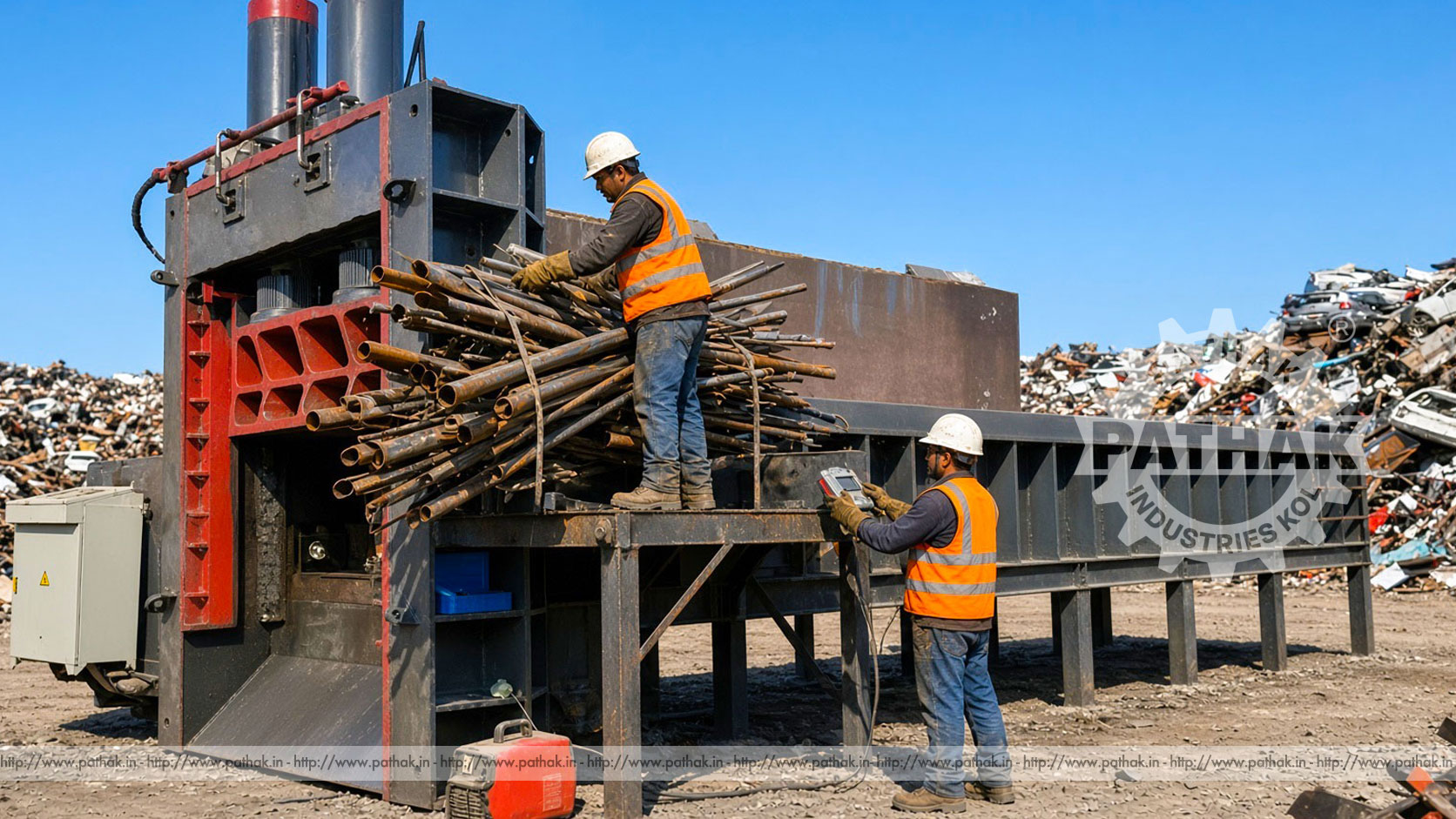
Recycling yards and metal processors often receive long, irregular, and bulky scrap that is difficult to transport, sort, charge, or process in its original form. A Heavy Duty Hydraulic Scrap Gantry Shearing Machine reduces suitable sheet, plate, bars, sections, and prepared scrap into shorter pieces by applying guided hydraulic force through a shearing blade.
The Pathak Industries range includes PHDGSM-1000, PHDGSM-1250, and PHDGSM-1500 configurations. Their published cutting widths are 2000 mm for the 1000 model and 2200 mm for the 1250 and 1500 models. All three list a 9-degree shear angle, a nominal shear speed of 3–4 times per minute, a maximum hydraulic-system working pressure of 25 MPa, and integrated PLC manual/automatic operation. Actual suitability depends on scrap grade, cross-section, bundle density, orientation, and the final confirmed machine configuration.
A gantry shear is a large scrap-processing machine built around a loading box or bed, hydraulic compression equipment, and a vertically arranged shearing zone. Material is loaded into the box, compacted or restrained, advanced toward the cutting opening, and divided by a moving blade. The gantry structure supports the high forces involved in holding and cutting irregular metal feed.
Unlike conventional sawing, the process separates suitable scrap through shear deformation rather than removing a continuous stream of chips. This can be effective for mixed prepared sections and plate that fit the machine’s approved envelope. It does not mean that every object found in a scrap yard can be loaded without inspection.
Material is first inspected, sorted, and placed in the loading box using the planned handling equipment. Hydraulic cut-oil-bed and pressure-cylinder systems then move or compress the feed according to the machine sequence. Restraint reduces movement at the cutting zone and presents the material to the blade in a more controlled form.
The shear blade travels through the supported scrap at the published 9-degree angle. The angled action concentrates the cut progressively across the width instead of applying peak load everywhere at once. After separation, the blade returns and the feed advances for the next cut. PLC controls coordinate manual setup actions and automatic production sequences in the supplied arrangement.
PHDGSM-1000 has a listed cutting width of 2000 mm and a cut opening of 750–1100 mm. Its loading box is published at 8000 × 2000 × 1000 mm. The two cut-oil-bed units each list a 1000 mm journey and 5000 kN maximum thrust. Its two pressure cylinders are model YG280/200, each with 1200 mm journey and 1600 kN maximum thrust.
PHDGSM-1250 increases cutting width to 2200 mm and the opening to 750–1200 mm. Its box is 8000 × 2200 × 1200 mm. Two cut-oil-bed units list 1200 mm travel and 6300 kN maximum thrust each. Three YG360/200 pressure cylinders list 1400 mm travel and 2500 kN maximum thrust per cylinder.
PHDGSM-1500 retains the 2200 mm cutting width, 750–1200 mm opening, and 8000 × 2200 × 1200 mm box. It lists two cut-oil-bed units with 1200 mm journey and 7500 kN thrust each. The three YG400/280 pressure cylinders have published 1400 mm travel and 2500 kN maximum thrust each. These figures should be read as model specifications, not as permission to shear material whose grade or section has not been approved.
Heavy-duty equipment performs best when incoming scrap is controlled. Loads should be screened for sealed containers, pressurised parts, hazardous residues, batteries, cylinders, incompatible materials, and objects that can damage the blade or create an unsafe reaction. The facility needs a written acceptance and segregation method before material reaches the box.
Long sections should be oriented so they feed predictably. Dense bundles, hollow shapes, layered plate, and tangled scrap behave differently under compression. A loose object can rotate or spring during restraint, while an extremely dense group may exceed the intended cutting condition even when its external dimensions appear acceptable.
Cutting width defines the transverse working span at the shear, while the cut opening describes available vertical access in the published range. Box dimensions describe the loading chamber, not the maximum safe dimensions of every individual piece. Material still needs to settle, compress, advance, and remain stable.
The 8-metre box length provides room for long feed, but site layout must add approach space for excavators or cranes, discharge handling, hydraulic equipment, control access, and maintenance zones. The selected model should be assessed with real scrap samples and the handling method used at the facility.
All three models list a maximum hydraulic-system working pressure of 25 MPa. Their oil pumps are published with 250 ml/rev flow and 31.5 MPa rated pressure. System working pressure and component rating are different values; operators should never raise pressure beyond authorised settings in an attempt to force unsuitable material through the shear.
Hydraulic cylinders transform fluid pressure into movement and force for compression, feed, restraint, and shearing functions. Reliable operation depends on clean oil, correct temperature, sound seals, stable pressure, and properly maintained valves and pumps. Leakage or erratic movement needs investigation rather than continued cycling.
The stored table lists total motor power of 315 kW for PHDGSM-1000, 220 kW for PHDGSM-1250, and 275 kW for PHDGSM-1500. It also lists seven, four, and five motor units respectively. These configurations should be confirmed during the technical and electrical review because supply, starting method, distribution, protection, and local installation conditions are significant for equipment of this scale.
Cooling is described as panel or plate cooling, with air-conditioning-based forced refrigeration options depending on the model. Hydraulic temperature affects oil condition, seals, efficiency, and repeatability. The cooling arrangement must be sized and maintained for the ambient environment and expected operating pattern.
Manual mode supports controlled setup, positioning, inspection, and maintenance-related movement under the authorised procedure. Automatic mode coordinates the repeating production cycle after the work area, material, and settings have been verified. The PLC can sequence commands, but it cannot determine whether unknown scrap is safe to process.
Interlocks, sensors, emergency stops, and guarding form part of the control strategy. They should be tested according to the maintenance plan and never bypassed. Alarm histories and cycle data can help maintenance personnel trace repeated faults or changes in operating behaviour.
The published shear speed is 3–4 times per minute across the range. This is a machine-cycle figure under relevant conditions, not a direct tonnes-per-hour guarantee. Actual output includes material sorting, loading, settling, compression, feed, cutting, discharge, and removal of interruptions.
Scrap density has a major effect. A consistent prepared feed may support a steady workflow, while tangled or contaminated material slows loading and increases the need for operator decisions. Throughput estimates should be developed from representative material trials rather than multiplying nominal cycles by an assumed piece weight.
Hydraulic gantry shears are used in scrap-metal yards, recycling plants, foundry-feed preparation, steel recovery operations, and large metal-processing facilities. They can reduce suitable plate, bars, pipes, structural sections, and prepared industrial scrap to lengths that are easier to handle, transport, charge, or process further.
The machine may work alongside sorting stations, material handlers, balers, conveyors, and downstream storage. Its role should be defined within the complete yard flow so incoming and discharged material do not cross vehicle routes or create unstable piles near the equipment.
Blade edges are exposed to impact, abrasive scale, variable metallurgy, and changing section thickness. Wear can increase cutting force, distort scrap, create incomplete separation, and place additional load on the hydraulic system. The blade and its fasteners should be inspected at specified intervals.
Material trapped incorrectly at the opening can damage the edge or supports. If a cut does not complete normally, the machine should be stopped and handled under the approved recovery procedure. Repeated cycling against an obstruction can turn a material issue into an expensive mechanical failure.
The loading box, pressure equipment, shear opening, discharge zone, and hydraulic components contain severe crushing and cutting hazards. No person should stand on feed material or enter the machine during loading or cycling. Material should be positioned with suitable mechanical handling equipment from an authorised safe location.
The operating zone needs physical controls that prevent unauthorised entry and separate workers from moving plant. Clear communication is required between the control operator and material-handler operator. Before inspection, jam clearing, blade work, or maintenance, electrical and hydraulic energy must be isolated and stored pressure safely released according to the machine procedure.
A gantry shear requires engineered foundations, drainage, electrical infrastructure, hydraulic-service access, cooling provision, and space for large handling equipment. Ground conditions and foundation design should follow approved machine loads and installation drawings. Delivery and erection may require cranes, transport access, and a staged assembly plan.
Site design should account for fire protection, lighting, noise control, oil containment, maintenance lifting, blade replacement, and safe escape routes. Incoming scrap storage and processed material piles should remain stable and outside equipment clearances.
Operators should check oil level and temperature, visible hoses and pipes, cylinders, pumps, valves, blade condition, guards, sensors, fasteners, cooling, and abnormal sounds. Leakage must be addressed safely; a suspected high-pressure leak should never be located with a bare hand.
Scheduled work includes oil analysis or replacement, filter service, cylinder and seal inspection, pressure verification, pump checks, blade servicing, structural examination, electrical maintenance, and control-system testing. Maintenance records help relate faults to material type, cycle count, temperature, or component life.
Characterise the incoming scrap by material grade, typical and maximum section, length, bundle density, contamination, and monthly volume. Identify the required output size and how it will be handled downstream. Provide photographs and representative samples where practical.
Then compare cutting width and opening, box dimensions, compression arrangement, cylinder thrust, expected duty, motor power, cooling, PLC functions, foundation, and handling equipment. Pathak Industries can use these details to assess which PHDGSM configuration aligns with the intended process. Capacity for each scrap type should be confirmed explicitly in the final technical offer.
It restrains and cuts suitable bulky metal scrap into shorter sections using hydraulically powered compression and shearing systems.
The published range includes PHDGSM-1000, PHDGSM-1250, and PHDGSM-1500, with different thrust and cylinder configurations.
PHDGSM-1000 lists 2000 mm, while PHDGSM-1250 and 1500 list 2200 mm cutting widths.
All three models list 3–4 shear cycles per minute. Actual throughput depends on loading, material density, compression, discharge, and interruptions.
No. Scrap should be screened for hazardous, sealed, pressurised, incompatible, or blade-damaging items and organised for predictable feeding.
The specification lists integrated PLC manual and automatic operation. Manual mode supports controlled setup, while automatic mode coordinates the approved repeat cycle.
Temperature control helps preserve oil condition, seals, efficiency, and stable system behaviour during demanding operation.
Provide scrap materials, sections, maximum sizes, density, monthly volume, desired output, handling equipment, utilities, site layout, and installation conditions.
A heavy-duty gantry shear is only one part of an effective recycling operation. Safe sorting, controlled loading, suitable compression, reliable hydraulics, blade maintenance, processed-material handling, and site traffic design must function together. The correct PHDGSM model is the one matched to representative scrap and realistic production flow.
Review the model table on the Heavy Duty Hydraulic Scrap Gantry Shearing Machine product page and share detailed scrap and site information with Pathak Industries. Confirm material capacity, utilities, foundation, controls, cooling, handling, installation, and safety provisions before ordering.