Head Office
117, Grand Trunk Road, Salkia Howrah-700013, Kolkata, India
 Hitesh PathakWed, Dec 20, 2023
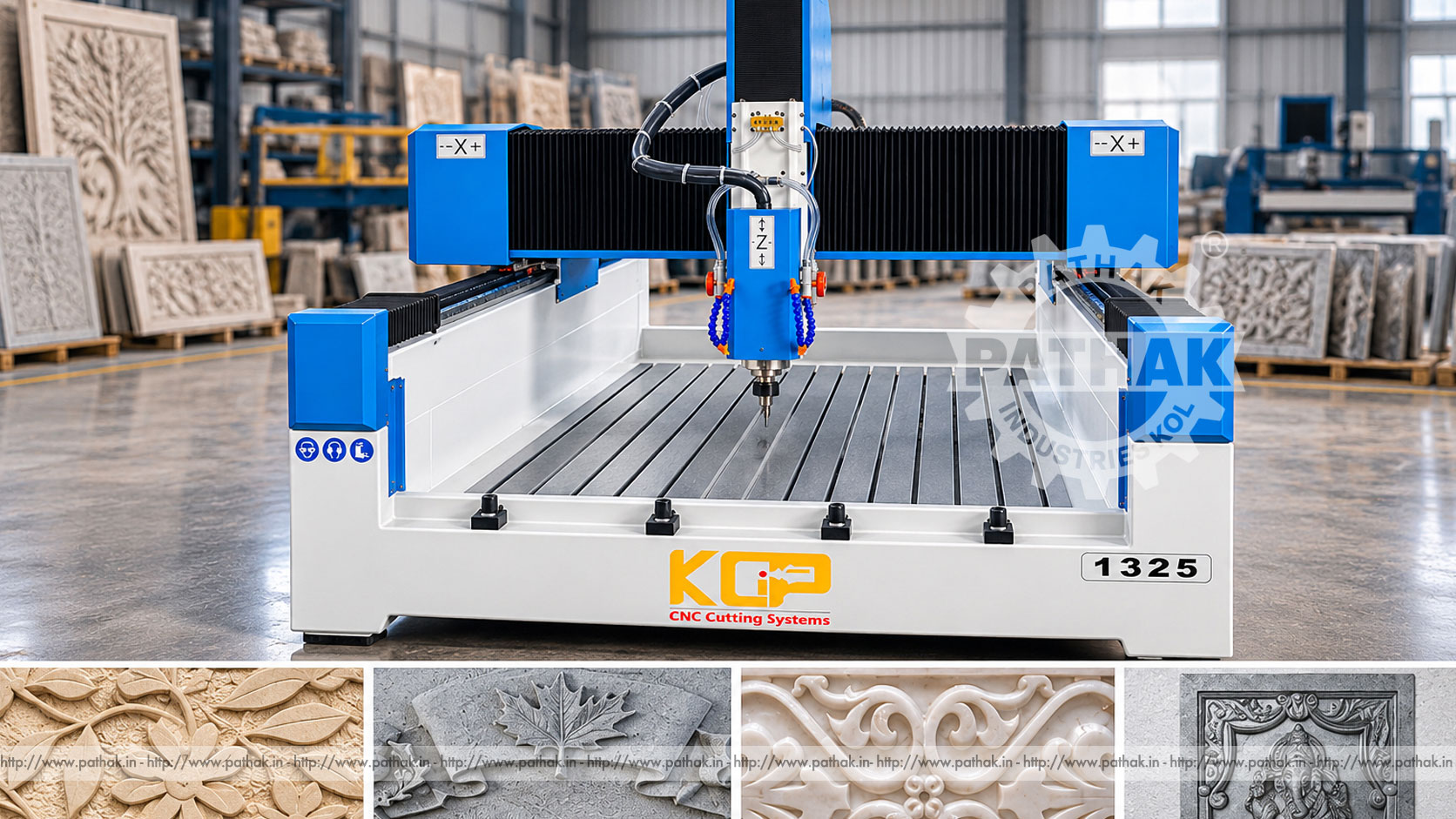
Decorative stonework combines demanding material properties with detailed geometry. Letters, reliefs, grooves, borders, pockets, and shaped panels must be produced without losing alignment or damaging the work. A CNC Stone Router uses programmed axis movement and a rotating cutter to organise these operations with repeatable positioning.
The Pathak Industries NR-1155 provides listed X-Y-Z movement of 1300 × 2500 × 200 mm and a 1440 × 3040 mm table. Its 4.5 kW (6 HP) water-cooled spindle operates up to 24,000 rpm, servo motors drive the machine axes, and the configuration includes manual T-slot clamping, a water tank, and automatic water cooling. Published maximum idle and cutting speeds are 35 and 25 m/min respectively, although practical cutting parameters must match the stone and tool.
A CNC stone router is a programmed machining centre designed to move a suitable cutting or engraving tool across a secured slab or panel. The controller interprets digital instructions and coordinates X, Y, and Z movement while the spindle rotates the selected tool.
The machine can form pockets, grooves, lettering, outlines, relief surfaces, and selected cut-outs. It does not remove the need for material knowledge. Stone type, inclusions, cracks, thickness, tool specification, coolant, depth per pass, and work support all affect the result.
The process begins with a drawing or three-dimensional model. Toolpath software converts the required geometry into machine instructions covering position, depth, order, feed, spindle speed, and safe movements. The operator reviews this program before transferring it through the supported interface.
The workpiece is placed on the table and secured using the manual T-slot clamping arrangement. After installing the correct tool, the operator establishes reference positions, verifies coolant delivery, and proves the program safely. The machine then follows the programmed route while water controls heat and helps manage cutting residue.
The listed axis movement is 1300 mm in X, 2500 mm in Y, and 200 mm in Z. The table measures 1440 × 3040 mm. The larger table supports the work outside the nominal cutting envelope and provides space for clamping, but it does not increase programmed travel.
Usable clearance depends on tool length, holder, fixture, sacrificial support, work thickness, and safe Z approach. A slab that fits the table may still place required geometry outside axis travel. Job planning should overlay the finished design, stock edges, clamp positions, and travel limits.
The machine lists a 4.5 kW (6 HP) water-cooled spindle with a stated range from zero to 24,000 rpm. Water cooling helps control spindle temperature during operation. Cooling flow, tank level, hose condition, pump performance, and coolant cleanliness should be verified before a cycle.
Spindle speed must suit tool diameter, tool construction, stone type, feed, and cut depth. The maximum listed value is not a universal working speed. Parameter selection should follow the tool recommendation and be validated on representative material.
Servo motors provide the listed drive arrangement. X-Y motion uses rack-and-pinion transmission, while the Z axis uses a ball screw. This combination is intended to support long planar travel with controlled vertical tool positioning.
Clean drive components, sound lubrication, correct alignment, and secure electrical feedback connections help maintain predictable movement. Stone slurry must not be allowed to harden on rails, racks, screws, covers, or sensors.
The product page lists maximum idle movement of 35 m/min and maximum cutting speed of 25 m/min. Idle travel moves between operations without cutting. Cutting feed is the rate used while the tool engages material.
These maxima describe machine capability, not recommended parameters for every job. Hard material, a small tool, deep engraving, or delicate detail may require substantially lower feed. Programs should use controlled acceleration and clearance to avoid clamp collision or edge impact.
Published collet sizes are 6, 8, and 12 mm. The installed collet, tool shank, nut, and holder must be clean and compatible. A mismatched or damaged collet can cause runout, tool slip, poor finish, or breakage.
Tool geometry should match the task and material. Lettering, rough pocketing, detailed relief, edge profiling, and finishing may use different tools. Minimum practical projection improves rigidity. Tool life should be monitored through finish, dimensions, spindle load, sound, and scheduled inspection.
The NR-1155 can support suitable applications such as:
Not every stone behaves alike. Hardness, abrasiveness, porosity, grain, reinforcement, natural fissures, and surface finish can change the process. Representative trials are valuable before committing costly slabs.
Clean geometry is essential. Open vectors, duplicate lines, overlapping contours, incorrect scale, or reversed depth can create unwanted cuts. The design should identify finished edges, engraving depth, relief height, corner radii, and protected areas.
Roughing paths remove bulk material while leaving allowance for finishing. Finishing paths use an appropriate stepover to achieve the required detail and texture. Safe heights, entry moves, and machining order should keep the tool away from clamps and reduce unnecessary travel.
The machine accepts G-code-based commands through a USB interface according to the product specification. Files should be created for the confirmed controller and checked for units, origin, axis orientation, feed values, spindle commands, and safe limits.
Programs need clear filenames and revision control. A proven file can still become unsafe if the tool length, slab thickness, clamp position, reference point, or fixture changes. Setup documentation should travel with the program.
T-slot clamping provides flexible positioning for different slab sizes. Supports must keep the work stable and avoid point loading that could crack stone. Clamps should secure the slab against cutting forces without obstructing any toolpath.
Before machining, verify that clamps remain below safe tool and spindle clearance. Large or irregular work may require additional stops and distributed support. Never rely on workpiece weight alone to resist cutter force.
The listed water tank and automatic water-cooling system support the machining process. Water can help control heat and airborne dust at the cutting zone, but it creates abrasive slurry that needs planned collection and disposal.
Flow should reach the tool-work interface without flooding controls or walkways. Screens, settling, tank cleaning, and pump inspection help prevent recirculated grit from blocking hoses. Site handling must comply with the material and local waste requirements.
Inspection may cover overall position, pocket depth, groove width, letter spacing, profile geometry, relief detail, edge chipping, and surface consistency. Templates, depth gauges, calipers, or coordinate checks may be used according to the drawing and accessibility.
Natural stone variation means visual expectations should be defined with reference samples where necessary. Records should link the result to stone batch, tool, program revision, zero location, and cutting settings.
Rotating tools, heavy slabs, moving axes, electricity, water, sharp fragments, and stone dust create combined hazards. Work must be loaded with suitable lifting practices, and operators must remain outside the moving envelope during an automatic cycle.
Guards and protective systems should remain functional. Suitable eye, hearing, respiratory, and other protection must follow the material risk assessment. Electrical and mechanical energy must be isolated before tool changes beyond the approved procedure, cleaning, blockage removal, or maintenance.
Daily attention includes cleaning slurry before it hardens, inspecting tools and collets, checking coolant level and flow, examining clamps, and observing rails, racks, ball screw covers, cables, guards, and controls. Abnormal vibration, noise, temperature, or axis behaviour requires investigation.
Scheduled maintenance should cover lubrication, drive alignment, fasteners, spindle cooling, tank and pump cleaning, electrical connections, servo systems, axis references, and machine geometry. Use approved cleaning methods that do not force abrasive residue into bearings or cabinets.
Provide drawings or samples, slab dimensions and mass, stone type, maximum thickness, required depths, smallest details, edge-finish criteria, batch quantity, and output expectations. Compare those requirements with the 1300 × 2500 × 200 mm travel, table, spindle, collets, clamping, water system, and tool access.
Also review floor capacity, lifting and loading, three-phase 380 V/50 Hz supply, drainage, slurry handling, tooling, programming skills, training, and service access. Pathak Industries can assess the application against the NR-1155 configuration.
The listed X-Y-Z movement is 1300 × 2500 × 200 mm, with a 1440 × 3040 mm table.
It lists a 4.5 kW (6 HP) water-cooled spindle with speeds up to 24,000 rpm.
The product specification lists 6, 8, and 12 mm collet sizes.
The listed arrangement uses manual T-slot clamping. Supports and clamps must suit the actual slab and toolpath.
Yes. A water tank and automatic water-cooling system are included in the published configuration.
The source lists 35 m/min maximum idle movement and 25 m/min maximum cutting speed, subject to suitable operating conditions.
No. Tool, speed, feed, depth, cooling, and passes must be selected for the specific stone and required feature.
Provide slab sizes, weight, stone type, drawings, depths, finish, smallest detail, output, utilities, lifting plan, and slurry-management requirements.
The Pathak Industries NR-1155 CNC stone router combines a large table, 1300 × 2500 × 200 mm axis travel, 4.5 kW water-cooled spindle, servo motion, and T-slot workholding for suitable engraving and routing applications. Reliable output depends on correct tooling, stable slab support, verified programs, controlled water flow, quality inspection, safe operation, and thorough slurry-focused maintenance.