Head Office
117, Grand Trunk Road, Salkia Howrah-700013, Kolkata, India
 Hitesh PathakSun, Jul 13, 2025
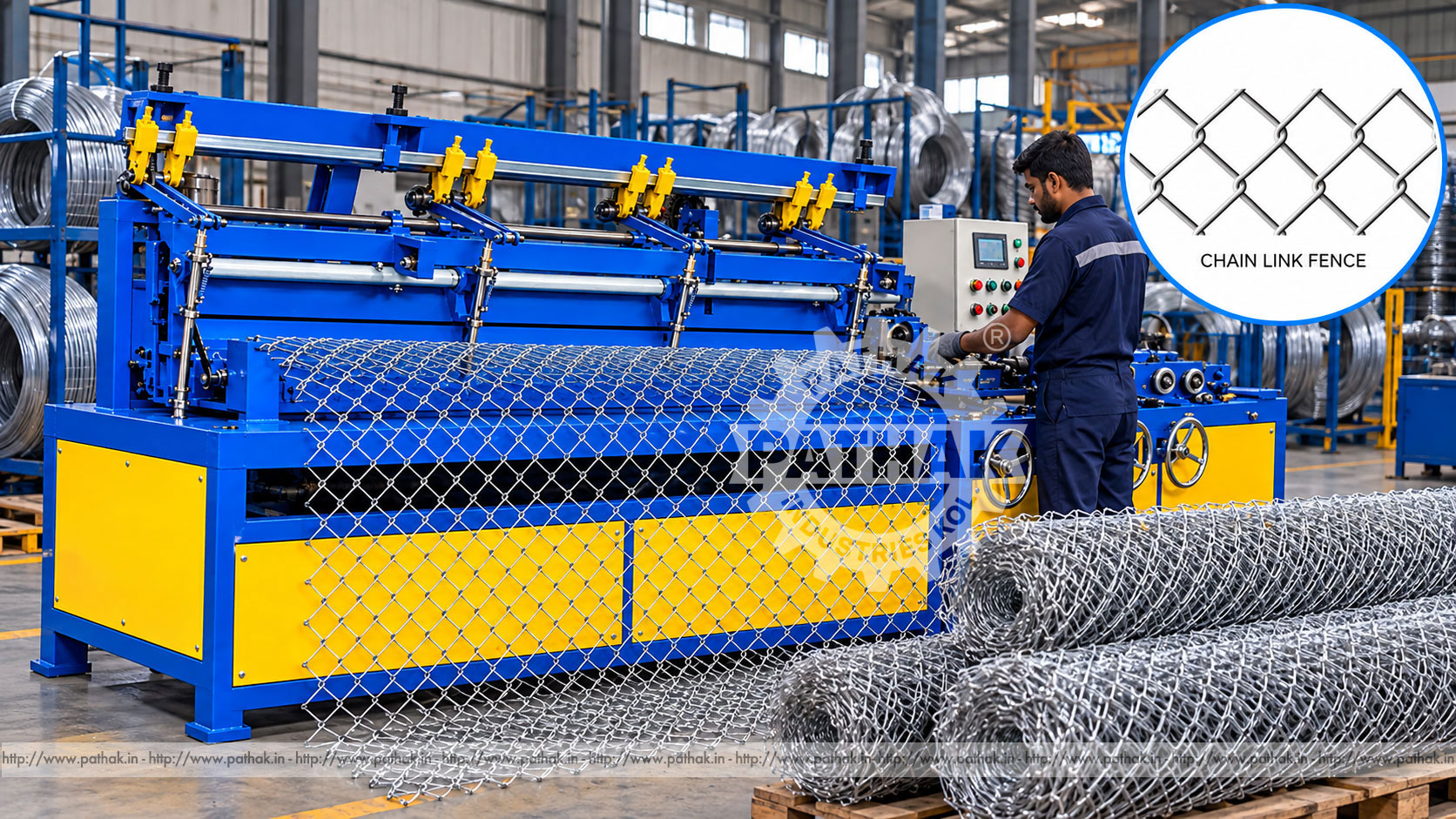
Chain-link fencing is created from a sequence of wire helices that interlock to form a flexible diamond-pattern mesh. Although the finished roll looks straightforward, dependable production requires accurate wire feeding, consistent helix geometry, reliable interlocking, controlled mesh width, suitable edge finishing, and orderly take-up. A purpose-built Chain Link Fencing Machine coordinates these operations for repeat manufacturing.
The Pathak Industries PCLF-1 is listed for mesh openings from 25 to 150 mm and wire from 2 to 4 mm, with finished width configured according to the requirement. Its published production rate is 8.0 to 8.5 metres per minute, supported by a 3 HP motor. This guide explains the production process, material and mesh choices, quality checks, safe operation, maintenance, and the information required to select an appropriate machine configuration.
A chain-link fencing machine shapes continuous wire into a flattened helix and inserts each newly formed strand through the preceding one. Repetition of this process creates the familiar diamond openings. The mesh advances across the working width and is collected in a roll or prepared in panels according to the production plan.
The selected forming tooling establishes the helix size and therefore influences the mesh opening. Feed condition, wire diameter, material strength, guide alignment, machine timing, and take-up behaviour all affect the finished fence. Automation provides coordinated motion, but it still relies on correct setup and trained supervision.
Wire is first supplied from a controlled payoff. It passes through guides and, where required, straightening or tension-control elements before entering the forming section. The forming tool bends the wire into a continuous zigzag helix corresponding to the selected diamond pattern.
As the helix emerges, it is rotated or guided into the last strand of the growing mesh. Correct timing allows the two helices to interlock without crossing, skipping, or distorting the opening. Once a strand reaches the required fence width, it is cut and its ends are finished according to the specified edge style.
The mesh then advances for the next strand and is collected. The roll must remain controlled so its weight and tension do not pull the mesh out of shape. Successful continuous production therefore depends on the relationship between forming speed, interlocking, width control, edge processing, and take-up.
The published PCLF-1 specification provides the following planning values:
These figures describe the stated model range. Actual output depends on wire diameter and condition, mesh opening, finished width, edge style, coil changes, take-up, operator practice, and inspection requirements. The exact configuration should be confirmed from representative finished-mesh specifications.
Wire selection affects durability, stiffness, forming load, roll weight, mesh stability, and tool wear. The PCLF-1 lists a 2 to 4 mm range, but diameter alone does not establish suitability. Tensile properties, coating, dimensional tolerance, surface condition, and coil quality also matter.
Galvanized wire is widely used where corrosion resistance is required. The zinc coating should be consistent and able to tolerate forming without excessive flaking or cracking. PVC-coated wire may be selected for colour, additional environmental protection, or handling characteristics, provided the total diameter and coating behaviour match the approved tooling and guides.
Wire coils should unwind cleanly without tangles, severe cast variation, rust, or damage. Before introducing a new material batch, verify the certificate, measure diameter, inspect its surface, and conduct a controlled production trial. Retaining an approved material and mesh sample helps operators identify changes quickly.
The PCLF-1 covers mesh openings from 25 to 150 mm. Smaller openings place more wire into a given area and generally produce a denser fence, while larger openings reduce material per square metre. The correct opening depends on security needs, animal size, application, wire diameter, visibility, weight, and customer specification.
Mesh size must be measured using a defined method because the diamond can move as the flexible fabric is stretched. Inspection should control how the sample is supported and tensioned. Inconsistent openings may result from forming-tool wear, guide movement, wire-property variation, or incorrect interlocking.
The relationship between wire diameter and mesh opening should also remain practical. A heavy wire formed into a very small opening can demand higher forming loads and a carefully matched tool, whereas a light wire with a very large opening may not provide the expected stiffness.
The machine's finished width is specified according to the production requirement. Buyers should define the actual fence height or fabric width, along with dimensional tolerance, rather than requesting only a general machine size. Common products may include low agricultural fencing, standard perimeter rolls, and taller industrial or sports-enclosure mesh.
Wider mesh requires suitable working clearance, support, and collection arrangements. Roll length also affects finished weight, handling, packaging, and transport. Production planning should state width, roll length, permissible mass, core or winding method, ties, labels, and pallet configuration.
Measuring roll length solely from machine time can accumulate error if operating speed changes. A verified length-counting method and periodic physical confirmation provide better control.
The top and bottom of chain-link fabric may be finished in different ways. A knuckled edge bends adjoining wire ends back to reduce exposed sharp points. A twisted or barbed edge twists wire ends together to create projecting tips, often used where increased deterrence is required. Some specifications use knuckled edges on both sides, while others combine one knuckled and one twisted edge.
The ordered edge style must be included in machine and tooling discussions because it affects processing, handling, packaging, and safety. Inspectors should check that bends or twists are secure, consistent, and free from cracks or excessive coating damage.
The listed production capacity of 8.0 to 8.5 metres per minute is an indicative machine rate for a suitable setup. Saleable shift output also depends on coil replacement, strand cutting, edge finishing, roll changes, inspection, packaging, adjustments, maintenance, and unplanned stops.
Manufacturers can monitor metres and square metres produced, accepted rolls, scrap, downtime by reason, coil-change duration, and tool life. Square-metre output is particularly useful because products of different widths contain different saleable areas even when linear speed is similar.
A balanced line ensures that payoff, forming, collection, inspection, and packaging can all support the planned rate. A fast forming station provides little benefit if completed mesh cannot be collected and removed safely.
Chain-link fabric is used across many environments, including:
The correct wire, coating, opening, width, edge treatment, and installation system must be selected for the environment. Fence fabric is one part of a complete system that also includes posts, rails, tension wire, fittings, gates, and foundations.
Correctly matched tooling and controlled wire feed support regular helix geometry and consistent interlocking across the finished mesh.
Helix forming and strand insertion occur in a coordinated sequence, supporting ongoing roll production with fewer separate handling stages.
The listed mesh range and specified-width configuration allow production to be planned around different fencing applications, subject to the appropriate tooling and setup.
Consistent openings and width make wire consumption per roll more predictable, supporting costing and raw-material planning.
The machine should be installed on a level, stable foundation with sufficient room for wire payoff, operating access, mesh delivery, roll collection, electrical isolation, guarding, maintenance, and material movement. The published machine dimensions do not represent the full working footprint.
Payoff equipment must handle the selected coil safely and provide a smooth wire path. Uncontrolled coil movement or changing drag can disturb forming. The finished-mesh area should support the widest product without snagging or forcing personnel into hazardous positions.
Electrical supply, protection, earthing, frequency, voltage, and phase must match the selected drive and control arrangement. Commissioning personnel should verify rotation, tool alignment, lubrication, guides, safety controls, feed path, edge treatment, and take-up before saleable production begins.
Routine inspection should cover wire diameter, coating condition, mesh opening, overall width, roll length, edge finish, strand interlocking, local distortion, broken wire, and packaging. Measure width at several positions and openings across a representative section rather than relying on one point.
Skipped interlocks may indicate incorrect helix presentation or timing. Progressive opening variation can result from tool wear, loose adjustments, or changing wire properties. A narrowing or widening fabric may point to support, edge, or take-up issues. Coating damage should trigger inspection of all wire-contact surfaces.
Checks should be made at startup, after coil or tooling changes, at planned intervals, and whenever the process sounds or behaves differently. Suspect mesh should remain identified and segregated until reviewed.
Chain-link machinery combines rotating and reciprocating components, cutters, pinch points, tensioned wire, sharp ends, and increasingly heavy rolls. Only trained personnel should operate or maintain the equipment. Guards and protective devices must remain in their designed positions.
Operators must not reach into forming, interlocking, cutting, or take-up areas while movement is possible. Before clearing tangled wire, changing tools, or entering a guarded zone, isolate all hazardous energy and verify that the machine is in a safe state.
Wire ends and edge finishes can cause cuts or punctures. Personal protective equipment should be selected through the site risk assessment, and mechanical handling should be used where roll size or weight makes manual control unsafe.
Daily checks should cover forming tools, guides, cutters, fasteners, drives, guards, cables, lubrication points, payoff condition, and take-up equipment. Remove wire fragments safely and investigate abnormal vibration, noise, heat, or mesh variation before continuing.
Tool wear changes helix geometry and can damage coating. Keep wear records by wire type, diameter, and output so servicing can be planned. Guides should remain smooth and aligned, while cutters and edge tools need suitable clearance and sharpness.
Periodic service should include bearing and drive inspection, alignment checks, electrical enclosure cleaning, safety-device testing, and verification of measuring or counting systems. Document adjustments to make recurring production problems easier to trace.
Provide representative mesh samples or drawings showing wire diameter, base material, coating, diamond opening, finished width, edge finish, roll length, roll weight, tolerances, and expected daily output. Also state available power, factory space, coil size, collection method, and packaging plan.
Compare those needs with the machine's approved wire range, mesh range, width configuration, forming tools, edge equipment, production rate, motor, controls, guarding, payoff, take-up, installation support, training, and spares. Multiple product sizes may require separate change parts and setup procedures.
Pathak Industries can review the required fencing specification against the PCLF-1 configuration. Final selection should be based on documented requirements and representative wire or mesh samples where practical.
The published range is 25 to 150 mm. The exact opening requires correctly matched forming tooling and confirmation against the selected wire.
The machine is specified for approximately 2 to 4 mm wire. Material strength, coating, diameter tolerance, and forming behaviour must also be suitable.
The product specification states that width is configured according to requirement. Buyers should provide the required finished width and tolerance when enquiring.
The listed capacity is approximately 8.0 to 8.5 metres per minute. Net output varies with product configuration, material handling, roll changes, edge finishing, and inspection.
Galvanized wire is commonly used for chain-link mesh, provided its total diameter, mechanical properties, coating condition, and forming behaviour suit the approved setup.
Chain-link mesh commonly uses knuckled or twisted edges, including combinations of the two. The required finish and corresponding tooling should be confirmed with the machine configuration.
Possible causes include forming-tool wear, guide misalignment, wire variation, loose adjustments, incorrect tension, or take-up influence. Stop and correct the cause before continuing accepted production.
Provide wire diameter and material, coating, mesh opening, finished width, edge style, roll length and mass, tolerances, daily output, electrical supply, coil details, and samples where available.
The PCLF-1 Chain Link Fencing Machine forms and interlocks wire helices into continuous diamond-pattern mesh. Its listed 25 to 150 mm mesh range, 2 to 4 mm wire capacity, made-to-requirement width, 3 HP motor, and indicative speed of 8.0 to 8.5 metres per minute provide a versatile basis for fencing production.
Reliable output depends on suitable wire, correctly matched tooling, careful first-roll approval, controlled collection, routine quality checks, safe operating practices, and preventive maintenance. Defining the finished fence clearly before purchase is the best way to select the right configuration and supporting equipment.