Head Office
117, Grand Trunk Road, Salkia Howrah-700013, Kolkata, India
 Hitesh PathakWed, Aug 23, 2023
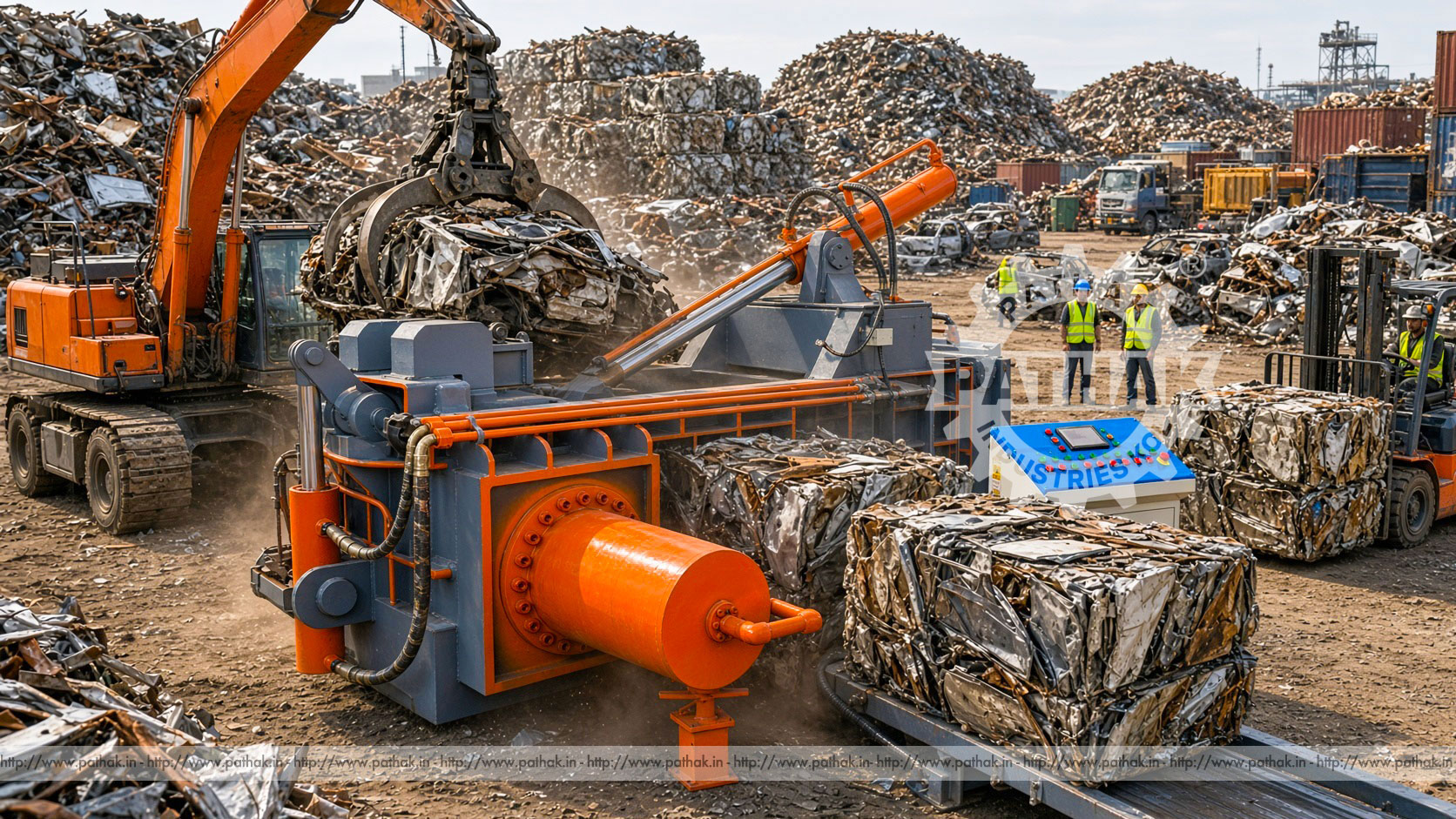
End-of-life vehicle bodies and other bulky sheet-metal scrap occupy substantial yard space in loose form. Their irregular geometry also makes stacking, loading, transport, and downstream processing difficult. A Car Baler Machine uses staged hydraulic compaction to reduce suitable prepared vehicle scrap into dense, regular packages that are easier to handle within a controlled recycling workflow.
The Pathak Industries PCBM-400 has a published chamber size of 3500 × 3000 × 1400 mm and produces 600 × 600 mm bales with an adjustable listed length of 600–1500 mm. Published bale weight is 500–1200 kg, depending on feed and bale dimensions, while nominal cycle time is 150 seconds. Front push-out removes the finished package from the compression area, and PLC plus remote-control operation coordinates the supplied hydraulic sequence.
A car baler is a heavy hydraulic press designed to compress suitable prepared vehicle shells and related bulky metal feed inside a reinforced chamber. Large lids, wings, or compression rams fold and reduce the material from several directions. The final package has a more regular cross-section than loose scrap, allowing it to be moved by appropriately rated equipment.
The machine does not replace depollution, dismantling, material identification, or hazardous-component removal. It is a compaction stage within a broader recovery system. Incoming feed must be made safe and compatible before it enters the chamber.
Prepared scrap is loaded into the 3500 × 3000 × 1400 mm chamber using suitable material-handling equipment. The operator confirms that the load is within the permitted envelope and that no person is inside the restricted area. Once the chamber and safety conditions are verified, hydraulic actuators close and compress the feed in the programmed sequence.
Each stage reduces voids and folds the material toward the final bale dimensions. The PLC coordinates movement, pressure-related logic, and return actions according to the machine design. After the bale is complete, the front push-out system transfers it from the compression chamber into a designated receiving area for removal.
Vehicle bodies must undergo the required depollution and dismantling process before compaction. Fuel, oils, coolant, refrigerants, batteries, gas cylinders, pressurised components, and other hazardous materials require controlled removal through the facility’s approved procedures. Tyres and non-metallic parts may also need removal depending on the processing route and downstream specification.
The body should be inspected for sealed spaces, unknown containers, and components that can react or rupture under compression. Yard acceptance rules should define which materials may enter the baler. The operator should never assume that a vehicle shell is safe merely because it appears empty.
The chamber defines the maximum loading space, but feed must still fit and settle in a way that allows the compression sequence to operate. Oversized projections should be handled using the approved preparation method instead of being forced between moving structures or guards.
The finished cross-section is listed as 600 × 600 mm, with a selectable or material-dependent bale length from 600 to 1500 mm. This range gives downstream operations flexibility, but the actual length and mass should suit lifting attachments, transport limits, storage arrangements, and the receiving processor’s requirements.
The product record lists bale weight from 500 to 1200 kg. Weight changes with feed type, material thickness, residual non-metal content, packing arrangement, compaction behaviour, and selected bale length. A larger package is not automatically denser, and two bales with similar dimensions can have different masses.
Handling equipment should be selected for the maximum expected bale, including a safe working margin. Where transport or inventory depends on weight, each bale should be measured using an appropriate weighing method rather than estimated from appearance.
Front push-out removes the completed bale in a controlled direction after the compression stages have finished. The discharge path must remain clear, and a receiving platform, conveyor, or handling zone should be prepared for the package. No worker should stand in front of the outlet or between the bale and a fixed object.
The pushed bale may still contain sharp edges or unstable layers. It should be lifted only with equipment and attachments suitable for its size, weight, and surface. Stacking plans need to consider bale stability and the condition of the storage ground.
The PCBM-400 lists four model 225M-4 motors, each rated at 45 kW and 1470 r/min. Its hydraulic system includes four A4V250 pumps with 250 ml/rev displacement and 35 MPa rated pressure. These are component specifications; operating pressures and sequence settings must remain within the authorised machine configuration.
Multiple motor-pump groups support the oil demand associated with large cylinders and repeated compaction movements. Electrical distribution, starting, cable sizing, protective devices, and transformer capacity require an engineering review before installation. Hydraulic lines, manifolds, filters, and reservoirs must remain clean and securely supported.
The listed oil-tank volume is 6000 litres. A large reservoir supports circulation, settling, temperature management, and the volume requirements of the hydraulic system. Oil grade, filling procedure, cleanliness level, and service interval should follow the machine documentation.
The source data specifies water cooling with a published 50 m² figure. The exact cooler interpretation, cooling-water demand, quality, temperature, and connection requirements should be confirmed during engineering. Inadequate cooling can raise oil temperature, reduce efficiency, accelerate seal wear, and cause unstable operation.
PLC control organises the sequence of chamber closure, compression, bale formation, return, and push-out. The electrical operating station gives the operator status and command access, while remote control can provide an authorised operating position with improved visibility of loading and machine movement.
Remote operation does not make the area inherently safe. The operator must have clear control of the restricted zone and follow the communication procedure with material-handler drivers. Emergency stops, interlocks, limit devices, and alarms should be tested at prescribed intervals and never bypassed.
The PCBM-400 lists a nominal cycle time of 150 seconds. This describes the machine cycle under relevant conditions, not the entire time required to create every bale. Loading, material preparation, inspection, discharge clearing, handling, and interruptions contribute to actual production output.
Feed consistency influences the cycle. A prepared body shell can behave differently from mixed light scrap or tangled sections. Realistic capacity planning should use trials with representative material and include the time needed to maintain a safe loading and discharge flow.
Car balers are installed in vehicle dismantling facilities, scrap yards, recycling plants, and metal-recovery operations. Their principal task is reducing compatible bulky automotive sheet-metal scrap for more organised storage, transport, and downstream processing.
The PCBM-400 may also be assessed for other suitable light and bulky ferrous scrap when explicitly approved. Its name and chamber size do not automatically qualify every metal object. Thick sections, hardened components, sealed items, or unsuitable mixed waste can create different loads and hazards.
A productive cell separates incoming inspection, depollution, dismantling, baler loading, bale discharge, weighing, and storage. Excavators, grabs, loaders, forklifts, and trucks should have defined routes that minimise reversing and prevent interaction with pedestrians.
The loading machine needs adequate reach without contacting the baler. Discharged bales must be removed before they obstruct the next cycle. Storage areas should prevent unstable stacks and retain access for fire response, inspection, and shipment.
The compression chamber, lids, cylinders, push-out system, and bale discharge contain severe crushing and trapping hazards. No person should stand on the scrap, climb into the chamber, or enter the discharge line while energy is available. Physical barriers and controlled access should define the operating zone.
Before clearing material, inspection, or maintenance, electrical and hydraulic energy must be isolated and stored pressure safely released under the approved lockout procedure. Raised components require mechanical support where specified; hydraulic pressure alone should never be relied upon to protect a worker below a moving structure.
Residual fuel, oil, batteries, and mixed combustible material can create a fire risk during compression or storage. Effective depollution, housekeeping, hot-material detection, emergency planning, and separation of incompatible feed are essential. The yard should have suitable fire-control arrangements for its material and site conditions.
Hydraulic oil containment is also important. Hose damage or seal failure can release significant fluid. Bunding, spill response, drainage control, and regular leak inspection should be included in facility planning. Cooling-water discharge must follow the approved environmental method.
The published machine weight is 75 tons. Foundation design must use the manufacturer’s load data, operating forces, anchor plan, ground conditions, and local engineering requirements. Delivery route, crane capacity, erection space, and assembly sequence need planning well before arrival.
The electrical supply is listed as 440 V, three-phase, 50 Hz. Confirm compatibility with the site and final motor-control arrangement. Installation also needs cooling-water services, drainage, hydraulic maintenance space, safe access platforms, lighting, and room for material handling.
Operators should check visible structure, pins, hinges, cylinders, hoses, pipes, valves, guards, interlocks, controls, oil level, temperature, cooling, and leakage. Unusual movement, repeated alarms, cracks, loose fasteners, or changing cycle behaviour require investigation before production continues.
Scheduled work includes oil and filter management, pump and motor inspection, cylinder seals, structural examination, electrical testing, cooling-system service, sensor checks, and control backups. Maintenance records can relate faults to cycle count, temperature, material type, or component life.
Document the types of vehicles and scrap, preparation method, monthly volume, expected bale dimensions, preferred bale weight, storage plan, transport limits, and downstream requirements. Describe available loaders and how the finished package will be removed and weighed.
Compare chamber size, bale range, cycle, push-out method, hydraulic power, controls, cooling, foundation, utilities, and safety integration. Pathak Industries can review the PCBM-400 against these details. Any material beyond prepared vehicle-body scrap should be specifically evaluated before inclusion in the operating scope.
It compresses suitable prepared vehicle bodies and related bulky metal scrap into compact packages for easier handling, storage, transport, and downstream recycling.
The published chamber measures 3500 × 3000 × 1400 mm. Feed must still be prepared and loaded according to the approved envelope.
The product page lists a 600 × 600 mm cross-section with bale length from 600 to 1500 mm.
Published bale weight is 500–1200 kg. Actual weight depends on material, preparation, compaction behaviour, and selected length.
Yes. It requires the prescribed depollution, hazardous-component removal, dismantling, inspection, and material acceptance process before loading.
After compaction, the machine pushes the completed bale forward from the chamber into a controlled receiving and handling area.
No. Actual output also includes preparation, loading, inspection, discharge, removal, and operational interruptions.
Provide vehicle types, preparation method, material volume, desired bales, handling equipment, electrical and cooling utilities, site layout, foundation conditions, and safety requirements.
The PCBM-400 can turn suitable prepared vehicle scrap into regular, transportable bales, but its effectiveness depends on the complete yard system. Depollution, loading, hydraulic reliability, discharge handling, weighing, storage, fire controls, and maintenance must operate as one planned process.
Review the confirmed data on the Car Baler Machine product page and provide Pathak Industries with representative vehicle scrap, volume, handling, and site information. Confirm feed acceptance, utilities, foundation, cooling, controls, installation, and safety provisions before ordering.