Head Office
117, Grand Trunk Road, Salkia Howrah-700013, Kolkata, India
 Hitesh PathakMon, Apr 6, 2026
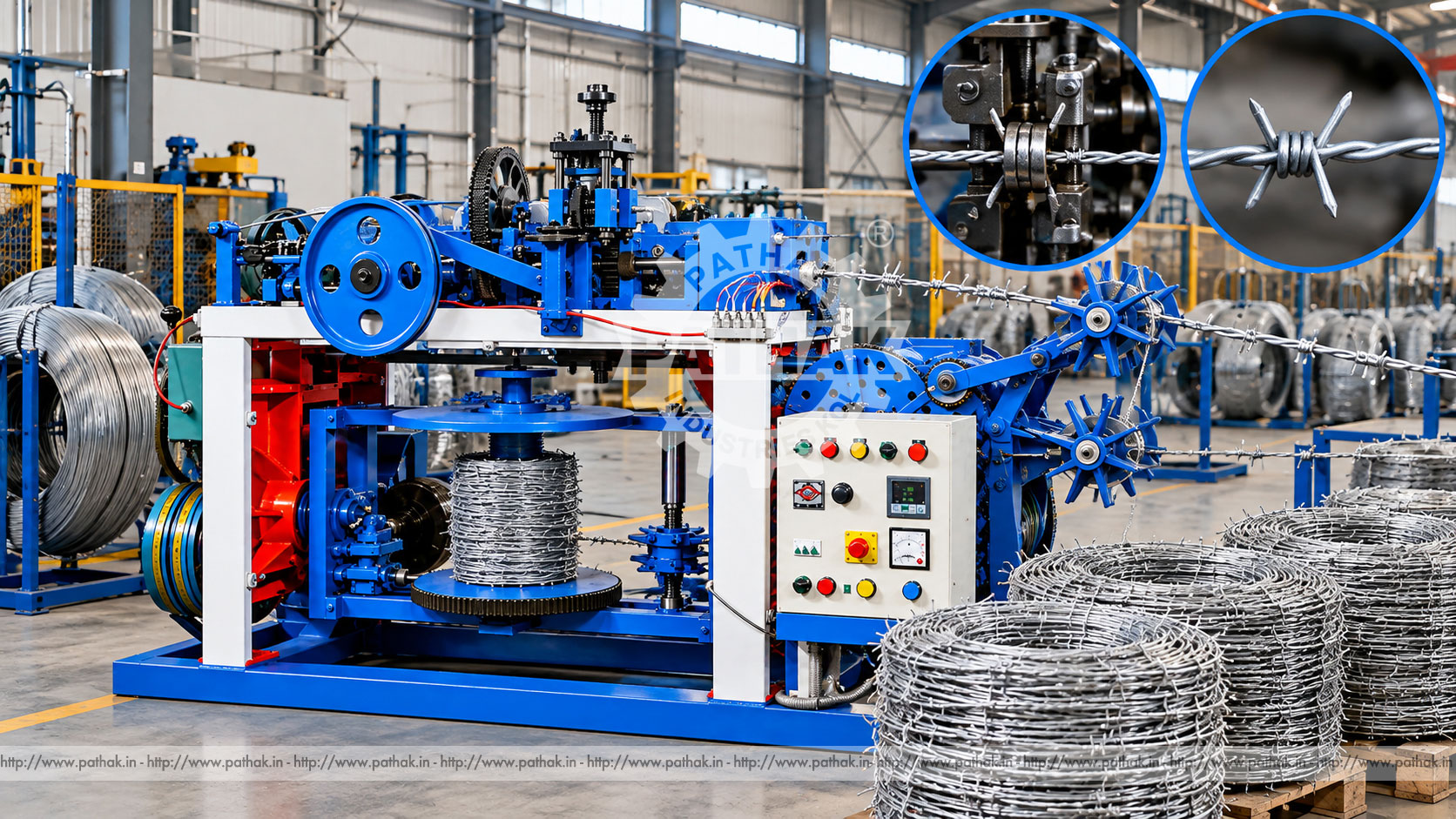
Barbed wire production requires more than twisting two strands together. Barb position, strand tension, point formation, pitch consistency, coil length, and wire condition all affect whether the finished fencing wire can be handled, installed, and supplied reliably. An Automatic Barbed Wire Making Machine coordinates these operations in a continuous process, helping manufacturers achieve repeat output with less manual handling.
The Pathak Industries PBWM-1 is specified for 12/12 SWG strand and point wire, corresponding to approximately 2.64 mm diameter. Its published production range is 140 to 160 barbs per minute, with an indicative capacity of about 500 kg per eight-hour shift under the stated wire and operating conditions. This guide explains the machine's working principle, important specifications, raw-material requirements, production workflow, safety practices, maintenance priorities, and the information a buyer should confirm before selecting a configuration.
An automatic barbed wire making machine forms fencing wire by feeding longitudinal strand wires and a separate point wire through a coordinated twisting and wrapping mechanism. The point wire is cut and wrapped around the strand at selected intervals to create barbs. The completed wire then travels to a winding arrangement that collects it into a manageable coil.
Automation brings the principal forming movements into one controlled cycle. It does not remove the need for correct raw material, setup, inspection, and trained supervision. Wire diameter variation, unsuitable tensile properties, poor galvanizing, incorrect tension, worn tooling, or an inaccurate pitch setup can still affect the final product.
The production sequence begins with prepared wire coils mounted so they can unwind freely. Strand wires are guided into the machine under controlled tension. Point wire enters the barb-forming section, where the mechanism meters, cuts, and wraps it around the strand assembly. The machine advances the wire by the selected distance before forming the next barb.
As production continues, the strand-twisting action locks the assembly together and the take-up system winds the finished wire into a coil. The operator monitors feed behaviour, barb formation, spacing, finished-wire alignment, and coil buildup. When the specified length or coil weight is reached, the cycle is stopped according to the operating procedure so the coil can be secured and removed.
Consistent results depend on balance between wire feed, forming timing, pitch setting, and take-up tension. Increasing speed without checking these relationships can produce displaced barbs, irregular spacing, loose wrapping, damaged galvanizing, or poorly formed coils.
The published specification for the PBWM-1 provides a practical reference for planning a barbed wire production line:
These figures describe the published model, not a guarantee for every wire and plant condition. Actual output varies with coil handling, wire quality, operator practice, required pitch, stoppages, maintenance condition, and the acceptance criteria applied to the finished product.
The machine specification identifies both strand and point wire as 12 SWG. A buyer should confirm diameter using the applicable gauge convention and an actual mill certificate rather than relying only on a trade description. Even small changes in wire diameter can alter forming load, tool clearance, finished mass per metre, and coil weight.
Galvanized wire is commonly chosen for fencing because its zinc coating helps resist atmospheric corrosion. The feed coils should have a sound, reasonably uniform coating without excessive lumps, flaking, or damage. The wire should unwind cleanly and have mechanical properties suited to twisting and barb formation. Material that is too hard may form poorly or accelerate tool wear, while excessively soft or inconsistent wire can reduce shape stability.
Before a new supply batch enters full production, check wire diameter, coil condition, surface quality, tensile documentation, and performance in a controlled trial. Retaining a short approved sample from each accepted batch gives operators and inspectors a useful visual reference.
Barb pitch is the longitudinal distance between successive barb groups. The PBWM-1 lists standard 3-inch and 4-inch settings, with other spacing available through suitable change parts. The required pitch should be established from the intended fencing product, customer specification, applicable standard, and material-cost target.
Closer spacing increases the number of barbs per unit length and affects point-wire consumption. Wider spacing reduces the barb count but may not suit every security or livestock application. A production order should clearly state the approved pitch, allowable tolerance, coil length or mass, strand and point-wire diameter, coating requirement, and packaging method.
Operators should measure pitch over several consecutive intervals instead of checking only one gap. This makes gradual feed variation easier to detect and gives a more representative result.
The listed machine information refers to coils up to approximately 400 metres and indicative bundles in the 40 to 50 kg range. The selected length and mass must be practical for the customer's installation method, local handling rules, packaging arrangement, and transport plan.
A well-formed coil should build evenly without loose loops, crossing, or excessive side pressure. Take-up tension must be sufficient to make the package stable but should not stretch the product or damage its coating. Each completed bundle should be secured using an approved method before it is released from the winding area.
Because barb points present a puncture hazard, coil handling needs suitable tools, gloves, protective clothing, and defined lifting practices. Heavy bundles should not be lifted manually when their size or shape makes control difficult.
The indicative capacity of 500 kg per eight-hour shift is a useful planning value for the specified 12/12 SWG product. Net saleable output will depend on effective running time. Material changes, coil removal, setup checks, routine inspection, cleaning, planned maintenance, and unexpected stops all reduce the time available for forming wire.
A realistic production plan separates theoretical cycle rate from good finished output. Manufacturers can track metres or kilograms produced, accepted quantity, scrap, downtime reason, changeover time, and maintenance time. These records reveal whether the main constraint is material preparation, coil handling, machine condition, quality correction, or downstream packaging.
Wire made on an appropriately configured machine can serve a broad range of fencing requirements, including:
The finished product must match the legal, safety, coating, and dimensional requirements of its destination market. Barbed wire is not appropriate for every location, particularly where people or animals may contact it unintentionally.
A correctly set feed mechanism advances the strand by a controlled distance between forming cycles. This supports more consistent pitch than individually positioning barbs by hand.
Bringing feeding, wrapping, twisting, and collection into a planned sequence reduces intermediate handling and helps maintain continuous production.
Once a wire specification and setup have been validated, cycle information and measured shift performance can support raw-material planning, staffing, and dispatch schedules.
Standard settings and approved change parts make it easier to organise different pitch requirements. Every changeover still requires verification before saleable production resumes.
The machine should be installed on a level, adequately prepared foundation with enough clearance for input coils, operating access, completed bundles, guarding, maintenance, and material movement. The listed shipping dimensions help with delivery planning but should not be treated as the complete operating footprint.
Electrical supply must match the selected motor and control arrangement. Earthing, protection, isolation, cable routing, and commissioning should be completed by qualified personnel. The plant layout should prevent raw coils and finished bundles from obstructing emergency access or creating trip hazards.
Before commissioning, confirm rotation, lubrication, fastener security, guards, emergency controls, tooling alignment, guides, take-up movement, and feed direction. Begin with a controlled trial at an approved setting and inspect the first output before increasing production.
Inspection should be frequent enough to detect drift before a large quantity is affected. Check strand and point-wire diameter, barb spacing, number and orientation of points, barb security, strand twist, coating damage, overall wire appearance, coil length or mass, and package stability.
Inspection gauges and measuring methods should be consistent between shifts. If pitch changes gradually, investigate the feed mechanism and drive condition. If barbs loosen, check material properties, wire path, forming tools, and timing. Surface scraping may indicate damaged guides, excessive pressure, misalignment, or debris in the wire path.
Barbed wire machinery combines rotating components, pinch points, cutting actions, tensioned wire, sharp finished points, and heavy coils. Only trained and authorised personnel should operate, adjust, or maintain the equipment. Guards and safety devices must remain in place during normal production.
Operators should never reach into the forming, twisting, feed, or winding zones while the machine can move. Stored wire tension must be released using the approved procedure. Electrical and mechanical energy should be isolated and verified before clearing entanglements, changing tooling, or performing maintenance.
Suitable eye protection, protective clothing, footwear, and cut- and puncture-resistant gloves should be selected through the site's risk assessment. Personal protective equipment supports safe work but does not replace guarding, isolation, correct tools, or training.
At the beginning of each shift, inspect forming tools, cutters, guides, drive components, fasteners, guards, cables, and the take-up system. Remove wire fragments and debris with the machine safely isolated. Apply lubrication only at the points and intervals stated in the maintenance documentation.
Wear in cutters and forming elements can change point quality and wrapping consistency. Replacing or servicing tooling before it fails helps limit scrap and unplanned stoppage. Feed and pitch components should be checked when measured spacing begins to drift.
Periodic work should include drive inspection, bearing checks, alignment verification, electrical enclosure cleaning, safety-device testing, and examination of high-wear wire-contact surfaces. Maintenance records help connect product defects with machine condition and make spare-parts planning more reliable.
Start with the finished product rather than the machine alone. Provide the required strand construction, strand and point-wire diameters, coating, tensile range, number and form of points, barb pitch, coil length, coil weight, production volume, applicable product standard, and available utilities.
Then compare the requirement with the machine's approved wire range, standard and optional pitch arrangements, production speed, drive power, take-up capacity, tooling, controls, footprint, guarding, training, installation support, consumables, and service access. If more than one product is planned, each configuration should be reviewed separately.
Pathak Industries can assess the intended product and plant conditions against the PBWM-1 arrangement. Final acceptance should be based on confirmed specifications and, where practical, representative wire samples.
The published specification lists 12/12 SWG strand and point wire, approximately 2.64 mm diameter. The actual wire and gauge convention should be confirmed before ordering.
The listed speed is approximately 140 to 160 barbs per minute. Saleable shift output depends on wire quality, pitch, coil handling, setup, inspection, and downtime.
Standard spacing is listed as 3 inches and 4 inches. Optional 5-inch, 6-inch, or other pitch arrangements require the appropriate change parts and confirmation.
The published figure is approximately 500 kg in an eight-hour shift for 12/12 SWG wire under the stated conditions. Actual output should be established through production trials.
Yes. The model information specifies hard bright, fully hot-dip galvanized wire within the recommended strength range. Coating condition and forming behaviour should be verified.
The listed information refers to coils up to approximately 400 metres and indicative bundles of around 40 to 50 kg. The approved coil configuration should be confirmed for safe handling and dispatch.
No. Operators must continue checking pitch, barb tightness, point shape, strand twist, surface condition, coil length or mass, and packaging throughout production.
Provide wire diameter and gauge, material and coating, tensile range, barb pitch, point configuration, coil length or mass, required daily output, electrical supply, applicable standard, and representative samples when available.
The PBWM-1 Automatic Barbed Wire Making Machine provides a coordinated method for feeding strand wire, forming barbs, maintaining selected spacing, and winding finished fencing wire. Its stated 12/12 SWG capacity, 140 to 160 barbs-per-minute speed, standard 3- and 4-inch pitch options, 5 HP drive, and indicative shift output make it a practical starting point for planned fencing-wire production.
Reliable operation ultimately depends on correct wire, verified tooling, disciplined setup, regular inspection, safe coil handling, and preventive maintenance. Buyers who define the required finished product clearly can select the machine and optional change parts with greater confidence.