Head Office
117, Grand Trunk Road, Salkia Howrah-700013, Kolkata, India
 Hitesh PathakTue, Jul 30, 2024
Learning to operate a lathe requires more than understanding a diagram or watching a machining demonstration. A learner must see how the workpiece is held, understand how spindle speed affects cutting, position the tool correctly, coordinate carriage movement, measure the developing component, and recognize when a setup needs correction. An All Geared Lathe Machine Trainer creates a practical environment in which these connected skills can be demonstrated and developed under supervision.
The All Geared Lathe Machine Trainer from Pathak Industries is designed for turning rotational components and producing faces, diameters, bores, and threads. Its all-geared drive provides selectable mechanical transmission, while the trainer configuration makes important machine functions accessible for instruction. This combination makes the equipment relevant to training workshops as well as facilities that need a compact platform for suitable turning work.
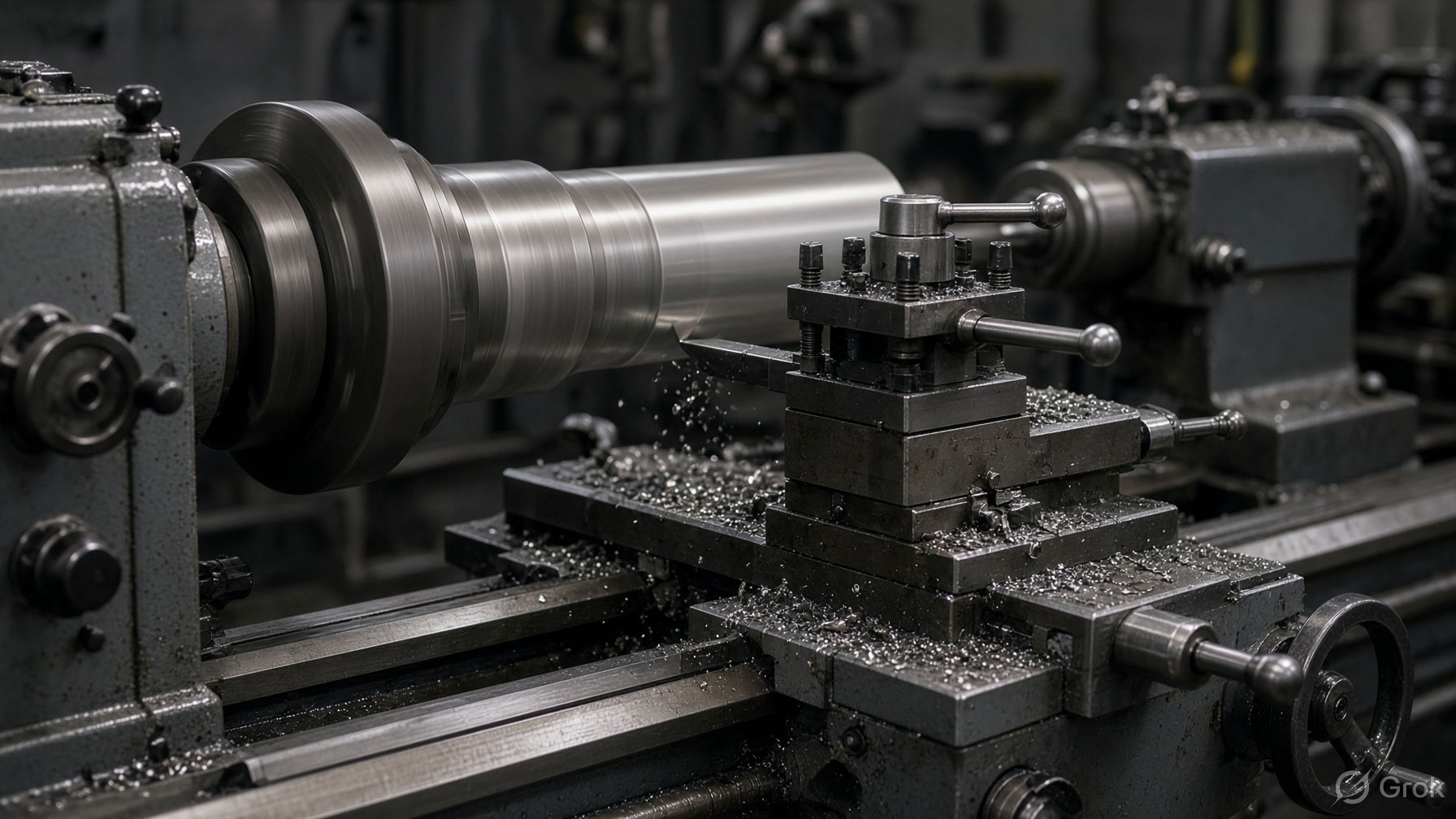
An All Geared Lathe Machine Trainer is a conventional turning machine configured to support supervised instruction in lathe setup and operation. During machining, the machine holds and rotates a workpiece while a cutting tool is guided against it. Material is removed in a controlled way to create the required external diameter, end face, bore, shoulder, thread, or related rotational feature.
The term “all geared” refers to the mechanical transmission used to provide selectable spindle operation. Instead of treating speed selection as an invisible process, the trainer gives learners an opportunity to understand how machine settings connect with the job. The equipment can therefore help bridge the gap between classroom principles and the disciplined sequence followed at a working lathe.
Typical practice workpieces may include shafts, bushes, sleeves, discs, pins, spacers, and other round components. The exact job must remain within the capacity of the selected model, tooling, holding arrangement, and published operating data.
A turning cycle starts before the spindle is switched on. The operator reviews the workpiece and drawing, selects a suitable holding method, checks the cutting tool, and confirms that the setup is secure. The workpiece is then rotated while the tool is moved along or across its surface. Longitudinal travel supports straight turning, while cross movement is used for facing and diameter-related work.
Boring uses internal tooling to enlarge or finish an existing hole. Thread cutting requires coordinated movement between the rotating job and the cutting tool. These operations reinforce an important training principle: a lathe result depends on the complete setup rather than on any single control. Workholding, tool geometry, alignment, machine setting, material condition, measurement, and operator technique all influence the finished component.
The trainer format allows an instructor to explain each stage in a logical sequence. Learners can observe how a setup is checked, how controls are used, why measurements are taken between passes, and how errors can develop if the job or tool is not aligned correctly.
A mechanically geared drive provides defined speed choices for different turning tasks. The published specification for both PLD 4 G and PLD 6 G lists eight spindle speeds ranging from 45 to 1,000 RPM. This range gives an instructor a practical basis for explaining why spindle speed must be selected according to the workpiece, diameter, material, cutting tool, and operation.
Speed selection is not simply a matter of choosing the highest available setting. A learner should understand that a larger diameter produces a different surface speed from a smaller diameter at the same spindle RPM. Facing, straight turning, boring, and threading can also present different operating considerations. By working with selectable mechanical transmission, trainees can connect these principles to an actual machine rather than treating them as abstract calculations.
Pathak lists two models for this machine: PLD 4 G and PLD 6 G. Both have a published height-of-center value of 165, swing-over-bed value of 330, swing-over-slide value of 190, bed-width value of 242, and spindle-bore value of 40. The spindle nose is listed as threaded on both versions.
The principal difference shown in the published working-length data is the A.B.C. value. PLD 4 G is listed at 600 mm, while PLD 6 G is listed at 1,000 mm. This distinction is important when selecting a trainer because the planned exercises and typical workpieces must fit the available distance.
Both models list cross-slide travel of 180 and top-slide travel of 125. The lead screw is specified at 4 TPI, and the tailstock sleeve taper is listed as MT3. Power required is published as 2 HP for either model. The thread ranges shown on the product page are 4 to 60 threads per inch and 0.5 to 7.5 for metric threading. Buyers should confirm the units and complete specification with Pathak Industries when matching the machine to a defined syllabus or production requirement.
A secure, correctly aligned workpiece is the foundation of safe and useful turning practice. Training can cover basic holding considerations, projecting length, support requirements, clearance checks, and the need to rotate a new setup manually before powered operation where the approved procedure calls for it.
The cutting edge must be presented to the work in an appropriate position. Learners can practice securing the tool, checking its relationship to the workpiece axis, allowing sufficient clearance, and recognizing how excessive tool overhang may affect stability.
Facing develops a flat end surface, while straight turning reduces or finishes an external diameter. Together, these operations teach carriage control, cross-slide use, incremental material removal, dimensional checks, and the importance of a consistent machining sequence.
Boring demonstrates how an existing hole can be enlarged or finished using internal tooling. It requires attention to tool clearance, alignment, chip evacuation, and measurement. The exercise helps learners understand why internal machining presents different visibility and setup challenges from external turning.
The published imperial and metric thread ranges allow training to address the relationship between spindle rotation, lead-screw movement, tool form, and pitch. Threading exercises should be planned within the listed range and carried out with the correct tooling and supervised operating procedure.
Turning instruction is incomplete without measurement. Learners should be taught to stop the machine safely before measuring, select an instrument suited to the feature, keep measuring faces clean, and compare results with the intended dimension. Intermediate inspection also helps prevent excessive material removal.
The All Geared Lathe Machine Trainer can support practical instruction in technical institutes, vocational training centers, industrial training departments, apprenticeship workshops, and educational machine shops. It may also be useful in tool rooms, repair workshops, general machine shops, and component facilities where supervised skill development is combined with suitable turning exercises.
In an education-focused environment, instructors can structure lessons from basic identification and safety checks through workholding, facing, diameter turning, boring, and threading. In an industrial setting, the trainer may help new operators become familiar with conventional lathe principles before they progress to more demanding assignments. Any production use should be evaluated against the selected model’s capacity and the actual job requirement.
Hands-on instruction helps learners understand cause and effect. They can see how a setting changes spindle behavior, how tool movement changes geometry, and why a rushed setup can create poor results. This experience supports better judgment than memorizing control names alone.
The trainer should not be viewed as a substitute for qualified instruction. Its value comes from combining the machine with a structured syllabus, competent supervision, appropriate tooling, approved guards, and progressively planned exercises.
Selection should begin with the training program or actual workpiece—not with the model name alone. Compare the maximum planned component length with the published A.B.C. values of 600 mm for PLD 4 G and 1,000 mm for PLD 6 G. Review the required swing, spindle bore, travel, speed choices, thread range, tailstock arrangement, power availability, floor space, and handling method.
A training institution should also consider the exercises it intends to teach, the experience level of learners, instructor visibility, workshop layout, guarding policy, tooling inventory, measurement equipment, and maintenance resources. A repair or production workshop should additionally assess recurring job sizes, materials, batch frequency, accuracy requirements, and how the trainer will fit into the wider workflow.
Before ordering, provide representative workpiece drawings and planned operations so the selected configuration can be reviewed against the application. Numerical suitability should always be confirmed from the current technical specification.
Every session should begin with a pre-use inspection. Check the workholding arrangement, cutting tool, guards, fasteners, lubrication points, controls, and work area. Remove adjustment tools before starting and confirm that the workpiece can rotate without interference. Loose clothing, jewelry, unsecured hair, and hands near rotating parts create serious hazards and must be controlled through training and workshop rules.
Chips should be removed with an appropriate tool only after the machine is stopped; they should never be cleared by hand. Measurements and setup adjustments must also follow the approved stopped-machine procedure. Energy should be isolated before maintenance or work that exposes hazardous movement.
Routine care includes cleaning chips and residue, maintaining lubrication, observing transmission condition, inspecting working surfaces, checking fasteners, and reporting abnormal noise, vibration, heat, or control behavior. The exact maintenance intervals and lubricant requirements should follow the documentation supplied with the machine. Accurate records help instructors and workshop managers identify recurring issues before they interrupt training.
It is used for supervised instruction and suitable turning work involving rotational components. Learners can study setup and practice operations such as facing, straight turning, boring, and thread cutting within the selected model’s capacity.
The published data shows an A.B.C. value of 600 mm for PLD 4 G and 1,000 mm for PLD 6 G. The other listed values—including center height, swings, bed width, spindle bore, travels, spindle-speed range, and threading ranges—are common to both models.
Both models are listed with eight spindle speeds across a published range of 45 to 1,000 RPM. The appropriate choice depends on the operation, workpiece diameter and material, cutting tool, and approved machining plan.
Yes. The product page lists imperial threading from 4 to 60 threads per inch and metric threading from 0.5 to 7.5. Tooling, setup, and the chosen exercise must match the required thread.
It may suit technical institutes, vocational centers, apprenticeship workshops, industrial training departments, tool rooms, repair facilities, and machine shops that need supervised instruction in conventional turning principles.
Provide the intended training exercises or production operations, representative workpiece sizes and materials, required thread types, available power, workshop space, tooling expectations, and any installation or instructional requirements.
No. The machine provides a practical platform, but safe and effective learning still requires qualified supervision, a structured lesson plan, correct protective measures, suitable tooling, and approved operating procedures.
An All Geared Lathe Machine Trainer gives learners direct experience of the relationships that define conventional turning: rotation and feed, workholding and alignment, tool position and geometry, machine setting and material response, machining and measurement. With PLD 4 G and PLD 6 G options, the published range supports different planned working lengths while retaining common operating characteristics.
For institutions and workshops, the best results come from matching the model to real exercises, providing competent instruction, and treating safe setup and maintenance as part of the skill—not as separate topics. That approach turns the machine into a structured learning platform for developing practical, transferable machining knowledge.