Head Office
117, Grand Trunk Road, Salkia Howrah-700013, Kolkata, India
 Hitesh PathakTue, Apr 5, 2022
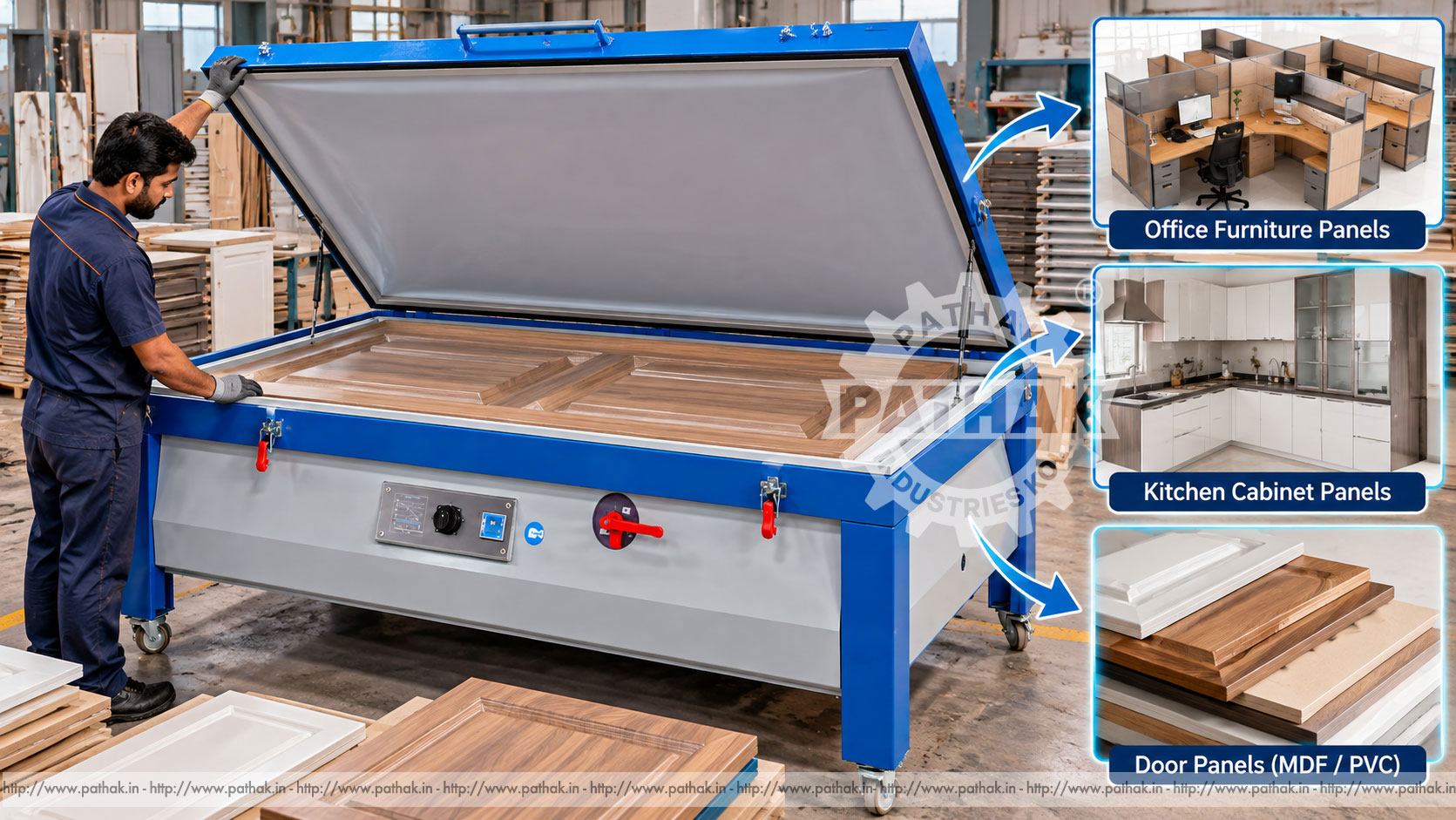
Decorative furniture components often require a film or veneer to follow routed profiles, raised panels, rounded edges, and recessed details. Flat pressing alone cannot always provide even contact over those three-dimensional forms. A Vacuum Membrane Press uses controlled vacuum and process heat to draw a flexible facing material over a prepared panel so the surface can bond around its contours.
The Pathak Industries machine is listed with a 2500 × 1250 mm workable table, a maximum working height of 60 mm, 15 kW startup power, 6 kW working power, a published vacuum value of 0.1 MPa, and an approximate machine weight of 1400 kg. This guide explains the membrane-pressing process, suitable applications, panel and film preparation, quality checks, safe operation, maintenance, and machine-selection factors.
A vacuum membrane press is a woodworking finishing machine used to laminate suitably prepared panel components with flexible decorative materials. The work is arranged on a sealed table, covered by a membrane or film, heated according to the approved process, and exposed to vacuum. Atmospheric pressure then pushes the flexible layer against the panel surfaces while air is evacuated from below.
The process is widely associated with MDF cabinet doors, furniture fronts, interior panels, and other routed components. Material compatibility must be confirmed because film, adhesive, substrate, profile depth, temperature, and cycle conditions all influence bond quality and appearance.
The process begins with machined panels that have been sanded, cleaned, and coated with a compatible adhesive where required. The components are arranged on the workable table with appropriate spacing and support. Decorative PVC film, veneer, or another approved flexible facing material is positioned over the work.
The press closes and the heating system brings the facing material and adhesive system into their specified processing range. Vacuum removes air and draws the flexible layer over the top face, edges, routed profiles, and recesses. The material remains under controlled conditions long enough for the adhesive to develop the required initial bond.
After cooling or stabilisation according to the material supplier's procedure, vacuum is released and the press is opened. Parts are removed carefully, excess material is trimmed, and the surfaces and edges are inspected before further assembly or packing.
The listed Vacuum Membrane Press configuration provides the following reference values:
These figures describe the stored product specification. Usable loading area and process suitability also depend on component shape, support boards, edge spacing, membrane movement, heater clearance, facing material, and the selected pressing method. Actual utilities and controls should be confirmed before ordering.
The table size suits common sheet-based furniture workflows and allows several smaller components to be arranged in one cycle. Good nesting improves utilisation, but parts cannot simply be packed edge to edge. The film or membrane needs enough free area to stretch down around each profile without bridging or tearing.
Operators should leave appropriate space between parts and around the table perimeter according to the film, profile height, and process instructions. Tall or sharply detailed pieces typically require more allowance than flat, shallow profiles.
The listed 60 mm maximum working height is a machine reference. A component near the maximum should be reviewed for actual membrane stretch, heater clearance, support, corner radius, and the ability of the selected film to conform without thinning or whitening.
MDF is frequently used because it can be routed into repeat profiles and provides a relatively uniform surface. The board should be dry, clean, dimensionally stable, and suitable for the selected adhesive and finish. Cut edges and routed areas often absorb adhesive differently from the face and may require particular preparation.
PVC films are available in solid colours, woodgrains, gloss levels, textures, and thicknesses. Each film has a specified forming temperature, stretch behaviour, adhesive compatibility, and recommended profile geometry. A film accepted for a shallow door may not suit a deep recess or tight corner.
Some vacuum pressing applications use wood veneer or other flexible laminating materials. Veneer behaves differently from thermoplastic film and may require a membrane, caul, different adhesive, moisture control, and another cycle. Compatibility must be validated with representative samples.
Panel geometry strongly affects pressing success. Smooth transitions and suitable radii allow facing material to flow over the profile. Very sharp internal corners, deep narrow grooves, abrupt height changes, and rough routed surfaces increase the risk of bridging, tearing, trapped air, or poor adhesion.
Routing tools should be sharp and the machine setup should limit chatter. After machining, remove fibres, dust, and burrs without rounding critical details unintentionally. Sanding should be consistent across the face, edges, and recesses so the final surface does not reveal scratches or machining defects through the film.
The adhesive must match the substrate, facing material, temperature, and end-use conditions. It should be applied at the supplier's recommended coverage, with attention to routed profiles and absorbent edges. Too little adhesive can cause lifting; excessive or uneven application may affect appearance, drying, and bond development.
Observe the required drying or open time before pressing. Trapping water or solvent can produce bubbles or weaken the bond. Panels should be handled with clean gloves or approved practices so oil and dust do not contaminate prepared surfaces.
Heat softens thermoplastic film and activates or supports the adhesive process. Insufficient temperature may prevent the film from conforming or the adhesive from bonding correctly. Excessive heat can cause gloss variation, texture loss, discolouration, excessive stretch, or film damage.
Machine settings do not always equal actual film or panel temperature. Ambient conditions, load density, part colour, film thickness, heater condition, and warm-up state all influence the result. A validated recipe should specify relevant setpoints, times, loading arrangement, and acceptance checks.
The published vacuum value is 0.1 MPa. Effective pressing requires the entire system to maintain a sound seal and evacuate air reliably. Leaks around gaskets, hoses, valves, fittings, table seals, or damaged membrane areas reduce available pressure and can cause local lifting or soft detail.
A membrane must remain clean, flexible, and free of punctures. It should move over the work without being trapped by sharp edges or loose debris. When processing film directly without a reusable membrane, the film itself and the clamping arrangement must establish the required seal.
A correctly configured vacuum membrane press can support production of:
The process should be proven for each combination of substrate, adhesive, facing, profile, and end-use environment. Components exposed to heat, moisture, sunlight, or cleaning chemicals may need specialised materials and additional testing.
Flexible film can follow routed faces, rounded edges, and recessed designs that are difficult to laminate with a simple flat platen.
The 2500 × 1250 mm workable area allows a planned batch of smaller doors or panels to be arranged together, subject to spacing and profile requirements.
Changing the routed panel program and decorative film can support multiple styles without changing the fundamental pressing method.
For suitable designs, film can cover the visible face and profiled edges within the same cycle, reducing separate edge-finishing steps.
Inspect the main face, corners, routed profiles, recesses, edges, and reverse wrap area. Look for bubbles, bridging, wrinkles, tears, whitening, gloss change, trapped particles, adhesive marks, edge lifting, incomplete detail, and panel distortion.
Bond testing should follow the product and adhesive requirement. Visual inspection immediately after pressing may not reveal every problem because some failures appear after cooling, trimming, conditioning, or environmental exposure.
Maintain a reference sample and record batch materials, panel program, adhesive lot, film lot, settings, cycle time, operator, and inspection result. These records help distinguish machine issues from material or preparation variation.
Film may span a groove instead of contacting it because of insufficient heat, unsuitable film, excessive profile depth, inadequate vacuum, poor spacing, or sharp geometry.
Possible causes include contamination, trapped moisture or solvent, low adhesive coverage, inadequate activation, vacuum leakage, or premature unloading.
Wrinkling may result from poor film placement, excessive loose material, uneven heating, closely spaced tall parts, or uncontrolled membrane movement.
Dust, chips, rough substrate, adhesive particles, or a damaged membrane can reproduce as visible marks in the finished face.
The machine combines heated surfaces, a closing lid or frame, vacuum equipment, electrical power, and large flexible materials. Operators must be trained and keep hands clear of closing and clamping zones. Guards, supports, interlocks, and emergency controls must remain functional.
Heated film, membranes, and panels can cause burns. Use approved handling practices and allow adequate cooling. Adhesives and cleaning materials may require ventilation, fire precautions, and personal protective equipment according to their safety data sheets.
Before servicing heaters, seals, pumps, valves, or the lid mechanism, isolate and verify all relevant energy. Never work beneath a raised cover unless it is secured by the approved mechanical support and maintenance procedure.
Daily checks should cover table cleanliness, gasket and seal condition, membrane condition, vacuum hoses, fittings, clamps, lid supports, heater surfaces, controls, and safety devices. Small leaks and debris can quickly affect surface quality.
Monitor vacuum performance and cycle behaviour. A gradual increase in evacuation time may indicate a leak, blocked line, worn pump, contaminated filter, or deteriorating seal. Investigate changes before they produce widespread defects.
Periodic maintenance should follow the manufacturer's schedule for vacuum-pump oil or service, filters, electrical connections, heaters, sensors, hinges, gas springs or lifting supports, fasteners, and calibration. Keep adhesives and cleaning agents away from seals and membrane materials unless compatibility is confirmed.
Start with representative panels and materials. Record maximum panel dimensions, number of parts per cycle, profile depth, working height, edge shape, substrate, film or veneer type, adhesive system, finish standard, daily output, and available utilities.
Then assess workable area, usable height, heating arrangement, vacuum performance, pump capacity, temperature control, cycle automation, membrane system, table arrangement, loading access, safety equipment, service support, and expected consumables. The listed 2500 × 1250 mm table and 60 mm maximum working height should be checked against the complete loaded setup.
Pathak Industries can review samples and application details against the available machine configuration. A trial with the intended panel, adhesive, and facing material is the most useful way to confirm process suitability.
The published workable table size is 2500 × 1250 mm. Actual loading capacity depends on part spacing, profile height, supports, film movement, and perimeter clearance.
The stored specification lists 60 mm. Components near that height should be reviewed for heater clearance, membrane stretch, profile geometry, and film suitability.
The product data lists 15 kW startup power and 6 kW working power. Final electrical requirements should be confirmed for the supplied configuration and installation site.
Yes, routed MDF cabinet and furniture panels are representative applications when the board, adhesive, PVC film, profile, and pressing recipe are compatible.
Selected veneer applications may be possible with a suitable membrane, adhesive, caul or support, and validated cycle. Veneer should not be processed using PVC-film settings without confirmation.
Common causes include contamination, trapped moisture, insufficient or uneven adhesive, vacuum leakage, unsuitable temperature or time, and unloading before the bond stabilises.
Space allows the film or membrane to move down around each edge and profile. Insufficient clearance can cause bridging, thinning, wrinkles, or incomplete edge contact.
Provide panel drawings and samples, substrate, film or veneer, adhesive, maximum dimensions and height, profile depth, parts per cycle, finish requirement, daily output, and electrical supply.
A Vacuum Membrane Press provides controlled three-dimensional laminating for suitable MDF doors, cabinet fronts, furniture panels, and decorative components. The Pathak Industries configuration lists a 2500 × 1250 mm workable table, 60 mm maximum working height, 15 kW startup power, 6 kW working power, and a published vacuum value of 0.1 MPa.
Consistent results depend on panel design, surface preparation, compatible adhesive and film, validated heating and vacuum settings, thoughtful loading, clean equipment, and disciplined inspection. Testing the intended materials and profile before volume production is the best foundation for a reliable pressing process.