Head Office
117, Grand Trunk Road, Salkia Howrah-700013, Kolkata, India
 Hitesh PathakMon, Jan 13, 2025
A ringlock scaffold standard is more than a tube with several welded discs. Each rosette must be positioned at the intended location, oriented correctly, and joined through a controlled welding process. Variation in spacing, alignment, fit-up, heat input, or weld continuity can affect assembly and consistency across a batch. A dedicated standard ringlock welding machine organizes these tasks into a repeatable production station.
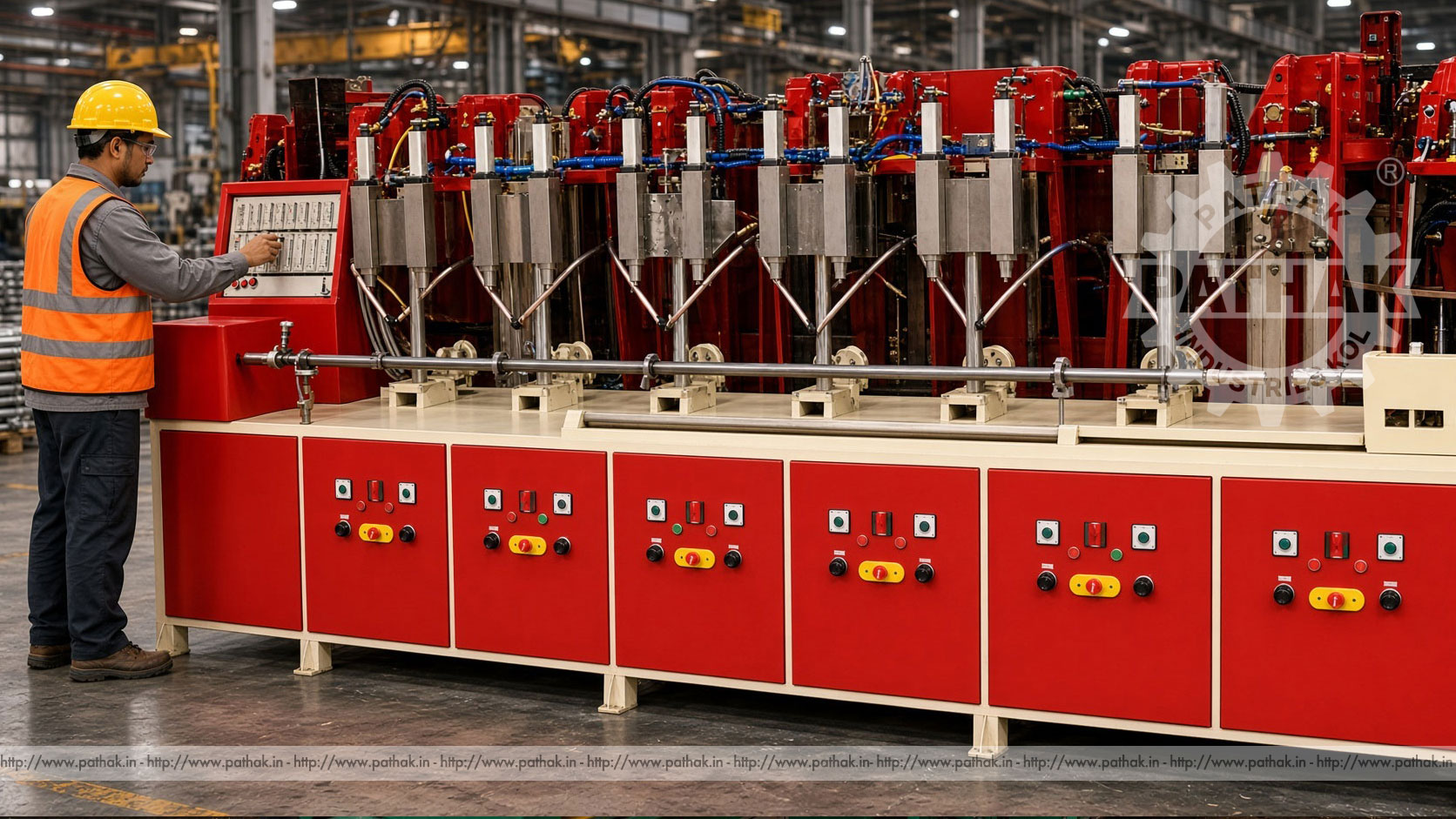
The Standard Ringlock Welding Machine from Pathak Industries is intended for joining prepared ringlock components in fabrication and repetitive production. Its role is to locate the standard tube and rosettes, maintain their relationship during the cycle, and support controlled welding around the joint. This guide explains the manufacturing workflow, fixture principles, quality controls, applications, selection questions, safety, and maintenance without inventing numerical specifications that are not published on the product page.
A Standard Ringlock Welding Machine is specialized equipment used to weld ringlock rosettes onto vertical scaffold tubes, commonly called standards. The rosettes provide connection points for ledgers, braces, and related system parts. Their axial position and angular orientation must remain consistent so compatible components can be assembled in the intended pattern.
The machine brings tube support, component positioning, clamping, indexing or feeding, and welding control into a defined workstation. Depending on the selected configuration, these functions may involve manual, assisted, or automated actions. The actual arrangement, welding process, production capacity, and utility requirements must be confirmed for the proposed model.
Dedicated machinery does not remove the need for prepared components and qualified welding procedures. Tube condition, rosette geometry, fit-up, cleanliness, consumables, shielding, heat input, and inspection continue to influence the finished standard.
The standard is the vertical member in a ringlock scaffolding system. Rosettes are placed along its length to provide connection locations for horizontal and diagonal components. During site assembly, wedges or other compatible connection elements engage these rosettes to create the scaffold structure.
For manufacturing, this means several relationships matter at once. The tube must remain straight enough for the intended product. Each rosette needs the required fit around the tube. Spacing should follow the approved product drawing, and orientation must remain controlled from one location to the next.
Welding introduces localized heat, which can cause distortion if the sequence, fit-up, or restraint is unsuitable. The machine fixture should locate the parts without preventing necessary process access or creating an uncontrolled release when clamps open.
Production begins with prepared standard tubes and rosettes. Tube ends, surfaces, and rosette openings are checked according to the approved component specification. Oil, rust, coating, burrs, or dimensional variation at the joint can affect location and welding behavior.
The tube is loaded into the support and clamping arrangement. A reference establishes its axial position, while fixtures locate one or more rosettes at the required points. The operator or control sequence verifies clamping and joint access before welding begins.
During the weld cycle, heat is applied according to the qualified procedure. The machine maintains the part relationship while the joint is produced. Depending on configuration, the work, welding head, or both may move to complete the required weld path. After the cycle, the joint is allowed to stabilize as required, clamps release, and the standard advances or is unloaded for inspection.
The exact process—such as welding method, number of active stations, motion sequence, and cycle timing—is not stated on the current product page. These details should be confirmed against actual tube and rosette samples before ordering.
A welding fixture establishes the geometry before the arc is started. It should support the tube without damaging it, locate rosettes against reliable references, and resist movement during the cycle. Repeatable clamping helps reduce differences caused by manual positioning.
Axial stops or indexing arrangements establish spacing along the standard. Orientation features control rosette rotation relative to the tube and other rosettes. Supports help limit sag, especially on longer tubes. The complete arrangement must also allow loading, welding, removal, cleaning, and inspection.
Fixture wear can gradually change product geometry. Locators, bushes, clamps, stops, and support surfaces therefore need inspection. A process can continue producing visually similar joints while spacing or alignment drifts, which is why dimensional checks remain necessary.
Welding creates a localized thermal cycle. As heated metal expands and cools, residual stress and distortion can develop. On a long scaffold standard with several rosettes, the sequence of joints can influence how those effects accumulate.
A qualified procedure should define joint preparation, consumable, current and voltage where applicable, travel behavior, shielding, weld size, sequence, and acceptance criteria. The machine settings then support that procedure; they should not be selected only by appearance or speed.
Fixtures must provide enough control to maintain location without creating damaging restraint. Cooling and unloading practices should also be consistent. If a hot component is released or stacked carelessly, its geometry may change after leaving the fixture.
Reliable welding requires repeatable incoming parts. Standard tubes should be checked for diameter, wall condition, straightness, length, end preparation, surface quality, and the approved material specification. Rosettes should be checked for opening size, flatness, thickness, geometry, and burrs.
The joint zone needs to be clean enough for the welding procedure. Scale, paint, oil, moisture, plating, or other contamination can affect arc stability, porosity, fumes, or fusion. If components are coated, the manufacturing plan must address when welding occurs and how affected surfaces are treated afterward.
Fit-up between the rosette and tube should remain within the approved range. Excessive gap or interference can change heat distribution and joint profile. Incoming inspection helps keep the machine from becoming an expensive sorting station for inconsistent components.
Inspection should cover both geometry and welding. Dimensional checks may include overall length, rosette spacing, orientation, tube straightness, end condition, and any interface dimensions needed for compatibility with the scaffolding system.
Visual weld inspection can identify issues such as incomplete coverage, irregular profile, visible porosity, undercut, overlap, cracks, spatter, or arc strikes according to the approved acceptance criteria. Additional testing may be required by the product specification, customer requirement, or applicable manufacturing plan.
A first-off standard should be inspected thoroughly after a setup change. Batch checks should continue at planned intervals because fixture wear, consumable condition, heat, incoming-part variation, and machine adjustment can influence later components.
The machine is intended for scaffolding component manufacturers, fabrication workshops, construction-equipment plants, and production lines making ringlock standards. It may operate as one station in a wider process that includes tube cutting, end preparation, rosette manufacture, welding, straightness checking, surface treatment, marking, and final inspection.
A dedicated standard-welding station is most valuable when the product family repeats. Fixtures and sequence can be established for defined tube lengths and rosette patterns. If a manufacturer supplies several standard variants, changeover should be planned so the correct stops, programs, fixtures, and inspection documents are used for each one.
The equipment is not a substitute for structural product design or compliance verification. Scaffolding components are used in load-bearing assemblies, so material, design, welding, inspection, traceability, and system compatibility should follow the requirements defined for the finished product.
Manual production can require repeated measuring, marking, positioning, tacking, rotating, and welding for every rosette. A purpose-built machine can consolidate those actions around fixed references and controlled motion. This may improve workflow and reduce variation when the machine is correctly configured.
The benefit depends on component consistency, fixture condition, a qualified welding procedure, trained operators, and planned maintenance. Automation cannot correct unsuitable materials or poorly prepared joints.
Because the current product page does not publish a fixed numerical configuration, buyers should provide complete component information. This includes tube outside diameter, wall thickness, material, length range, rosette drawing, joint fit, number of rosettes, spacing pattern, orientation, welding requirement, batch size, and production target.
Also describe current upstream and downstream processes. Explain how tubes and rosettes will reach the machine, how finished standards will be removed, whether variants require changeover, what inspection is performed, and which utilities are available.
Sample parts and approved drawings help Pathak Industries review fixture, support, access, control, and welding requirements. Any requested numerical performance should be confirmed in the final technical specification rather than inferred from photographs.
The machine needs more than its physical footprint. Provide safe space for raw tube storage, rosette staging, loading, unloading, finished-standard racks, welding supplies, fume extraction, maintenance access, and inspection. Long standards require controlled handling so they do not strike personnel or nearby equipment.
Material flow should prevent uninspected parts from mixing with accepted production. Component identification and job documents should stay with the batch through welding and inspection. If several variants look similar, clear changeover verification reduces the risk of using the wrong spacing or rosette type.
Ergonomics also affect consistency. Frequently handled parts, controls, and gauges should be arranged so the operator does not need unsafe reaches or awkward lifting. Mechanical assistance may be needed for long or heavy standards.
Welding presents arc radiation, heat, fumes, sparks, hot metal, electrical energy, compressed systems, and moving-machine hazards. The machine should be operated only by trained and authorized personnel using the required guarding and protective equipment.
Fume extraction and ventilation must suit the material, coating, consumable, and process. Flammable materials should be removed from the area, and fire-prevention controls must be maintained. Operators and nearby personnel need protection from direct and reflected arc exposure.
Keep clear of clamps, locators, indexing systems, welding heads, and moving tubes during the automatic or assisted cycle. Stop and isolate all energy before clearing a fault, changing tooling, servicing the machine, or entering a safeguarded zone. Hot standards should be marked or handled so other workers are not exposed unknowingly.
Maintenance should cover welding equipment, fixtures, clamps, supports, drives, controls, cables, hoses, guards, extraction, and utility systems. Spatter and residue should be removed using the approved method before they interfere with locating surfaces or moving elements.
Inspect electrical connections, welding leads, consumable delivery, contact points, bearings, fasteners, sensors, and emergency devices according to the machine documentation. Locators and stops should be checked dimensionally rather than judged only by appearance.
Changes in weld appearance, arc behavior, cycle movement, component spacing, or clamping force should be investigated promptly. Production and maintenance records help distinguish material variation from machine or tooling changes.
It joins ringlock rosettes to prepared vertical scaffold tubes, producing standards for a compatible ringlock scaffolding system according to the approved component design.
Spacing establishes the connection positions available along the standard. Consistent spacing helps compatible ledgers and braces assemble according to the system geometry.
No numerical production rate is currently published on the product page. Output should be confirmed for the actual tube, rosette pattern, weld procedure, loading method, inspection, and selected configuration.
Possible variants depend on the machine’s confirmed fixture, support, indexing, and control arrangement. Buyers should provide every required tube length and rosette pattern during configuration.
Part preparation, fit-up, fixture location, consumables, shielding, heat input, sequence, machine condition, operator practice, and incoming material variation can all affect the joint.
Inspection should follow the approved product plan and may include dimensions, rosette spacing and orientation, straightness, visual weld quality, identification, and any additional specified testing.
Provide tube and rosette drawings, materials, dimensions, lengths, joint details, rosette quantity and spacing, welding procedure requirements, product variants, batch volumes, target output, utilities, and inspection standards.
A Standard Ringlock Welding Machine organizes tube support, rosette positioning, clamping, welding, and handling around a recurring scaffold component. Its purpose-built arrangement can reduce repeated manual positioning and support consistent production when matched to a clearly defined product.
The machine is only one part of the result. Reliable standards require controlled incoming parts, qualified welding, maintained fixtures, safe operation, dimensional verification, weld inspection, and traceability. Providing complete product drawings and production requirements is therefore the most important first step in configuring the right ringlock welding solution.