Head Office
117, Grand Trunk Road, Salkia Howrah-700013, Kolkata, India
 Hitesh PathakFri, Oct 10, 2025
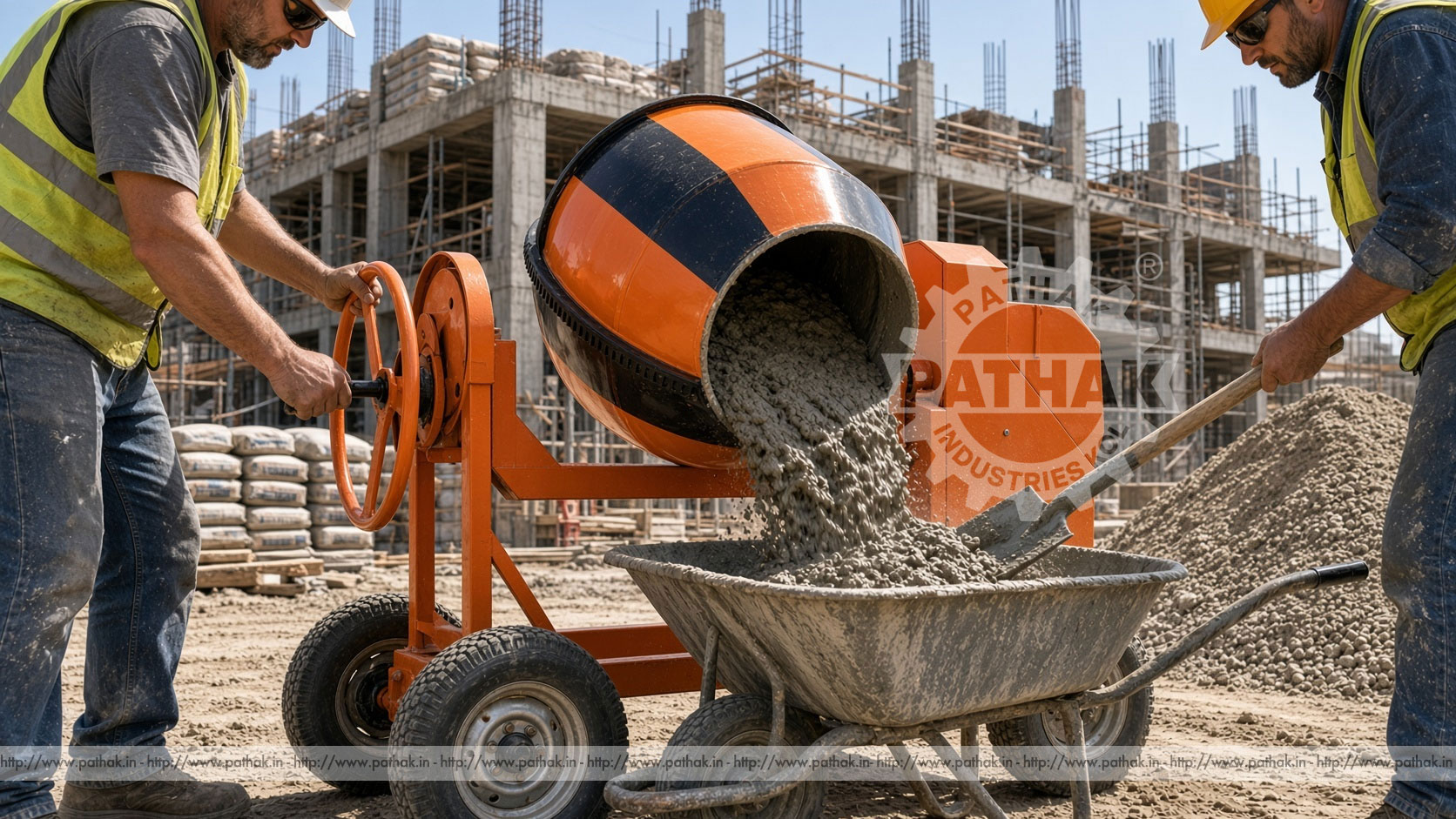
Small and medium construction batches need a reliable way to combine cement, aggregates, water, and approved admixtures without depending entirely on hand mixing. A Non Hopper Concrete Mixer Machine provides a rotating mixing chamber that brings these ingredients together before discharging the batch for placement. Its open loading arrangement suits sites where materials are measured and introduced directly rather than raised through a separate loading hopper.
The Pathak Industries product record identifies model PNHCM with a 200-litre volume and a 10/7 CFT three-gear configuration. Power is listed as 6.5 HP/5 HP, representing available drive configurations that should be confirmed for the required installation. These figures describe the offered machine, while the usable batch and mixing procedure must follow the approved mix design, site practice, and final technical documentation.
A non-hopper mixer is a batch mixing machine without a mechanical charging hopper. Operators load measured materials directly into the drum opening, normally using pans, buckets, wheelbarrows, or a planned manual feed arrangement. Internal blades lift and tumble the ingredients as the drum rotates, helping distribute cement paste around the aggregate.
After the required mixing period, the drum is tilted or positioned for discharge according to the machine design. Fresh concrete or mortar flows into a wheelbarrow, pan, or receiving container for transport to the work area. This straightforward layout can be useful where batch sizes are manageable and the site has an organised manual loading team.
The cycle begins with the approved proportions for the intended concrete or mortar. Materials are measured rather than estimated by shovel count alone. The drum is placed in its loading position and ingredients are introduced in the sequence established by the site method. The drive rotates the drum so its blades repeatedly lift, divide, and recombine the mixture.
Water addition must be controlled. Adding excess water merely to make discharge easier can alter consistency and affect the intended performance of the finished concrete. Once the batch is uniformly mixed for the required time, it is discharged promptly and the next measured batch can begin. Delays should be managed according to the applicable concreting procedure.
Without a charging hopper, the crew brings each measured ingredient directly to the drum mouth. This reduces the number of loading mechanisms on the machine, but it places greater emphasis on safe access, material presentation, and operator coordination. Bags, aggregate containers, and water measurement should be arranged so workers do not repeatedly cross the discharge path.
The loading height and weight of each container must suit the crew and site method. Mechanical assistance or smaller measured containers may be appropriate where manual lifting would be excessive. A non-hopper design should not be interpreted as permission to stand on the frame, reach into a moving drum, or improvise a raised platform.
The product page lists a volume of 200 litres. Drum volume does not necessarily equal the amount of finished, usable concrete produced in every cycle. Materials need free space to tumble and mix, and the relationship between dry input and wet output varies with the mix. Overfilling can reduce mixing action, strain the drive, increase spillage, and produce an inconsistent batch.
For planning, distinguish total drum volume, nominal input, and expected output. The approved loading quantity should come from the machine documentation and the mix design. A trial batch can confirm whether the materials circulate correctly and whether the receiving container accommodates the discharge without loss.
The source specification describes the PNHCM as 10/7 CFT with three gears. In common mixer terminology, paired CFT figures may describe input and output ratings, but buyers should confirm the exact definition used for this model rather than relying on convention. The three-gear entry relates to the drum-drive arrangement stated in the product data.
Gears, bearings, shafts, and their guards form part of the machine’s working system. They require correct alignment, lubrication, and protection from aggregate and cement contamination. Operators should never run the machine with a gear or drive guard removed.
The published power line lists 6.5 HP/5 HP. The precise drive type associated with each figure, electrical requirements where applicable, and supplied configuration should be confirmed before ordering. Site planning must provide the correct fuel or electrical service and a safe means of isolation.
For an electrically driven mixer, cable routing and earthing need particular attention in a wet, abrasive construction environment. Leads should be protected from vehicles, sharp aggregate, standing water, and physical damage. Any engine-driven option requires ventilation, fuel handling, hot-surface control, and maintenance suited to that drive. Never infer interchangeability between drive options without technical approval.
Mix consistency depends on repeatable measurement. Cement, fine aggregate, coarse aggregate, water, and approved admixtures should follow the project mix. Containers used for volumetric batching need a known size and should be filled consistently. Moisture in sand and aggregate can change the effective water content, so site control may need adjustment.
Keep cement protected from moisture before use and prevent soil or debris from contaminating aggregate stockpiles. Water should meet the applicable project requirement. Admixtures must be measured using the specified method; casual additions can produce significant variation in a small batch.
A planned loading sequence helps prevent cement from forming dry pockets or sticking in one region of the drum. The correct sequence varies with the mixer and material, so the site should establish it during trials. Ingredients should enter gradually enough to circulate instead of blocking the opening or falling directly back out.
Mixing time should begin from a defined point, such as completion of loading, and remain consistent between batches. Very short mixing can leave non-uniform material, while unnecessarily long mixing delays placement and may affect workability. Visual appearance is useful, but it should not replace the established timing and quality checks.
Non-hopper concrete mixers may support building sites, contractor fleets, repair work, civil projects, precast yards, and small production areas. Suitable tasks can include measured batches for foundations, paths, floor repairs, masonry work, posts, kerbs, small precast items, and other planned construction activities within the machine’s confirmed capability.
The mixer is most useful where batch demand matches its output and materials can be supplied without interrupting the cycle. Large continuous pours may require a different production and delivery method. Selection should reflect placement rate, travel distance, crew size, and the time fresh material can remain workable.
Place the mixer on firm, level ground with enough space for loading, discharge, cleaning, and maintenance. It should not obstruct vehicle routes or sit where excavation edges, unstable ground, or falling material create additional risk. Wheels or transport components must be secured as directed before operation.
Arrange cement, aggregate, water, and measured containers to minimise unnecessary movement. The discharge side needs clear access for the receiving wheelbarrow or pan. Drainage should prevent wash water and slurry from creating a slipping hazard or entering an uncontrolled area.
Use the same measurement method, loading order, water control, and mixing time for each approved batch. Periodic workability or other quality checks should follow the project plan. If a batch differs noticeably, investigate measurement, moisture, mixing time, drum condition, and material identity rather than correcting it casually.
Do not add unmeasured water after mixing simply to restore workability. Any adjustment should follow the authorised procedure. Recording batch details is helpful where concrete is used for defined structural or precast work.
A rotating drum and drive contain trapping, crushing, and entanglement hazards. Guards must remain fitted, and hands or tools must never enter the drum while motion is possible. Loose clothing should be controlled, and workers should stay clear of gears, belts, shafts, and the tilting mechanism.
Cement can irritate skin and eyes, while dry handling creates dust. Appropriate gloves, eye protection, footwear, and dust controls should be used for the task. Manual handling must be planned for bags and aggregate containers. Before cleaning, adjusting, or clearing a blockage, isolate the drive and prevent unintended movement of the drum.
Fresh residue should be removed before it hardens on the drum and blades. Hardened buildup changes the internal shape, reduces effective volume, adds rotating weight, and can break away into a later batch. Cleaning should follow the machine instructions and site environmental controls.
The machine must be isolated before anyone approaches hazardous internal areas. Do not strike critical components in a way that damages the drum, blades, bearings, or guards. Collect washout appropriately; uncontrolled cement slurry can harm drains, soil, and working surfaces.
Before each shift, inspect the frame, drum, blades, gears, guards, controls, wheels, fasteners, power system, and tilting arrangement. Look for cracks, looseness, abnormal noise, oil leakage, damaged cables, or irregular drum movement. Defects affecting safe operation should be corrected before mixing resumes.
Lubricate bearings and gears only at the specified points and intervals. Excess lubricant can attract abrasive cement dust. Drive-system service should follow the configuration supplied. Keeping a maintenance record helps distinguish normal wear from repeated overload or poor cleaning.
Estimate the volume needed at the placement point and how frequently batches must be delivered. Compare that demand with confirmed mixer input and output, loading time, mixing time, discharge time, and transport distance. Consider whether a non-hopper loading method is practical for the crew and materials.
Confirm drum rating, drive option, power source, controls, mobility, guards, spare parts, and service requirements. Pathak Industries can review the proposed application, but the final order should clearly state the selected power configuration and all relevant accessories. Avoid choosing from drum size alone when site logistics may be the limiting factor.
It is a rotating batch mixer loaded directly through the drum opening rather than through a separate mechanical charging hopper.
The product specification lists a 200-litre volume. Confirm nominal input and usable output for the selected mix before planning production.
It is the paired CFT rating published for the machine. The exact input/output definition should be confirmed in the final technical documentation.
The product record lists 6.5 HP/5 HP. Confirm which drive and supply arrangement corresponds to each option before purchase.
Not necessarily. Ingredients need room to tumble, and wet output differs from dry input. Follow the approved batch rating rather than filling the drum to its physical limit.
Use the duration established for the machine and approved mix after loading is complete. Keep timing consistent and verify uniformity through the project’s quality method.
Residue can harden on the drum and blades, reducing volume, disturbing mixing action, adding load, and contaminating later batches.
Provide required batch output, mix type, placement demand, loading method, site power, mobility needs, working conditions, and preferred drive configuration.
A non-hopper concrete mixer offers a direct and practical batching arrangement when material measurement, manual loading, mixing, discharge, and placement are organised together. Consistency comes from controlled ingredients and timing, while reliability comes from proper loading, cleaning, guarding, and maintenance.
Review the PNHCM information on the Non Hopper Concrete Mixer Machine product page and provide Pathak Industries with the intended mix, batch demand, site conditions, and available utilities. Confirm usable output, power option, mobility, accessories, and operating requirements before ordering.