Head Office
117, Grand Trunk Road, Salkia Howrah-700013, Kolkata, India
 Hitesh PathakTue, May 14, 2024
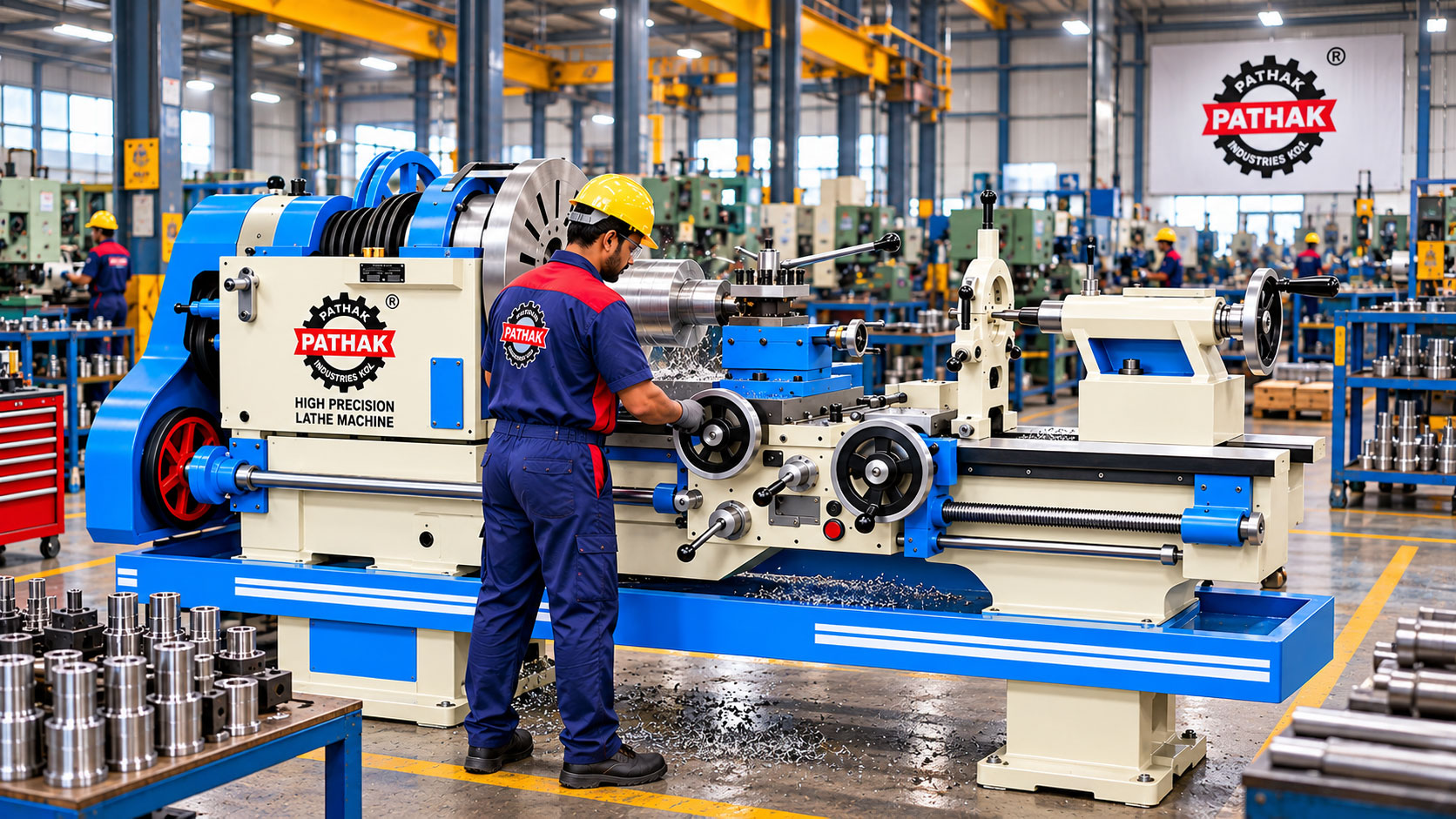
In modern manufacturing, accuracy is not simply a desirable feature—it directly influences product quality, component compatibility, production efficiency, and overall manufacturing reliability. When industries need to produce cylindrical components with controlled dimensions, consistent finishes, and dependable repeatability, a High Precision Lathe Machine becomes an important part of the machining process.
A high precision lathe is designed for turning and related machining operations where dimensional control and machining quality are critical. The machine rotates a workpiece while a cutting tool removes material in a controlled manner. Depending on the tooling and machine configuration, operators can perform operations such as straight turning, facing, taper turning, threading, boring, drilling, grooving, and parting.
High precision lathes are particularly useful for manufacturers producing shafts, bushes, sleeves, pins, rollers, threaded components, tooling parts, machine components, and other accurately machined products.
For engineering workshops and manufacturing facilities looking for a combination of precision, versatility, operator control, and dependable machining performance, a well-selected high precision lathe can become one of the most valuable machines on the shop floor.
A High Precision Lathe Machine is an industrial machine tool engineered to perform turning operations while maintaining close dimensional control and consistent machining quality.
The basic working principle is straightforward. The workpiece is securely held in a chuck, faceplate, between centers, or another suitable workholding arrangement. The spindle rotates the workpiece at the selected speed, while the cutting tool is moved against it at a controlled feed.
Material is progressively removed until the required diameter, length, profile, thread, or surface is achieved.
What distinguishes a precision lathe from a general-purpose turning setup is its emphasis on factors such as spindle stability, machine rigidity, accurate carriage movement, controlled feed, proper workholding, and repeatable tool positioning.
The actual achievable tolerance will depend on the machine specification, tooling, workpiece material, operator setup, measuring equipment, and machining conditions.
The machining cycle begins with proper workpiece preparation and secure workholding. The operator selects the appropriate cutting tool, spindle speed, feed rate, and depth of cut according to the workpiece material and required operation.
Once the spindle starts rotating, the tool is carefully brought into contact with the workpiece. Controlled movement of the carriage and cross-slide allows material to be removed from the required area.
For straight turning, the cutting tool travels longitudinally along the workpiece. During facing, the tool moves across the end face. Thread cutting requires synchronized tool movement, while boring involves machining an existing internal diameter.
The quality of the finished component depends on the complete machining system rather than one factor alone. Machine condition, alignment, tooling geometry, workholding, cutting parameters, lubrication or coolant strategy, and operator technique all contribute to the final result.
A precision lathe should provide a stable mechanical platform for accurate machining. A rigid machine structure helps control vibration and supports consistent cutting conditions during both roughing and finishing operations.
Depending on the particular machine model, additional specifications and accessories may be available. Buyers should always refer to the technical specifications of the selected machine rather than assuming that every precision lathe has the same capacity or configuration.
One major advantage of a lathe is the number of machining operations that can be performed on a single machine.
These capabilities make a precision lathe suitable for both general engineering work and specialized component manufacturing.
High precision lathe machines can support production and maintenance requirements across numerous industries.
In the automotive and auto-component industry, turning machines can be used to manufacture suitable shafts, bushes, pins, sleeves, threaded components, and other rotational parts where dimensional consistency is important.
In general engineering workshops, high precision lathe machines are valuable for machining custom components, repair parts, prototypes, replacement components, and production batches.
The tool room and die-making sector may use precision turning for tooling components, fixtures, mandrels, spacers, and other accurately machined parts.
Manufacturers of industrial machinery frequently require turned shafts, rollers, bushes, couplings, sleeves, and related components during machine production.
High precision turning is also useful in maintenance facilities where damaged or worn components need to be reproduced, modified, or repaired according to dimensional requirements.
The suitability of a lathe for a particular component should always be determined according to the machine's actual swing, distance between centers, spindle bore, speed range, workpiece weight limits, tooling, and other technical parameters.
The primary benefit of a High Precision Lathe Machine is improved dimensional control. Accurate movement and stable machining conditions help operators manufacture components according to the required dimensions.
Production facilities and tool rooms have different priorities, but both can benefit from precision turning capability.
A production environment may focus on cycle time, repeatability, component quality, and efficient batch machining. A tool room may place greater emphasis on flexibility, one-off components, prototypes, maintenance jobs, and accurate custom machining.
A suitable High Precision Lathe Machine can support both types of work when its capacity and configuration match the intended applications.
For manufacturers handling frequently changing jobs, a conventional precision lathe can also provide direct operator control and flexibility without requiring a complex programming workflow for every machining task.
Selecting a lathe should begin with the actual components that need to be manufactured. Buyers should avoid choosing a machine based only on its overall physical size or general appearance.
Important factors to consider include:
The required machine capacity should provide reasonable allowance for future production requirements without unnecessarily oversizing the equipment.
Before operating the machine, the user should inspect the working area and verify that the lathe is in appropriate operating condition. Workholding equipment, cutting tools, guards, lubrication, and other relevant systems should be checked according to the machine documentation.
Check the machine condition, lubrication system, chuck, cutting tools, guards, and surrounding work area before beginning the machining operation.
The workpiece must be securely mounted using an appropriate workholding method. Improper clamping can affect both machining quality and operator safety.
Select the cutting tool according to the workpiece material and machining operation. Tool geometry and condition can significantly influence cutting performance and surface finish.
Spindle speed, feed, and depth of cut should be selected based on the workpiece material, diameter, tooling, operation, and desired finish.
When beginning a new job, operators may use controlled initial cuts and verify dimensions with suitable measuring instruments before proceeding with final machining.
Measurements should be taken using appropriate equipment such as vernier calipers, micrometers, bore gauges, or other inspection instruments according to the required tolerance.
Operators should follow the machine manufacturer's operating instructions and applicable workplace safety procedures. Loose clothing, jewelry, unsecured hair, and unsafe interaction with rotating components should be avoided.
Even a high-quality lathe cannot maintain machining accuracy indefinitely without proper maintenance. Regular inspection and preventive maintenance help preserve machine performance and reduce unexpected downtime.
Preventive maintenance can reduce unplanned downtime and help preserve the machine's accuracy, reliability, and service life.
For industrial buyers, purchasing a lathe is not simply about acquiring a machine. The selected machine must correspond to the intended workpiece sizes, machining processes, production requirements, and workshop conditions.
Pathak Industries provides machine tool solutions for engineering workshops and industrial manufacturing applications. Buyers considering a High Precision Lathe Machine should evaluate their component dimensions, materials, required operations, production expectations, and other technical requirements before selecting a particular machine configuration.
This approach helps ensure that the selected machine is suitable for the actual manufacturing application rather than choosing equipment based on generic specifications alone.
A High Precision Lathe Machine is a turning machine designed to machine rotating workpieces with controlled dimensional accuracy and consistent surface quality. Depending on its configuration, it can perform operations such as turning, facing, threading, boring, drilling, grooving, and taper turning.
Typical components include shafts, pins, bushes, sleeves, rollers, threaded parts, spacers, machine components, tooling parts, and many other cylindrical or rotational components.
They are commonly used in general engineering, automotive component manufacturing, machinery production, tool rooms, maintenance workshops, fabrication-related machining, and other industrial sectors.
Yes. Suitable lathe machines can perform thread-cutting operations. The available thread types and pitches depend on the specific machine configuration and technical specifications.
Yes. With appropriate tooling and setup, a lathe can enlarge and finish existing internal diameters through boring operations.
Machine rigidity, spindle condition, alignment, guideway condition, tooling, workholding, cutting parameters, operator technique, temperature, and measuring practices can all influence machining accuracy.
Consider the maximum workpiece diameter and length, spindle bore, required operations, workpiece material, production quantity, tooling requirements, and future machining needs. These requirements should then be compared with the technical specifications of the specific machine model.
Yes. Cleaning, lubrication, inspection, alignment checks, and preventive maintenance are essential for maintaining reliable operation and machining quality throughout the machine's service life.
A High Precision Lathe Machine is a versatile machining solution for manufacturers that require accurate turning, controlled dimensions, consistent surface finishing, and flexibility across different component types.
From shafts, bushes, sleeves, and pins to threaded parts and custom engineering components, precision turning remains fundamental to industrial manufacturing.
The best results come from selecting a machine according to the actual workpiece and production requirements, using appropriate tooling and machining parameters, and maintaining the equipment correctly throughout its operating life.
For workshops, tool rooms, component manufacturers, and industrial production facilities, a properly selected Pathak High Precision Lathe Machine can provide a dependable foundation for accurate and efficient turning operations.