Head Office
117, Grand Trunk Road, Salkia Howrah-700013, Kolkata, India
 Hitesh PathakTue, May 12, 2026
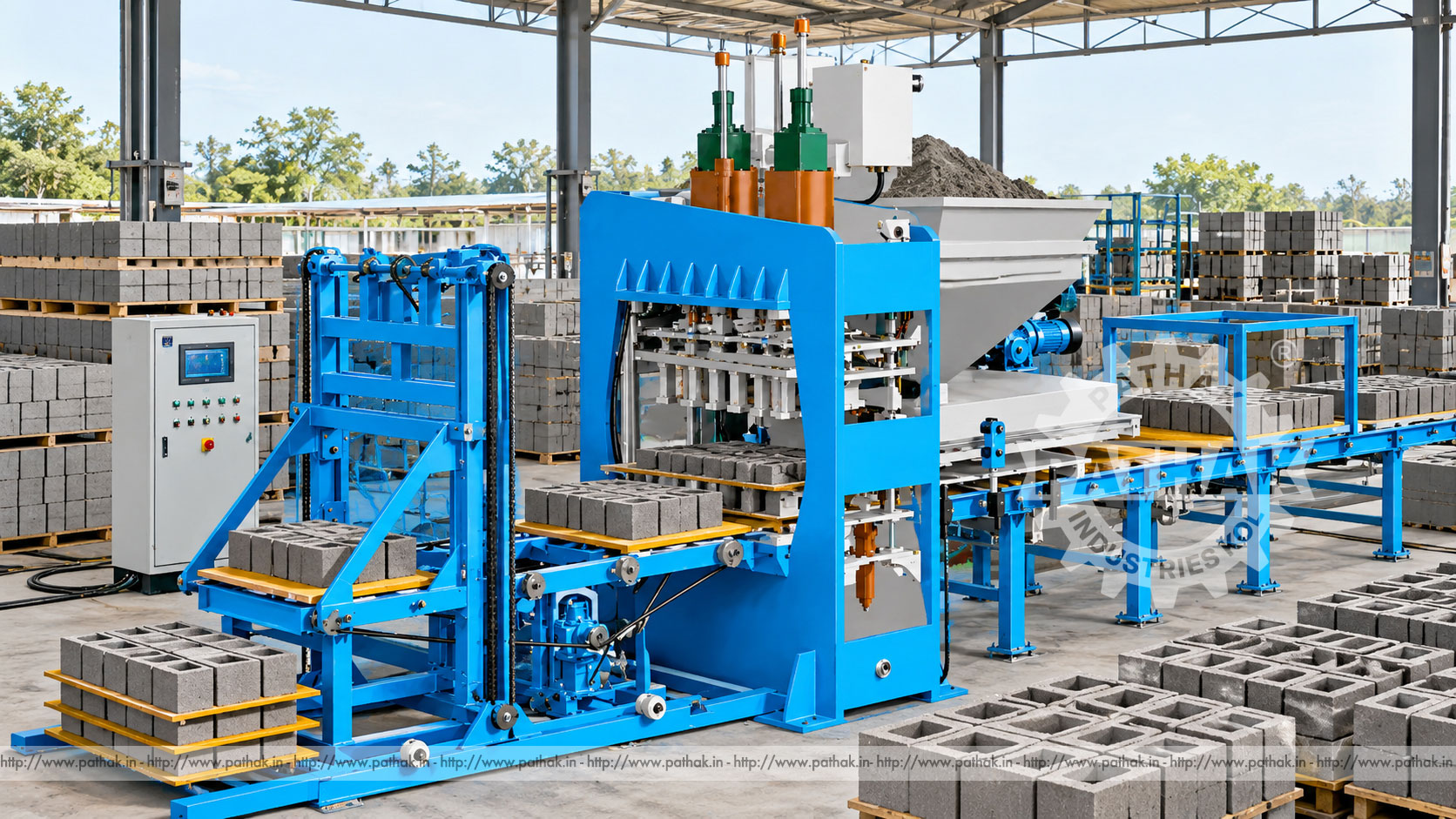
Consistent masonry-unit production depends on much more than filling a mould. Material preparation, moisture control, measured feeding, compaction, ejection, handling, and curing must work as one controlled process. A Fly Ash Bricks Making Machine provides a dedicated hydraulic forming station that helps manufacturers organise these stages for repeat output.
Pathak Industries lists four PFABM models for different production requirements. Their stated capacities extend from 2,400–2,500 bricks per hour on the PFABM-22 to 4,500–4,600 bricks per hour on the PFABM-35. Depending on the model, each stroke produces 8, 10, 12, or 15 bricks. The range uses an automatic hydraulic vertical press with heavy-duty cylinder and automated electrical control, while mix feeding can be arranged by conveyor or manually and formed bricks are removed by rubber belt.
A fly ash brick machine measures prepared material into a mould and applies controlled pressure to form units of repeatable shape. After compaction, the mould opens or ejects the fresh bricks so they can move to the next handling and curing stage. The machine concentrates on forming; final brick quality also depends on raw-material suitability, proportioning, mixing, moisture, curing, and quality control.
The listed PFABM machines use vertical hydraulic pressure. Hydraulic power allows the forming load to be applied through a controlled stroke, while the automated panel coordinates the cycle. A production line may include upstream mixing and conveying as well as downstream transfer and curing arrangements selected for the plant.
Production begins with properly selected and measured ingredients. The product data identifies fly ash, iron oxide, lime, sludge, cement, and quarry waste among potential inputs. This is not a fixed recipe: the permitted composition and proportions must be established through material evaluation, trials, applicable requirements, and the desired finished performance.
The prepared mix reaches the forming area through a conveyor or manual feed arrangement. The mould cavities are filled consistently, excess material is controlled, and the hydraulic vertical press compacts the charge. The formed units are released and transferred by rubber belt. They must then be handled carefully and cured under a defined procedure before testing or dispatch.
The PFABM series offers four stated production levels:
These figures help compare nominal capability, but a realistic production plan must account for material supply, mould filling, transfer, cleaning, planned checks, changeovers, curing capacity, and downtime. The largest machine is useful only when the surrounding plant can sustain its feed and safely handle its output.
The source specification describes an automatic hydraulic vertical press using a heavy-duty cylinder. During forming, hydraulic pressure drives the pressing member through its controlled movement. Consistent pressure, clean hydraulic fluid, sound seals, correct valve action, and accurate mould filling all influence repeatability.
The listed oil tank capacities are 200 litres for PFABM-22 and 310 litres for PFABM-25, PFABM-30, and PFABM-35. Oil level, temperature, cleanliness, leakage, and filter condition should be checked according to the maintenance schedule. Operators must never search for leaks with bare hands or work beneath unsupported moving members.
An automated electrical control panel coordinates the forming sequence. It can organise feed, pressing, return, ejection, and transfer according to the selected machine configuration. Repeatable sequencing reduces dependence on manually timing every movement, but it does not replace trained supervision.
Control settings should be restricted to authorised personnel. Before production, the operator should verify the selected recipe or cycle, emergency stops, guards, sensors, and clear working area. Any unexplained alarm or irregular movement needs investigation rather than repeated resetting.
The PFABM range supports conveyor or manual mix feed. Conveyor feeding can provide a more continuous material supply when properly matched to the mixer and machine demand. Manual feed may suit a particular layout or smaller operation, but material quantity and safe access still require control.
Formed bricks leave on a rubber belt according to the published configuration. The downstream area should prevent congestion and minimise impacts on fresh units. Belt tracking, tension, cleanliness, and support condition require routine inspection because unstable transfer can damage corners or interrupt the cycle.
A powerful press cannot correct an unsuitable mix. Variation in particle size, moisture, binder content, or mixing time can change cavity filling and green strength. Incoming materials should therefore follow a documented inspection and storage procedure, with moisture protected from uncontrolled weather exposure.
Batching equipment should measure ingredients consistently. Mixing must distribute fine materials and moisture evenly without leaving dry pockets or excessive clumps. Trial batches and laboratory checks are important when a source material changes. Production teams should follow the approved formulation rather than adjusting ingredients casually at the machine.
The mould defines brick geometry and must match the intended product and selected machine. Before installation, confirm cavity count, dimensions, locating features, wear surfaces, ejection clearances, and compatibility. A mould change should follow an approved lifting and locking procedure.
Wear or material build-up can affect dimensions and release. Operators should inspect cavities and pressing surfaces without reaching into an energised machine. Finished bricks should be sampled at defined intervals for dimensions, appearance, mass, and other required quality characteristics.
Hourly machine output is one part of total plant capacity. To estimate a shift, multiply the planned running hours by a realistic sustained rate, then allow for start-up, cleaning, inspections, material replenishment, mould attention, and planned maintenance. Curing and storage capacity must also accommodate the resulting daily volume.
For example, selecting a higher-output model without adequate mixing or pallet movement may merely move the bottleneck. A balanced line coordinates raw-material storage, batching, mixer discharge, machine feed, brick transfer, curing, inspection, stacking, and vehicle access.
Fly ash brick machines may serve dedicated masonry-unit plants, building-material manufacturers, infrastructure supply operations, and businesses converting suitable industrial mineral materials into formed products. They can support recurring standard units or planned product sizes within the confirmed mould and machine arrangement.
Actual brick use depends on verified finished properties and applicable project requirements. Manufacturers should test products through an appropriate quality process and maintain batch traceability rather than assuming that appearance alone confirms performance.
Automated control coordinates the machine cycle, helping keep press movement and transfer consistent when material and setup remain controlled.
Four model choices allow a buyer to match nominal output and bricks per stroke to the planned market, shift pattern, and supporting equipment.
Conveyor feed and belt removal can connect forming to the adjacent stages, reducing unnecessary handling when the layout is properly designed.
Compatible mould arrangements may allow a plant to plan different products, subject to confirmed tooling, cycle requirements, and changeover procedures.
The installation area must support the machine load and dynamic forces. The foundation, level, anchoring, electrical supply, hydraulic access, drainage, material routes, and maintenance clearance should be finalised before delivery. Dust control and housekeeping provisions are especially important around dry ingredients.
People, forklifts, raw materials, fresh bricks, and finished pallets need separated routes wherever practical. Controls and inspection points should be accessible without entering hazardous movement zones. Adequate lighting helps operators see material flow, leakage, damaged bricks, and unsafe conditions early.
Daily care includes cleaning material deposits, inspecting mould surfaces, checking hydraulic oil level and leaks, examining belt tracking, and testing safety functions. Guards must be replaced after authorised access, and all energy sources must be isolated before hands enter the forming area.
Planned maintenance should cover filters, oil condition, cylinders, seals, hoses, valves, fasteners, electrical connections, sensors, drive components, mould alignment, and conveyor supports. Maintenance records reveal developing problems and help parts or service be scheduled without avoidable production loss.
Start with the required brick size, daily saleable output, working days, shift hours, material availability, curing area, and expected growth. Compare this demand with the published hourly output and bricks per stroke, then apply realistic utilisation rather than assuming continuous nameplate production.
Also review power, hydraulic tank capacity, mould requirements, mixer and conveyor capacity, labour, factory space, loading equipment, storage, training, installation, and maintenance support. Pathak Industries can review the intended product and production plan against an appropriate machine configuration.
Published output ranges from 2,400–2,500 bricks per hour for PFABM-22 to 4,500–4,600 bricks per hour for PFABM-35, subject to proper material flow and operating conditions.
The listed figures are 8 for PFABM-22, 10 for PFABM-25, 12 for PFABM-30, and 15 for PFABM-35.
The machines use an automatic hydraulic vertical press with a heavy-duty cylinder, coordinated through the electrical control arrangement.
Yes. The product specification lists conveyor or manual mix feeding for all four models.
The published configuration uses a rubber belt for brick removal. Downstream handling must protect fresh units from impact and congestion.
The source mentions fly ash, iron oxide, lime, sludge, cement, and quarry waste. The actual formulation must be validated for the available materials and required finished performance.
PFABM-22 lists 200 litres, while PFABM-25, PFABM-30, and PFABM-35 each list 310 litres.
Choose from required saleable output, brick design, material supply, mixer capacity, curing and storage area, utilities, labour, and realistic shift utilisation—not hourly capacity alone.
The Pathak Industries PFABM range provides four capacity choices for organised fly ash brick production. Hydraulic vertical pressing, automated cycle control, flexible mix feeding, and belt removal create a practical forming platform. The best result comes from matching the model to the entire plant, validating the material recipe, maintaining the hydraulic and transfer systems, and controlling every stage from batching through curing and inspection.