Head Office
117, Grand Trunk Road, Salkia Howrah-700013, Kolkata, India
 Hitesh PathakWed, Sep 25, 2024
Producing one turned component and producing a batch of matching components present different workshop challenges. A single part may allow frequent tool changes and repeated manual adjustments, but those interruptions become expensive and inconsistent when the same sequence must be performed many times. A capstan lathe addresses this problem by arranging several tools on an indexable turret so the operator can move through a planned series of operations without resetting the machine for every step.
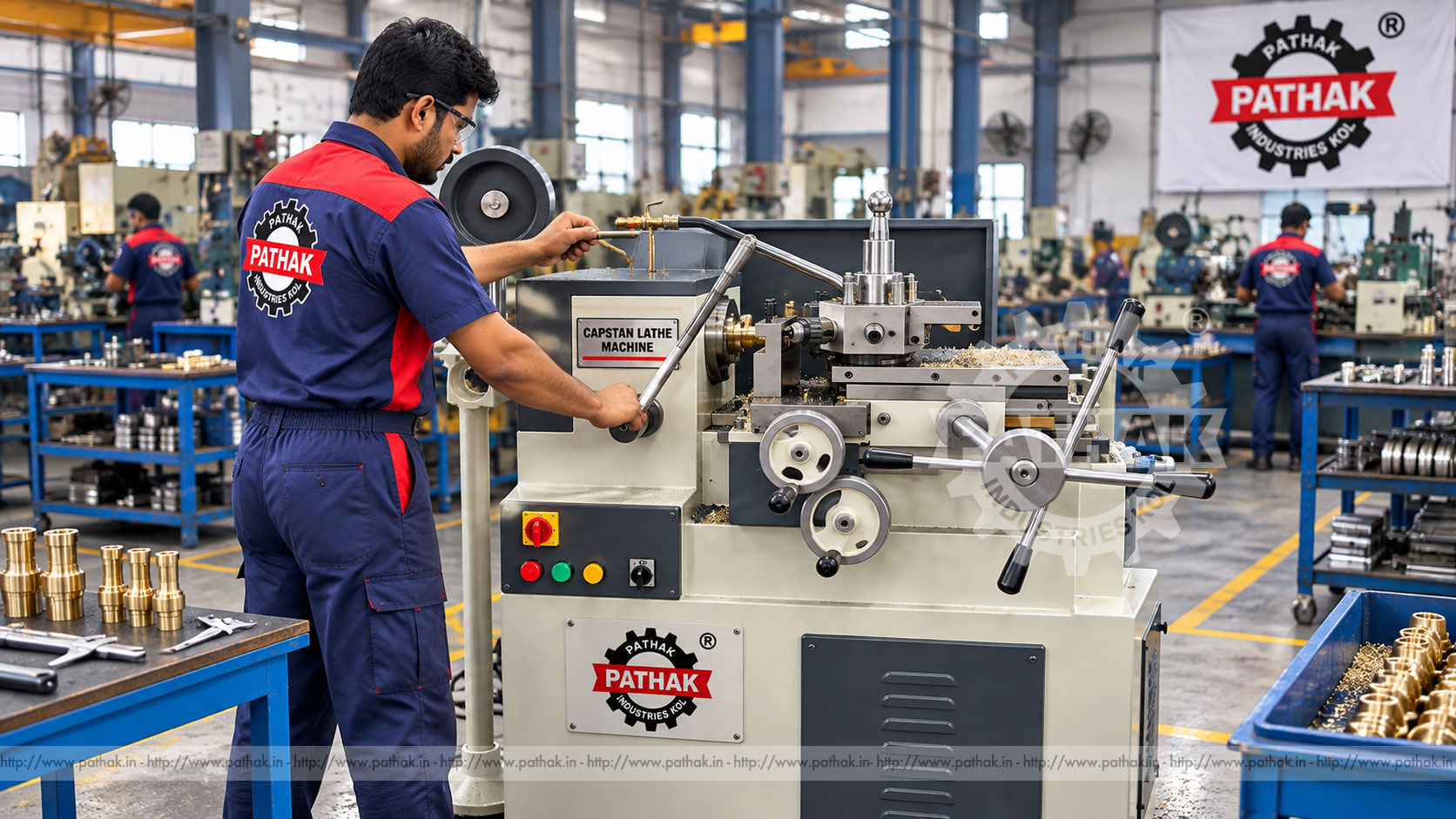
The Capstan Lathe Machine from Pathak Industries is intended for turning rotational components and producing faces, diameters, bores, and threads. Its product range covers eight PCL models with different spindle openings, collet capacities, spindle speeds, and turret-slide strokes. This article explains how the capstan arrangement works, why it suits repetitive work, how the published models differ, and what a buyer should evaluate before selecting a configuration.
A capstan lathe is a production-oriented turning machine in which a hexagonal turret carries multiple tools. The turret is mounted on a sliding ram connected to a stationary saddle. Each indexed station can hold a tool for one part of the machining sequence. After an operation is completed, the ram retracts, the turret indexes, and the next tool is brought into position.
This arrangement is especially useful for suitable short-length components produced in small-to-medium batches. A planned cycle might combine facing, drilling, boring, reaming, recessing, or threading, depending on the component and installed tooling. The objective is not simply to use more tools; it is to organize those tools in a repeatable order that reduces unnecessary handling between operations.
The machine still requires a skilled setup. Tool lengths, stops, clearances, collet selection, work projection, spindle speed, and cutting conditions must be established for the actual material and drawing. Once the setup is proven, the operator can repeat the sequence with fewer individual adjustments.
Work commonly begins with suitable bar stock or another rotational blank held in a collet or approved workholding arrangement. The material is positioned to the required projection and clamped securely. Cross-slide tools may perform facing, turning, forming, or cutting-off work, while turret-mounted tools approach the work axially for operations such as drilling, boring, reaming, or threading.
The operator advances the turret slide until the active tool completes its planned travel or reaches the established stop. After retraction, the turret is indexed to the next station. This continues until the machining sequence is complete. A finished component can then be separated, the stock repositioned where applicable, and the cycle repeated.
Repeatability depends on the stability of the setup. A loose collet, worn tool, incorrect stop, accumulated chips, changing stock condition, or careless loading can affect subsequent parts. Batch production therefore requires in-process inspection rather than assuming that the first acceptable component guarantees every later result.
The turret gives the machine a logical operating sequence. Instead of removing one tool and installing another after each operation, several tools remain arranged around the head. This can shorten non-cutting time and reduce repeated alignment work. It also makes the sequence easier to document for recurring components.
The published PCL models list a turret hex-head bore size of either 32 or 25, depending on the configuration. PCL 60 GN, PCL 50 GN, PCL 40 GL, and PCL 40 GN are listed at 32. PCL 32 GN, PCL 25 GN, PCL 25 S, and PCL 20 S are listed at 25. Tooling must match the relevant turret arrangement and remain suitable for the planned load and operation.
Multiple stations do not require every tool to cut during every cycle. A setup may use only the stations needed for the part, leaving the remaining positions available for later process changes. The important point is that every installed tool has adequate clearance throughout indexing, approach, cutting, and retraction.
The Pathak range includes PCL 60 GN, PCL 50 GN, PCL 40 GL, PCL 40 GN, PCL 32 GN, PCL 25 GN, PCL 25 S, and PCL 20 S. Their model names correspond with different spindle and collet capacities, but selection should be based on the complete specification rather than one number.
Published spindle-hollow values progress from 62 on PCL 60 GN through 52, 42, 42, 38, 32, 28, and 25 on the remaining models. Maximum collet capacity is listed as 60, 50, 40, 40, 32, 25, 25, and 20 respectively. These figures help a buyer narrow the range according to stock and workholding needs.
The spindle-speed ranges also vary. PCL 60 GN is listed at 90–1,000, PCL 50 GN and PCL 40 GL at 100–1,050, and PCL 40 GN and PCL 32 GN at 165–1,500. PCL 25 GN has a published range of 275–900, while PCL 25 S and PCL 20 S are listed at 650–1,660. The correct operating speed within the selected model’s range must be determined for the workpiece diameter, material, tool, and operation.
Effective turret-slide stroke affects how far an axial tool can advance. The published strokes are 180 for PCL 60 GN, 175 for PCL 50 GN, 165 for PCL 40 GL, 140 for PCL 40 GN and PCL 32 GN, 130 for PCL 25 GN, 110 for PCL 25 S, and 100 for PCL 20 S.
Maximum distance from spindle nose to turret face is listed from 430 on the larger three configurations down to 300 on PCL 20 S. Cross-slide transverse travel is 150 on PCL 60 GN, PCL 50 GN, and PCL 40 GL, while the other models list 95. Cross-slide longitudinal travel is listed as 300 across the range.
These values should be studied together. A tool may physically fit the turret but still require more approach distance or travel than the intended operation allows. Buyers should map the longest tool assembly and work projection through the complete movement before finalizing a machine.
Capstan lathes are associated with repeatable production of suitable small and medium rotational parts. Examples may include bushes, sleeves, pins, spacers, collars, fastener-related parts, fittings, short shafts, and turned blanks. Actual suitability depends on material, diameter, length, geometry, required operations, tolerance, finish, and model capacity.
The product is linked with tool rooms, fastener industries, fabrication workshops, metalworking shops, automotive component work, appliance manufacturing, educational institutes, and precision turning of small parts. A capstan lathe can also support repair or preparation jobs when its work envelope and tooling match the component.
Its strongest advantage appears when a stable machining sequence repeats. Very different one-off components may require frequent retooling and reduce that benefit. Production planning should therefore consider batch size, setup time, inspection frequency, tool life, stock preparation, and downstream handling.
The product data distinguishes the two machine types by turret mounting and intended work. On a capstan lathe, the turret is mounted on a sliding ram fixed to a stationary saddle. On a turret lathe, the turret is mounted on a moving saddle. This structural difference affects available movement and the kinds of work commonly assigned to each machine.
A capstan lathe is generally associated with small-to-medium batch production and shorter workpieces. A turret lathe is typically considered for medium-to-large batches and longer or heavier jobs. The capstan’s hexagonal turret supports an organized sequence with a simpler, compact production approach, while a turret lathe can offer greater movement for more demanding components.
Neither description alone decides the correct machine. The workpiece drawing, starting stock, operation list, tool arrangement, batch quantity, and required working envelope should guide the choice.
A collet can locate suitable bar stock concentrically and support rapid clamping in repeat work. It must match the stock size and shape within its approved gripping range. Stock that is bent, heavily scaled, damaged, or inconsistent may not locate reliably, even when its nominal size appears correct.
The work should project only as much as the operation requires. Excessive unsupported projection can reduce stability and affect finish or dimensional control. Before powered operation, the setup should be checked for clearance between the workpiece, cross-slide tools, turret tools, stops, and machine components.
The product record also identifies standard items such as a chuck plate, face plate, dead centers, follow-rest assembly, change gears, stationary steady, and toolbox. Optional workholding and process equipment include self-centering and independent chucks, a digital readout, coolant pump, motor and starter, metric-thread gears, revolving center, taper-turning attachment, and tool-post grinder. Final supply and compatibility should be confirmed for the selected configuration.
Begin with the finished drawing and work backward to the stock. List every operation, identify which tools approach axially and which work from the cross slide, and decide an order that maintains stable workholding. Tool paths should avoid interference, and each station should have enough room to index safely.
A first-off component should be machined cautiously and inspected at intermediate stages. Tool stops can then be refined according to the approved process. Once the component meets requirements, record the tool positions, sequence, inspection points, and replacement criteria. This documentation helps maintain consistency when a batch resumes later.
Tool wear must be monitored. A process that remains mechanically repeatable can still drift dimensionally as cutting edges deteriorate. Inspection intervals should reflect the material, tool, feature importance, and observed stability of the batch.
Start with the maximum stock and finished-part envelope. Compare it with spindle hollow, maximum collet capacity, turret stroke, spindle-to-turret distance, cross-slide travel, and center height. Next, compare the required cutting speeds with the model’s published range. Review bed length and width, tooling space, motor arrangement, floor area, and the way material will reach the operator.
All listed models show an approximate floor-space requirement of 3 m × 1 m, but installation planning must also allow access for operation, bar handling, chip removal, maintenance, and safe movement around the machine. Packing sizes differ by model and should not be treated as installed clearances.
Provide representative drawings, materials, batch quantities, operation sequences, and required workholding when requesting a configuration. This enables Pathak Industries to assess the application against more than nominal collet capacity.
Only trained personnel should operate the machine. Workholding, tooling, stops, guards, and controls must be checked before each run. Hands, clothing, measuring tools, and adjustment keys must remain clear of rotating stock and moving machine elements. Long bar stock requires an approved support and guarding arrangement.
Chips should be removed with a suitable tool after motion has stopped. Measurements and adjustments must follow the approved stopped-machine procedure. If the machine produces unusual noise, vibration, heat, or tool behavior, stop and investigate instead of continuing the batch.
Routine care includes cleaning, lubrication, checking slide movement, inspecting collets and toolholders, verifying fasteners and guards, and observing the drive and electrical systems. Turret indexing and stops should remain clean and correctly adjusted. Maintenance intervals and lubricants must follow the machine documentation, and energy must be isolated before service work.
It is mainly used for repeatable turning of suitable short rotational components in small-to-medium batches. Multiple turret tools allow a planned sequence of operations without changing each tool individually between steps.
A capstan lathe uses an indexable turret on a sliding ram to hold several tools for sequential work. A conventional lathe is generally arranged for more flexible individual turning operations and typically requires a different approach to repeated tool changes.
PCL 60 GN has the largest listed maximum collet capacity at 60. The other models provide published capacities of 50, 40, 40, 32, 25, 25, and 20.
PCL 25 S and PCL 20 S are listed from 650 to 1,660. A higher available RPM does not by itself make a model suitable; stock size, tooling, material, travel, and the complete operation must also be considered.
Suitable turret tooling can support axial operations such as drilling and threading, while the exact process depends on the selected model, tool arrangement, workholding, material, and documented machine capability.
The first component confirms whether work projection, stops, tools, sequence, and cutting conditions produce the intended dimensions. It allows corrections before the same error is repeated across a batch.
Provide stock size and material, finished drawings, component length, operation sequence, required speed range, batch quantity, tooling preferences, inspection needs, and available installation space.
A Capstan Lathe Machine turns a collection of separate machining steps into an organized production sequence. Its value lies in the relationship between secure collet workholding, indexed turret tools, cross-slide operations, defined stops, and systematic inspection. When those elements are planned carefully, the machine can support efficient output of recurring turned components.
The eight published PCL configurations provide different capacities and working ranges for different part families. Selecting among them requires more than choosing the largest model. The right decision matches stock, component geometry, tooling travel, spindle speed, workspace, and batch requirements to a documented machine configuration.