Head Office
117, Grand Trunk Road, Salkia Howrah-700013, Kolkata, India
 Hitesh PathakWed, Nov 12, 2025
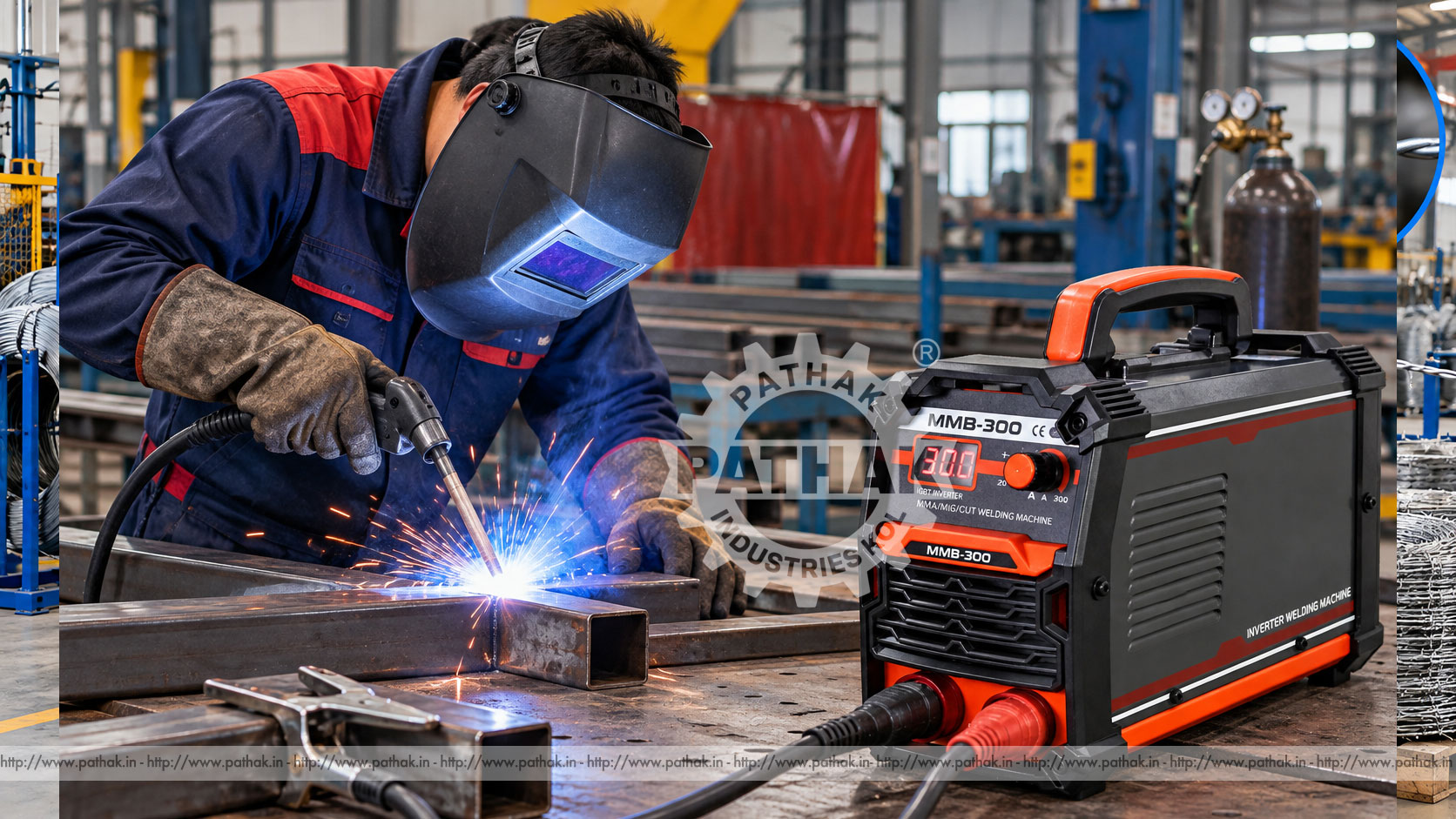
Fabrication quality depends on much more than melting two metal edges together. Joint preparation, electrode choice, current, polarity, arc length, travel angle, heat input, and inspection all influence whether the finished weld can perform its intended duty. An ARC Welding Machine 300 AMPS provides a higher-current class platform for suitable fabrication, construction, repair, and production work.
The Pathak Industries product is identified as a 300-amp arc welding machine intended for joining prepared metal components. Its current product record does not publish a matching detailed electrical or duty-cycle table; the attached table belongs to a different cutting-equipment family. For that reason, this guide does not assign an unverified input voltage, duty cycle, electrode range, process combination, or plate-thickness capacity to the machine. Those details should be confirmed for the exact supplied unit.
An arc welding power source creates and controls an electrical arc between an electrode and the workpiece. Arc heat melts the joint edges and, depending on the process, filler metal. The molten pool solidifies to form the weld.
The “300 AMPS” designation indicates the named current class, but it should not be interpreted as continuous 300-amp output under every condition. Available current, rated output, duty cycle, supply requirements, and thermal limits must come from the machine nameplate and approved technical sheet.
The power source connects to an electrode lead and a work-return lead. When the electrode approaches or touches the prepared work according to the process, the electrical circuit establishes an arc. The operator maintains the appropriate arc length and moves along the joint at a controlled rate.
A sound work-return connection is essential. Paint, rust, oil, scale, or a loose clamp can create unstable current flow and unwanted heating. Cables and connectors must be correctly rated for the current and length, with insulation intact.
Amperage affects arc energy and electrode capability, but machine selection cannot rely on the maximum number alone. A buyer also needs the rated current range, voltage behaviour, duty cycle at relevant outputs, supply phase and voltage, input current, efficiency, protection, cooling, and environmental rating.
For example, a machine may deliver its maximum current only for a limited portion of a standard time period before cooling is required. That is the purpose of duty-cycle information. Because the product page does not provide a matching value, production planning should wait for written confirmation rather than assuming continuous full-output operation.
“Arc welding” is a broad term covering several processes. The supplied unit’s actual compatibility must be confirmed. Electrode holders, wire-feed systems, torches, shielding arrangements, polarity options, and control characteristics are process-specific.
The product should not be advertised as supporting stick, wire, or another arc process merely because a promotional image depicts a particular torch. Buyers should request the exact process designation and included accessories before selecting consumables or preparing the electrical installation.
A correctly specified 300-amp-class arc welding machine may serve:
Material, joint design, service load, weld position, code requirement, and inspection level determine whether the machine and process are appropriate. Rated amperage by itself does not qualify a weld for a critical application.
Good welding starts with a joint designed for access and penetration. Edges may require cleaning, squaring, bevelling, root spacing, or backing according to the approved procedure. Oil, moisture, paint, rust, and other contamination should be removed from the weld zone.
Parts need accurate fit-up and restraint. Excessive gap or mismatch can change heat demand and filler usage. Over-clamping can prevent normal contraction and increase residual stress. Tack welds should hold alignment without creating defects in the final joint.
Consumable selection depends on the confirmed welding process, base material, thickness, joint, position, mechanical properties, polarity, and service conditions. Diameter and current must fall within both the consumable recommendation and machine capability.
Consumables should be stored and handled according to their requirements. Moisture, contamination, damaged coatings, rusty wire, or incorrect shielding can produce porosity and unstable operation. Traceability may be required for critical work.
Current influences penetration, deposition, and arc behaviour. Too little current may cause poor fusion or an unstable arc; too much can create undercut, excessive spatter, burn-through, or overheating. The correct setting comes from the approved procedure and consumable guidance.
Arc length and travel speed work together with current. An unnecessarily long arc can reduce control and increase spatter. Moving too rapidly may leave insufficient fusion, while moving too slowly can build excessive heat and an oversized bead. Operators need training and test practice for the selected process.
Some arc processes and consumables require a specific direct-current polarity, while others may use a different output. The machine’s available output type and polarity connections must be verified before use. Incorrect polarity can significantly change penetration and electrode behaviour.
The incoming electrical supply must match the nameplate. Cable size, isolator, protective devices, earthing, plug or termination, and extension leads should be planned by qualified personnel. The product’s unrelated plasma table must not be used to size the supply for this welder.
Welding cables carry high current and must be sized for output, length, duty cycle, and installation conditions. Excessively long or undersized cables cause voltage drop and heat. Loose connectors create resistance and can fail.
The electrode holder or torch and work clamp should be inspected before every shift. Damaged insulation, exposed conductors, overheated lugs, weak clamp springs, or loose terminals require correction before welding begins.
Welding introduces concentrated heat, and the joint contracts as it cools. Large assemblies can move out of tolerance even when the bead looks acceptable. Balanced sequences, intermittent welding where allowed, fixtures, presetting, controlled heat input, and planned cooling can limit distortion.
The welding procedure should define interpass control where necessary. Quenching a hot weld without an approved procedure can alter properties or create cracking. Temperature control depends on base material and service requirements.
Visual inspection can identify cracks, porosity, undercut, overlap, incomplete fill, excessive reinforcement, arc strikes, and poor bead placement. Joint dimensions and distortion should also be checked against the drawing.
Critical work may require penetrant, magnetic, ultrasonic, radiographic, destructive, or other qualified examination. The appropriate method depends on material, joint, service, and governing requirements. A smooth-looking bead is not proof of internal fusion.
Welding fumes and gases depend on the base material, coating, consumable, shielding, and process. Adequate ventilation or local extraction should keep exposure controlled without disturbing necessary shielding. Coated or contaminated material may create particularly hazardous fumes.
Work in tanks, vessels, pits, or other confined spaces requires a dedicated confined-space procedure, atmospheric assessment, ventilation, rescue planning, and supervision. A welding machine should never be taken into such work without the full site controls.
Arc radiation, sparks, molten metal, hot workpieces, current, and compressed gases where used create multiple hazards. Screens protect nearby personnel from arc light. Suitable helmet shade, clothing, gloves, footwear, hearing protection, and respiratory measures should follow the risk assessment.
Combustible materials must be removed or protected, and hot-work controls applied. Cylinders, if part of the confirmed process, must be secured and handled safely. The machine should be isolated before internal maintenance, and wet conditions require particular electrical caution.
A 300-amp class can support suitable higher-current work while still requiring confirmation of its actual rated range and duty cycle.
With the verified process and accessories, the machine can be considered for workshop, site, maintenance, and production applications.
An appropriate power source provides adjustable electrical output so a qualified operator can follow the approved procedure.
Documented settings, fixtures, consumables, and inspection allow recurring joints to be produced under controlled conditions.
Before use, inspect cables, connectors, holder or torch, work clamp, controls, cooling vents, fan operation, enclosure, and supply lead. Dust and metal particles should be removed using the approved method with power isolated.
Scheduled service should cover internal connections, insulation, output terminals, cooling system, switches, displays, protective devices, and calibration where required. Repairs should be performed by qualified personnel using compatible components.
Provide base materials, thickness range, joint types, welding positions, process, consumables, required current, duty cycle, shift pattern, site supply, cable lengths, environmental conditions, portability needs, and applicable quality requirements.
Ask Pathak Industries for a matching technical sheet that confirms rated input, output range, duty cycle, output type, polarity, protection, cooling, dimensions, weight, supplied accessories, and warranty. Those verified details—not the incompatible cutting table—should control the purchase decision.
Not necessarily. Continuous capability depends on the published duty cycle and thermal rating at the selected current.
The current product record does not clearly confirm the exact process combination. Obtain the matching model specification before selecting accessories or consumables.
The product page does not provide a reliable matching electrical table. Use only the supplied unit’s nameplate and confirmed technical sheet.
No. Suitability depends on process, output, polarity, consumable, base material, joint, procedure, and operator qualification.
Follow the qualified procedure and consumable guidance, then validate arc behaviour, fusion, bead form, and inspection results.
It completes the welding circuit. A loose or contaminated connection can cause instability, voltage loss, and local overheating.
Joint preparation, fit-up, consumable condition, current, polarity, arc length, travel, heat control, cleanliness, and operator technique all matter.
Confirm process, output range, duty cycle, electrical input, polarity, protection, cables, accessories, dimensions, weight, service, and the intended welding procedure.
The Pathak Industries ARC Welding Machine 300 AMPS is positioned for suitable fabrication, construction, maintenance, and production joining work. Because the current product table does not match the named welder, responsible selection requires a confirmed technical sheet. With the correct process, electrical installation, consumables, procedure, operator training, inspection, and maintenance, a 300-amp-class power source can become a capable workshop asset.