Head Office
117, Grand Trunk Road, Salkia Howrah-700013, Kolkata, India
 Hitesh PathakTue, Aug 13, 2024
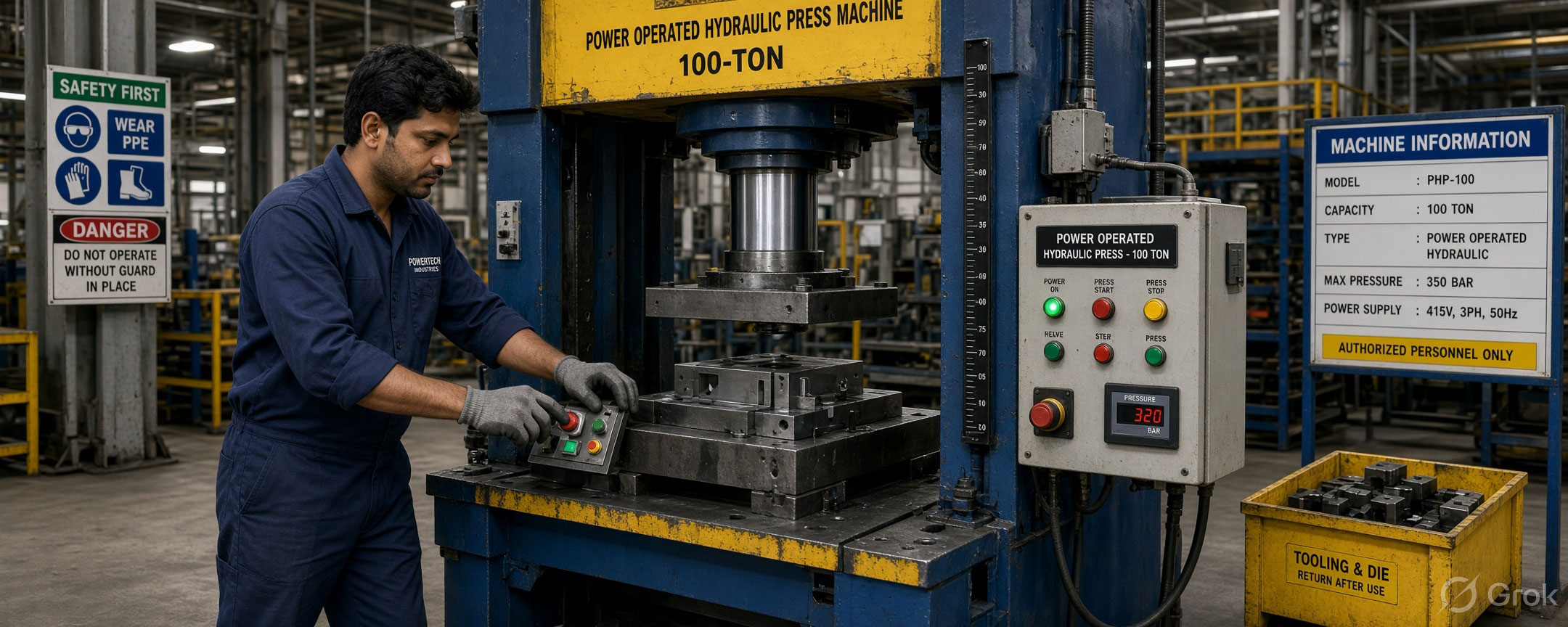
Industrial pressing work often calls for substantial force delivered through a controlled, stable movement. Components may need to be formed, fitted, straightened, punched, compacted, assembled, or separated without relying on uncontrolled impact. A power-operated hydraulic press creates a dedicated workstation for these jobs by converting hydraulic pressure into guided ram movement against a supported workpiece.
The Power Operated Hydraulic Press Machine 100-Ton from Pathak Industries is intended for suitable heavy workshop operations that require progressive force and rigid reaction support around the working zone. Its documented 100-ton configuration combines a defined working space, ram travel, and motor power that buyers can evaluate against their actual components and processes. This guide explains how the machine works, where it can be applied, what the published specifications mean, and which practical factors should be reviewed before installation.
A 100-ton hydraulic press is a powered machine designed to apply compressive force through a moving ram. The workpiece and tooling are positioned within the press frame, and the hydraulic system advances the ram so that force is transferred through the tool into the supported material. The frame provides the reaction structure needed to contain the pressing load.
The 100-ton rating identifies the nominal force class of this configuration; it does not mean that every component should automatically be processed at maximum force. The actual requirement depends on the operation, material, contact area, tooling geometry, component condition, and process plan. Correct work must remain within the machine’s approved capacity and working envelope.
Unlike an impact process, hydraulic actuation can provide progressive movement. This characteristic can help an operator control approach and pressing action for a suitable setup. However, successful work still depends on correct support, centered loading, appropriate tooling, trained operation, and observance of the machine instructions.
A hydraulic system uses pressurized fluid to transmit energy. During a pressing cycle, the power unit supplies flow to the actuator, causing the ram to move toward the work. The ram transfers force through the selected tool or pressing surface, while the bed and frame react against that load. When the operation is complete, the system permits the ram to stop and return according to the machine’s control arrangement.
The process begins with job planning rather than ram movement. The operator must establish the required operation, examine the workpiece, select approved tooling, position the supports, and confirm that the load path is aligned. The working area is then checked for clearance. A controlled approach helps verify that the tool, component, and support remain correctly located before significant force is applied.
Off-center loading can place unintended stress on tooling, the workpiece, and the press structure. Parts that are unstable, brittle, spring-loaded, or likely to eject also require specific risk controls. Hydraulic control does not correct an unsuitable setup; it must be combined with sound process design.
The product specification lists a 100-ton configuration with a between-column working area of 1200 × 600 mm. The minimum and maximum ram-to-bed figures are published as 180 × 975 mm, and ram travel is listed as 225 mm. Motor power for this configuration is 7.5 HP.
These values describe different parts of the usable machine envelope:
No single figure establishes application suitability. A component may fit between the columns but still need more opening, travel, or tooling clearance than the setup provides. Conversely, a physically small component can demand careful force analysis because of its material, geometry, or operation. Buyers should review all dimensions together and confirm the proposed job with Pathak Industries.
A power-operated hydraulic press can serve fabrication, assembly, maintenance, repair, and production environments. Its usefulness comes from pairing suitable tooling with a stable pressing station. The 100-ton configuration may be evaluated for operations such as controlled fitting, straightening, forming, punching, compaction, pressing bearings or bushes, assembly, and component separation.
Bushes, bearings, sleeves, pins, and similar components may require a controlled interference fit. A press can apply axial force through appropriately designed tools while the mating component is supported. The fit, alignment, material, and tooling must be established before work begins so that force is not transferred through a vulnerable surface.
Some shafts, sections, plates, or fabricated parts can be corrected through planned pressing at selected support points. Straightening requires measurement, incremental correction, and knowledge of how the material responds. Excessive or poorly placed force can make distortion worse, so this is not an operation for trial-and-error loading.
With approved dies and adequate clearance, a hydraulic press may support suitable forming or bending tasks. Required force varies with material, thickness, bend length, geometry, and tooling. The die must be compatible with the press, securely located, and arranged so the force remains within the intended load path.
Punching uses a matched punch and die to create an opening or separate material. Tool alignment and stripping behavior are important because the punch must enter and withdraw without damaging the tooling or workpiece. The required punching force and tooling design must be calculated for the actual material and geometry.
Industrial maintenance departments often encounter seized, worn, or tightly fitted components. A press may provide a more controlled approach than impact methods when removing or installing suitable parts. Unknown residual stresses, damaged components, and stored energy still require careful assessment before a load is applied.
The product record lists four standard accessories: a front operator control box, pressure-reversal hydraulic switches, a stroke counter, and variable stroke adjustment with a limit switch. Each supports a different part of operating control.
The front operator control box places relevant operating controls at the workstation. Pressure-reversal hydraulic switches relate to control of the hydraulic cycle. A stroke counter provides a way to record completed cycles, which can assist production tracking or planned checks. Variable stroke adjustment with a limit switch allows the working movement to be set according to the approved job arrangement.
Accessories should be considered as parts of the complete machine setup rather than isolated features. Their exact function, adjustment method, and safe use should follow the supplied operating documentation and commissioning guidance.
Press capability depends heavily on the tooling between the ram and workpiece. Tooling must suit the operation, resist the intended load, and contact the component in a predictable way. Improvised spacers or damaged supports can shift, fracture, or eject under load.
The workpiece should be supported so that pressing force travels through the intended section. The tool and support should share a common load path wherever the process requires centered loading. Operators must also account for what happens as the component moves: a fitted part may suddenly release, a bent component may spring, or a separated assembly may drop.
Before production, a trial setup should confirm fit, clearance, ram approach, tool retention, and component handling. If a job is repeated, documented setup instructions can help maintain consistency between operators and shifts.
Hydraulic actuation provides progressive force and controlled movement for an appropriate press process. This can support a deliberate approach to the workpiece and reduce dependence on manual force generation. The machine also brings pressing work into a defined station with a rigid frame, working bed, and control system.
These benefits do not guarantee the result of any particular operation. Component quality depends on process engineering, tool condition, alignment, material variation, operator practice, and inspection.
Start with the work, not the tonnage label. Identify the material, component geometry, operation, required force, tooling dimensions, opening, travel, loading method, output target, and inspection requirement. Compare those needs with the 100-ton model’s published 1200 × 600 mm between-column area, 180 × 975 mm ram-to-bed figures, 225 mm ram travel, and 7.5 HP motor.
Also review workshop access, foundation and floor requirements, electrical supply, material handling, operator position, maintenance clearance, tooling storage, and guarding. A large component may require lifting assistance even when it fits in the working area. The layout should permit safe movement without placing personnel beneath suspended loads or between unstable components.
Provide Pathak Industries with representative drawings and a clear operation description before ordering. If several jobs are planned, include the largest, smallest, and most demanding examples rather than relying on a single typical part.
Only trained and authorized personnel should operate the press. Guards and protective devices must be present and functional. Before starting, inspect the tooling, supports, workpiece, hoses, visible hydraulic components, fasteners, controls, and working area. Keep hands and body parts outside the point of operation and use the approved handling method for positioning.
Never exceed the machine rating or use damaged tooling. Stop the cycle if the component shifts, the tool misaligns, or the machine produces unusual noise, leakage, vibration, or movement. Hydraulic pressure can remain stored even after power is removed, so maintenance must follow the documented isolation and pressure-release procedure.
Personal protective equipment must be selected through the facility’s risk assessment. PPE complements guarding and safe setup; it does not make an unstable pressing operation acceptable.
Routine maintenance helps preserve controlled movement and identify problems before they affect production. Keep the press and surrounding floor clean, examine the hydraulic system for leakage or damage, inspect the ram and working surfaces, verify fasteners and guards, and follow the documented lubrication and service intervals.
Hydraulic fluid condition, filters, seals, hoses, connections, control devices, and the power unit should be maintained according to the manufacturer’s schedule. Tooling also needs inspection because wear, cracking, or deformation can change how force enters the workpiece. Record checks, repairs, and unusual observations so recurring changes can be investigated.
It provides controlled compressive force for suitable forming, fitting, straightening, punching, compaction, assembly, and maintenance operations. The exact job must match the machine’s capacity, working space, travel, tooling, and approved process.
The published between-column dimensions are 1200 × 600 mm. Buyers should consider tooling and handling clearance as well as the workpiece dimensions when assessing fit.
The product specification lists 225 mm ram travel for the 100-ton configuration. The published ram-to-bed minimum and maximum figures are 180 × 975 mm.
The technical table lists a 7.5 HP motor for the 100-ton configuration. Installation requirements should be confirmed from the current machine documentation before preparing the electrical connection.
It may be suitable when the component, fit, required force, support, tooling, and alignment have been properly evaluated. Force should be applied through the intended surface without loading vulnerable bearing elements or unsupported component sections.
Centered loading keeps force within the intended path through the ram, tooling, workpiece, bed, and frame. An off-center setup can produce unintended stress, movement, poor results, or damage.
Provide the operation, workpiece drawings, material, dimensions, required force, tooling concept, production frequency, loading method, available utilities, floor space, and any installation or control requirements.
A 100-ton hydraulic press can become a versatile workstation for suitable fabrication, assembly, maintenance, and production tasks. Its effectiveness comes from more than rated capacity. The working envelope, ram travel, tooling, component support, controls, handling plan, and operator procedure must function as one system.
The Pathak power-operated configuration provides documented values that help buyers begin that evaluation. By comparing those figures with real components and by planning tooling and safety before installation, a workshop can select a press around its actual work rather than tonnage alone.