
Head Office
117, Grand Trunk Road, Salkia Howrah-700013, Kolkata, India
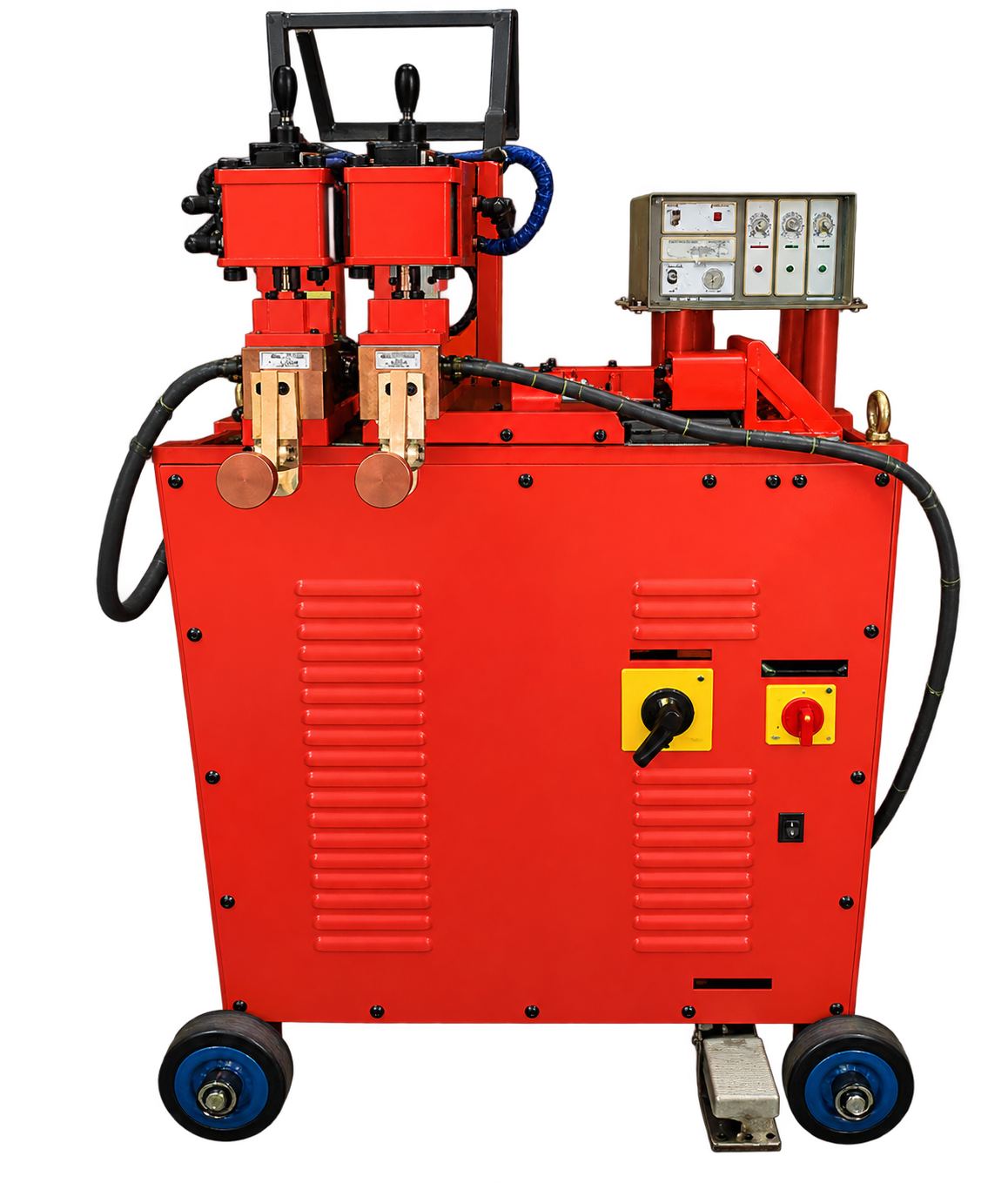
A resistance butt-welding range for joining suitable rods and blade sections in mild steel, high-carbon steel, copper, brass, aluminium and selected blade materials. Eleven models cover ratings from 10 to 150 kVA.
Shipping Information Usually dispatched With In business days
The Rod Welder uses electrical resistance and controlled upsetting force to join correctly prepared rod or blade ends. The opposing sections are clamped, current heats the interface and the machine brings the softened ends together to form the weld. Correct settings and preparation are essential for alignment, consistency and joint integrity.
The range covers eleven models from 10 to 150 kVA. All models list AC 380/440 V, two lines of three-phase input at 50/60 Hz, a 10% duty cycle, eight adjusting taps and a common approximate footprint of 785 x 525 x 1050 mm. Fuse requirements increase with machine rating.
Model-specific capacities are supplied for mild steel, high-carbon steel, copper, brass and aluminium rod. Selected lower and medium ratings also list carbon-steel blade and bimetal blade ranges. The appropriate model must be chosen from the actual material and cross-section rather than from kVA alone.
Typical applications include fabrication, wire and rod processing, maintenance, blade preparation and joining operations where suitable resistance butt welding is specified. Weld procedure development should address material composition, end squareness, cleanliness, clamping, tap setting, upset allowance, flash removal, heat treatment where required and the applicable inspection or bend test.
| Specification | TLPRB-10 | TLPB-15 | TLPB-20 | TLPB-25 | TLPB-30 | TLPB-40 | TLPB-50 | TLPB-60 | TLPB-75 | TLPB-100 | TLPB-150 |
|---|---|---|---|---|---|---|---|---|---|---|---|
| kVA Rating | 10 kVA | 15 kVA | 20 kVA | 25 kVA | 30 kVA | 40 kVA | 50 kVA | 60 kVA | 75 kVA | 100 kVA | 150 kVA |
| Input Voltage | AC 380/440 V, 2 lines of 3-phase, 50/60 Hz | AC 380/440 V, 2 lines of 3-phase, 50/60 Hz | AC 380/440 V, 2 lines of 3-phase, 50/60 Hz | AC 380/440 V, 2 lines of 3-phase, 50/60 Hz | AC 380/440 V, 2 lines of 3-phase, 50/60 Hz | AC 380/440 V, 2 lines of 3-phase, 50/60 Hz | AC 380/440 V, 2 lines of 3-phase, 50/60 Hz | AC 380/440 V, 2 lines of 3-phase, 50/60 Hz | AC 380/440 V, 2 lines of 3-phase, 50/60 Hz | AC 380/440 V, 2 lines of 3-phase, 50/60 Hz | AC 380/440 V, 2 lines of 3-phase, 50/60 Hz |
| Mild Steel | 3–10 mm | 3–12 mm | 4–14 mm | 5–16 mm | 6–17 mm | 8–18 mm | 10–20 mm | 16–22 mm | 18–25 mm | 19–28 mm | 20–31 mm |
| High-Carbon Steel | 3–8 mm | 3–9 mm | 4–11 mm | 5–12 mm | 6–13 mm | 7–14 mm | 8–15 mm | 10–16 mm | 12–15 mm | 12–18 mm | 13–20 mm |
| Copper | 3–6 mm | 3–7 mm | 4–8 mm | 5–9 mm | 6–10 mm | 7–11 mm | 8–12 mm | 10–14 mm | 12–15 mm | 12–18 mm | 13–20 mm |
| Brass | 4–8 mm | 4–9 mm | 5–10 mm | 6–11 mm | 7–12 mm | 8–13 mm | 8–14 mm | 10–16 mm | 12–17 mm | 13–19 mm | 14–22 mm |
| Aluminium | 4–8 mm | 4–9 mm | 5–10 mm | 6–11 mm | 7–12 mm | 8–13 mm | 8–14 mm | 10–16 mm | 12–17 mm | 13–19 mm | 14–22 mm |
| Carbon-Steel Blade | 20–40 mm | 20–40 mm | 30–50 mm | 30–60 mm | 35–75 mm | - | - | - | - | - | - |
| Bimetal Blade | 5–24 mm | 5–27 mm | 20–37 mm | 25–41 mm | 35–45 mm | 35–50 mm | 40–65 mm | - | - | - | - |
| Fuse Rating | 30 A | 30 A | 40 A | 50 A | 75 A | 100 A | 125 A | 150 A | 180 A | 250 A | 375 A |
| Duty Cycle | 10% | 10% | 10% | 10% | 10% | 10% | 10% | 10% | 10% | 10% | 10% |
| Adjusting Taps | No. 8 | No. 8 | No. 8 | No. 8 | No. 8 | No. 8 | No. 8 | No. 8 | No. 8 | No. 8 | No. 8 |
| Approx. Dimensions (L x W x H) | 785 x 525 x 1050 mm | 785 x 525 x 1050 mm | 785 x 525 x 1050 mm | 785 x 525 x 1050 mm | 785 x 525 x 1050 mm | 785 x 525 x 1050 mm | 785 x 525 x 1050 mm | 785 x 525 x 1050 mm | 785 x 525 x 1050 mm | 785 x 525 x 1050 mm | 785 x 525 x 1050 mm |