Head Office
117, Grand Trunk Road, Salkia Howrah-700013, Kolkata, India
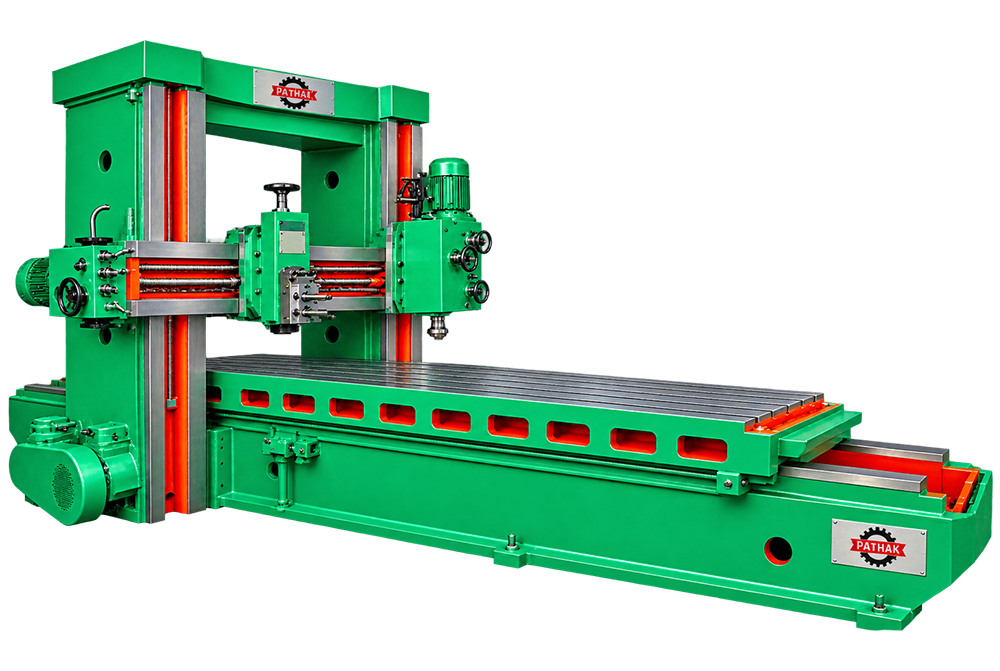
The primary role of the Planer Cum Plano Milling Machine is machining faces, slots, keyways, and contoured features. The operating method supports tool rooms, maintenance departments, and component factories and centres on controlled table travel and rigid cutter support.
Shipping Information Usually dispatched With In business days
Used for machining faces, slots, keyways, and contoured features, the Planer Cum Plano Milling Machine addresses a distinct stage of industrial work. It accommodates machine parts, dies, fixtures, and repair components and keeps setup, tool engagement, and job handling centred on that task.
Natural settings include tool rooms, maintenance departments, and component factories. There the machine may serve production, repair, preparation, assembly, finishing, or testing according to its title and the surrounding workflow.
Its cycle is based on the way it feeds supported work against a rotating multi-edge cutter. The design therefore prioritises controlled table travel and rigid cutter support; actual output still depends on the chosen model, tool, workpiece, and operating method.
Selection should follow the real workpiece, material, operation, production frequency, handling method, and available space. Exact performance data must come from the technical specification for the chosen Planer Cum Plano Milling Machine.
Pathak is a Manufacturer, Supplier and Exporter offering this machine with application-based product guidance.
| MODEL | 1218/1225/1235 | 1625/1635/1645 | 2035/2045/2060 |
| Table Size (mm) | 800 x 2100/2800/3800 | 950 x 2800/3800/4800 | 1300 x 3800/4800/6300 |
| Table Stroke (mm) | 1800/2500/3500 | 2500/3500/4500 | 3500/4500/6000 |
| No. of T - Slots | 5 | 6 | 8 |
| Width of T - Slots (mm) | 20 | 20 | 20 |
| Distance Between T -Slots (mm) | 145 | 150 | 150 |
| Table Feed Stepless (mm/min) | 40-600 | 40-600 | 40-600 |
| Table Rapid Stepless (mm/min) | 3000 | 3000 | 3000 |
| Table Feed Motor (hp) | 2/3/3 | 3/5/5 | 5/7.5/7.5 |
| Width Between Column (mm) | 1200 | 1600 | 2000 |
|
Maximum Height under Spindle (mm) |
1000 | 1000 | 1000 |
| Vertical Traverse of cross Rail (mm) | 1030 | 1030 | 1030 |
| Vertical Feed of Cross Rail (mm/min) | 300 | 300 | 300 |
| Cross Rail Feed Motor (hp) | 3 | 3 | 3 |
| Horizontal Traverse of one Saddle (mm) | 1700 | 2100 | 2500 |
| Saddle Cross Feed Motor (hp) | 3 | 3 | 3 |
| Saddle Cross Feed Stepless (mm/min) | 40-600 | 40-600 | 40-600 |
| Saddle Cross Rapid Stepless (mm/min) | 2200 | 2200 | 2200 |
| Milling Head | |||
| RPM | 80-500 | 80-500 | 80-500 |
| Speeds | Variable (2 step) | Variable (2 step)/div> | Variable (2 step) |
| Motor (hp) | 5 | 5 | 5 |
| Spindle Nose | 150-50 | 150-50 | 150-50 |
| Quill Traverse (manual) (mm) | 100 | 100 | 100 |
| Maximum Cutter Die (mm) | 125/160 | 125/160 | 125/160 |
| Swivel (manual) | .45'' | .45'' | .45'' |
| Standard | - | (standard machine comes with one vertical head) | - |
| Optional | - | Up to four (Two on cross slide ) (Two , One each on Both Columns ) | - |
| Overall Size ( L x B x H) | 2700/3750/5250 x 3035 x 2900 | 3750/5250/6750 x 3435 x 2900 | 5250/6750/9000 x 3835 x 2900 |