Head Office
117, Grand Trunk Road, Salkia Howrah-700013, Kolkata, India
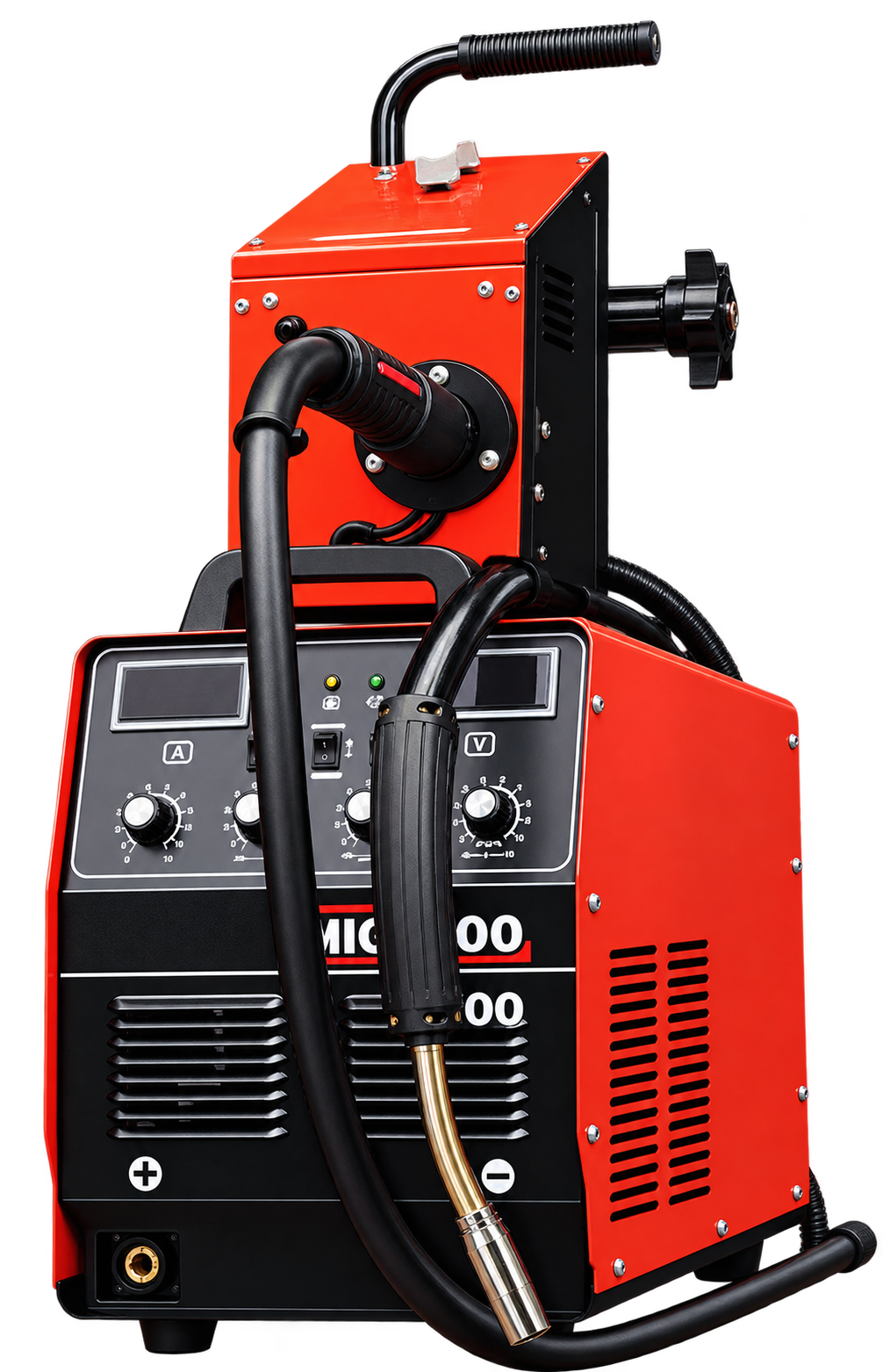
A three-phase MIG welding range for fabrication and production work, with 250 A, 400 A and 600 A duty-rated models. Available feeder configurations support 0.8–1.6 mm wire and listed speeds from 1.5 to 22 m/min.
Shipping Information Usually dispatched With In business days
The MIG Welding range uses a continuously fed electrode wire and externally supplied shielding gas to create the weld. Coordinated wire speed, voltage and current support efficient fabrication with less electrode changing than manual stick welding, particularly on repetitive seams and production assemblies.
The range includes MIG250A, MIG400A and MIG600A power sources for 370–440 V, three-phase, 50/60 Hz input. Listed outputs at 60% duty cycle are 250, 400 and 600 A respectively, while continuous-duty outputs are 190, 310 and 465 A.
Wire-feeder speed is listed from 1.5 to 22 m/min. MIG250A and MIG400A support listed 0.8, 1.0 and 1.2 mm wire, while MIG600A lists 1.0, 1.2 and 1.6 mm wire. Available feeder information includes air- and water-cooled configurations, push-pull feeding for longer reach, twin-spool options and flux-cored feeder arrangements.
Typical applications include general fabrication, structural assemblies, equipment manufacture, repair and workshop production using suitable wire, shielding gas and procedures. Select the system according to material and thickness, required transfer mode, joint design, wire type and diameter, duty cycle, torch cooling, feeder distance, electrical supply, fume extraction and production rate.
| Rating | MIG250A | MIG400A | MIG600A |
|---|---|---|---|
| Input Voltage | 370–440 V, 3-phase, 50/60 Hz | 370–440 V, 3-phase, 50/60 Hz | 370–440 V, 3-phase, 50/60 Hz |
| Output Current Range | 30–250 A | 50–600 A | 50–600 A |
| Output at 60% Duty Cycle | 250 A | 400 A | 600 A |
| Output at 100% Duty Cycle | 190 A | 310 A | 465 A |
| Output Arc Voltage Range | 16–27 V | 17–34 V | 17–39 V |
| Protection Class | IP23 | IP23 | IP23 |
| Wire-Feeder Speed | 1.5–22 m/min | 1.5–22 m/min | 1.5–22 m/min |
| Wire Diameter | 0.8/1.0/1.2 mm | 0.8/1.0/1.2 mm | 1.0/1.2/1.6 mm |
| Approx. Weight Without Wire Feeder | 20 kg | 42 kg | 56 kg |
| Technical Specification | WFA III | WFW III | Special Wire-Feeder Options | W Torch Options |
|---|---|---|---|---|
| Unit / Cooling | Air / inverter / 600 A | Water / inverter / 600 A | Water-cooled wire feeder for higher current | 300 A, air-cooled |
| Additional Configuration | - | - | Push-pull wire feeder for longer reach | 400 A, air-cooled |
| Feed-Roll Sizes | 0.8/0.8, 0.8/1.2, 1.0/1.0, 1.2/1.2, 1.2/1.6; standard 0.8/1.2 or as ordered | Twin-spool wire feeder for versatility | 600 A, air- or water-cooled | |
| Connection / Drive / Speed | EURO connection, four-roll drive, 1.5–22 m/min | Flux-cored wire feeder, all geared for welding or reclamation | 400/600 A reclamation configuration | |