
Head Office
117, Grand Trunk Road, Salkia Howrah-700013, Kolkata, India
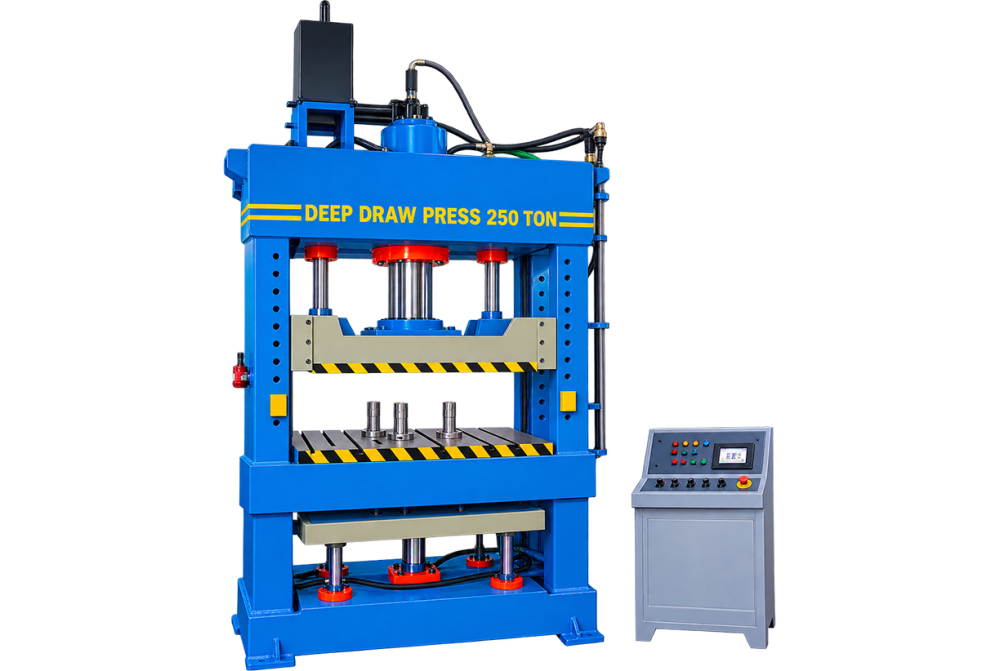
The Double Action Deep Drawing Press is designed for applying controlled force for forming, fitting, punching, or compaction. The operating method supports fabrication, assembly, maintenance, and production workshops and centres on rigid reaction support around the working zone.
Shipping Information Usually dispatched With In business days
For facilities needing applying controlled force for forming, fitting, punching, or compaction, the Double Action Deep Drawing Press offers a process-specific workstation. Its arrangement supports components and materials named by the product title while keeping the important operating area accessible.
Likely users are found in fabrication, assembly, maintenance, and production workshops. They may use it to organise the named operation, reduce repeated handling, and establish a consistent workstation for suitable jobs.
In operation, it advances a guided working member against supported material. The practical focus is rigid reaction support around the working zone. Correct workholding, tooling, supervision, and routine inspection remain important because results depend on the material and setup.
When comparing versions of the Double Action Deep Drawing Press, buyers should review the work envelope, tooling, control method, loading, and service access. Numerical capacity, speed, accuracy, or power must be confirmed from the selected model’s documented specification.
Pathak is a Manufacturer, Supplier and Exporter offering this machine with application-based product guidance.
| Technical Date | PDDP 30 | PDDP 60 | PDDP 100 | PDDP 150 | PDDP 250 |
| Maximum Pressure Force | 30 M.T. | 60 M.T. | 100 M.T. | 150 M.T. | 150 M.T. |
| Maximum Opening Force | 15 M.T. | 30 M.T. | 50 M.T. | 50 M.T. | 1000 M.T. |
| Size of platen table | 380 X 380 mm | 500 X 500 mm | 600 X 600 mm | 700 X 700 mm | 900 X 900 mm |
| Maximum Daylight | 450 mm | 600 mm | 700 mm | 800 mm | 1000 mm |
| Minimum Daylight | 250 mm | 300 mm | 350 mm | 400 mm | 500 mm |
| Difference between side column | 400 mm | 530 mm | 640 mm | 750 mm | 950 mm |
| Maximum stroke of piston | 200 mm | 300 mm | 350 mm | 400 mm | 500 mm |
| Capacity deep draw | 125 mm | 150 mm | 150 mm | 200 mm | 250 mm |
| Maximum working pressure | 320 ATM | 320 ATM | 320 ATM | 320 ATM | 320 ATM |
| Downward piston speed under low pressure | 75 mm/sec | 70 mm/sec | 50 mm/sec | 60 mm/sec | 50 mm/sec |
| Downward piston speed under high pressure | 4 mm/sec | 2.2 mm/sec | 1.3 mm/sec | 1.6 mm/sec | 3.2 mm/sec |
| Upward piston speed under low pressure | 75 mm/sec | 70 mm/sec | 50 mm/sec | 60 mm/sec | 50 mm/sec |
| Upward piston speed under high pressure | 7 mm/sec | 4 mm/sec | 2.2 mm/sec | 4.5 mm/sec | 6.4 mm/sec |
| Electric Motor | 3 H.P. | 5 H.P. | 7.5 H.P. | 10 H.P. | 15 H.P. |