Head Office
117, Grand Trunk Road, Salkia Howrah-700013, Kolkata, India
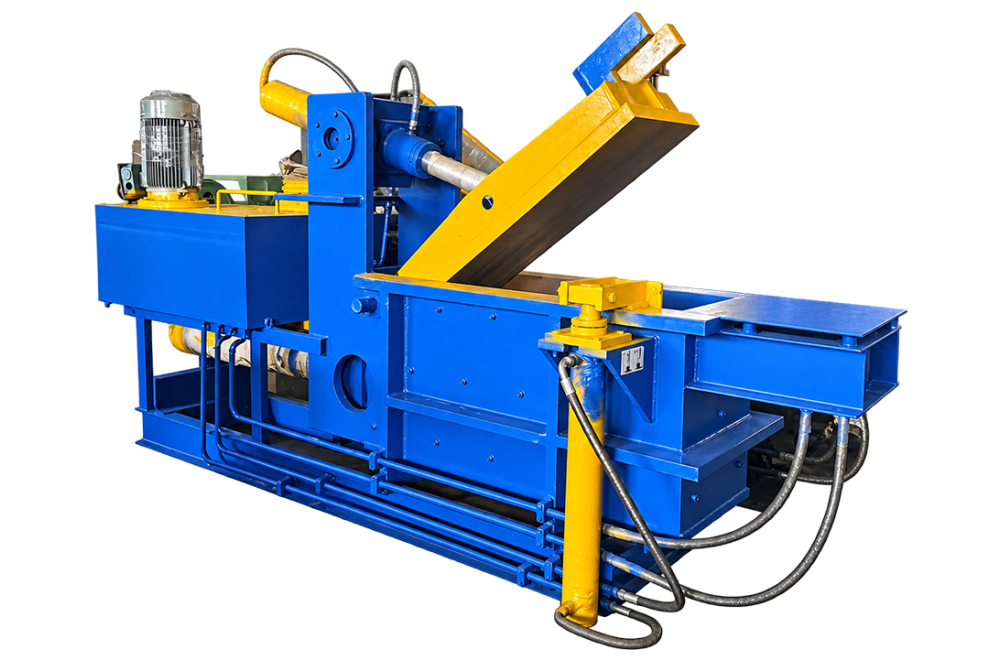
The Double Action Baling Press Machine is designed for compressing loose recyclable material into manageable bales. Typical users include recycling yards, recovery facilities, mills, and waste processors, where contained compaction for storage and transport is valuable.
Shipping Information Usually dispatched With In business days
The Double Action Baling Press Machine provides a dedicated method of compressing loose recyclable material into manageable bales. Rather than acting as unrelated general equipment, it brings the working elements together around metal, cardboard, textile, plastic, or title-specific recyclable feed.
Its cycle is based on the way it loads material into a chamber and applies ram pressure. The design therefore prioritises contained compaction for storage and transport; actual output still depends on the chosen model, tool, workpiece, and operating method.
Likely users are found in recycling yards, recovery facilities, mills, and waste processors. They may use it to organise the named operation, reduce repeated handling, and establish a consistent workstation for suitable jobs.
Selection should follow the real workpiece, material, operation, production frequency, handling method, and available space. Exact performance data must come from the technical specification for the chosen Double Action Baling Press Machine.
Pathak is a Manufacturer, Supplier and Exporter offering this machine with application-based product guidance.
| Model | PDHB 8"x15" | PDHB 16"x16" | PDHB 16"x20" | PDHB 18"x18" | PDHB 18"x24" | PDHB 20"x20" |
| Baling Chamber | 22"x15"x26" (HxWxL) (2 Cyl) | 25"x16"x52" (HxWxL) (4 Cyl) | 25"x20"x52" (HxWxL) (4 Cyl) | 25"x18"x52" (HxWxL) (4 Cyl) | 27"x24"x52" (HxWxL) (4 Cyl) | 29"x20"x52" (HxWxL) (4 Cyl) |
| Bale Size | 8"x15" (HxW) | 16"x16" (HxW) | 16"x20" (HxW) | 18"x18" (HxW) | 18"x24" (HxW) | 20"x20" (HxW) |
| Electric Motor | 7.5 H.P.,3 Phase,1440 RPM | 15 H.P.,3 Phase,1440 RPM | 15 H.P.,3 Phase,1440 RPM | 15 H.P.,3 Phase,1440 RPM | 15 H.P.,3 Phase,1440 RPM | 15 H.P.,3 Phase,1440 RPM |
| Body | Fabricated 25 mm | Fabricated 45 mm | Fabricated 45 mm | Fabricated 45 mm | Fabricated 40 mm | Fabricated (45+12) mm |
| Hard Liner Plates | Provided (C 45) 10 mm | Provided (C 45) | Provided (C 45) 12 mm | Provided (C 45) | Provided (C 45) 12 mm | Provided |
| Oil Drive | Vane Pump Systems | Double Pump Systems | Double Pump Systems | Double Pump Systems | Double Pump Systems | Vane Pump Systems |
| Working Liquid | HYDRO/ENCLO-68 (Not in Our Scope) | HYDRO/ENCLO-68 (Not in Our Scope) | HYDRO/ENCLO-68 (Not in Our Scope) | HYDRO/ENCLO-68 (Not in Our Scope) | HYDRO/ENCLO-68 (Not in Our Scope) | HYDRO/ENCLO-68 (Not in Our Scope) |
| No. Of Cylinder | 2 Nos | 4 Nos | 4 Nos | 4 Nos | 4 Nos | 2 Nos/4 Nos for Auto Eject |
| Force On Lid | 30 Tons (125 Borex140 ODx80 RAM) | 40 Tons (140 Borex170 ODx90 RAM) | 40 Tons (140 Borex170 ODx90 RAM) | 40 Tons (140 Borex170 ODx90 RAM) | 40 Tons (140 Borex170 ODx90 RAM) | 40 Tons |
| Force On Main Cylinder | 50 Tons (170 Borex205 ODx110 RAM) | 80 Tons (200 Borex245 ODx135 RAM) | 80 Tons (200 Borex245 ODx135 RAM) | 80 Tons (200 Borex245 ODx135 RAM) | 100 Tons (220 Borex270 ODx150 RAM) | 100 Tons |
| Door Lock Cylinder | - | 12 Tons (100 Borex115 ODx65 RAM) | 12 Tons (100 Borex115 ODx65 RAM) | 12 Tons (100 Borex115 ODx65 RAM) | 12 Tons (100 Borex115 ODx65 RAM) | - |
| Bale Eject Cylinder | - | 12 Tons (100 Borex115 ODx65 RAM) | 12 Tons (100 Borex115 ODx65 RAM) | 12 Tons (100 Borex115 ODx65 RAM) | 12 Tons (100 Borex115 ODx65 RAM) | - |
| Working Pressure | 2000 PSI | 3000 PSI | 3000 PSI | 3000 PSI | 3000 PSI | 3000 PSI |
| Bale Eject | By Cylinder | By Cylinder | By Cylinder | By Cylinder | By Cylinder | By Cylinder |
| Door Lock | By Manual | By Cylinder | By Cylinder | By Cylinder | By Cylinder | By Manual/Hyd for Auto Model |
| Starter | Provided | Provided | Optional | Provided | Optional | Optional |
| Idle Cycle Time | 30-35 Sec.(Approx) | 60-65 Sec.(Approx) | 60-65 Sec.(Approx) | 60-65 Sec.(Approx) | 60-65 Sec.(Approx) | 50-55 Sec.(Approx) |
| Weight of The Bale | MS 10 to 20 kg | Light Commercial 30 to 40 kg | Light Commercial 40 to 50 kg | Light Commercial 35 to 40 kg | Car Body 50 to 60 kg | Light Commercial 70 kg |
| Oil Tank Capacity | 200 Ltr | 400 Ltr | 400 Ltr | 400 Ltr | 500 Ltr | 500 Ltr |
| Operation Of The Machine | Manual 2 Through Levers | Manual 3 Through Levers | Manual 3 Through Levers | Manual 3 Through Levers | Manual 3 Through Levers | Manual Through Levers |