Head Office
117, Grand Trunk Road, Salkia Howrah-700013, Kolkata, India
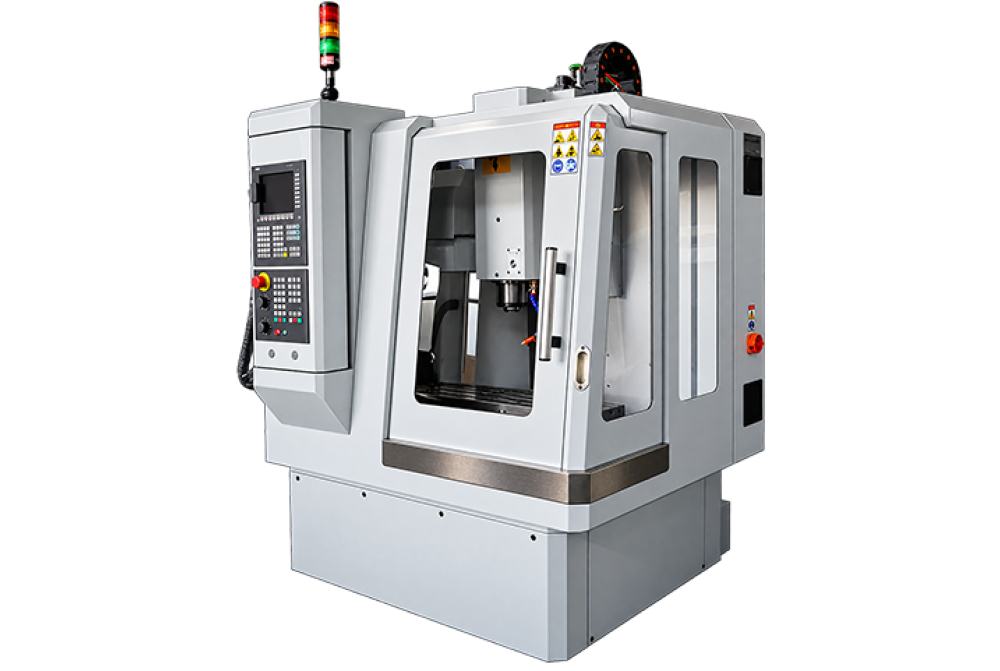
Built around machining faces, slots, keyways, and contoured features, the CNC Milling Machine provides a dedicated working arrangement. It feeds supported work against a rotating multi-edge cutter, with controlled table travel and rigid cutter support. Programmed motion supports repeatable positioning and cycle control.
Shipping Information Usually dispatched With In business days
Used for machining faces, slots, keyways, and contoured features, the CNC Milling Machine addresses a distinct stage of industrial work. It accommodates machine parts, dies, fixtures, and repair components and keeps setup, tool engagement, and job handling centred on that task.
The machine is applicable to tool rooms, maintenance departments, and component factories. It can support individual jobs, recurring batches, or a dedicated station between earlier preparation and later inspection.
A typical cycle begins with locating the job correctly, after which the machine feeds supported work against a rotating multi-edge cutter. Its controlled table travel and rigid cutter support supports repeat work without replacing the need for trained operation. Programmed motion supports repeatable positioning and cycle control.
Machines within milling machines can differ in arrangement and capability. The required CNC Milling Machine should therefore be matched to actual samples or process details, with tooling, controls, guarding, and utilities verified before ordering.
Pathak is a Manufacturer, Supplier and Exporter offering this machine with application-based product guidance.
| Model Name | TLPCM 122 | TLPCM 126 | TLPCM 132 | TLPCM 136 |
| Worktable Size | 700x210 mm | 800x260 mm | 800x320 mm | 1250x360 mm |
| T-Slots (NxWxD) | 5-18x100 mm | 3-16x75 mm | 3-16x100 mm | 3-18x80 mm |
| X/Y/Z Axis Travel | 400/220/350 mm | 450/320/450 mm | 600/400/450 mm | 900/350/500 mm |
| Distance From Spindle Center to Column | 270 mm | 360 mm | 400 mm | 460 mm |
| Distance From Spindle Nose to Worktable Surface | 75-520 mm | 90-540 mm | 100-550 mm | 100-600 mm |
| Spindle Taper | BT30 | BT40 | BT40 | BT40 |
| Spindle Power | 2.2-3.7 K.W. | 3.7 K.W. | 5.5 K.W. | 5.5 K.W. |
| Max. Spindle Speed | 8000 RPM | 8000 RPM | 8000 RPM | 8000 RPM |
| Max. Feed Speed | 18 m/min | 10 m/min | 10 m/min | 10 m/min |
| Rapid Feed Speed (X/Y/Z) | 10/10/10 m/min | 15/15/15 m/min | 20/20/18 m/min | 10/10/8 m/min |
| AC Servo Motor Torque (X/Y/Z) | 6/6/6 N.m. | 6/6/15 N.m. | 7.7/7.7/15 N.m. | 7.7/7.7/15 N.m. |
| X/Y/Z Feed Motor Power | 0.75/0.75/1 K.W. | 1/1/2 K.W. | 1.5/1.5/2 K.W. | 1.5/1.5/2 K.W. |
| Power | 4.5 K.W. | 8 K.W. | 11 K.W. | 11 K.W. |
| X/Y/Z Ball Screw | 2505 | 2510 | 3210 | X-3206,Y-4006 |
| Tool Magazine Capacity | 8T/12T (optional) | 12T | 12T/16T (optional) | 16T |
| Tool Length | 175 mm | 200 mm | 200 mm | 200 mm |
| Tool Change Time | 7 S. | 7 S. | 7 S. | 7 S. |
| Positioning Accuracy (X/Y/Z) | 0.02 mm | 0.02 mm mm | 0.01 mm mm | 0.02 mm mm |
| Re-Positioning Accuracy (X/Y/Z) | 0.01 mm | 0.01 mm | 0.005 mm | 0.01 mm |
| Overall Dimension (LxWxH) | 1470x1550x2080 mm | 2100x1850x2250 mm | 2200x1950x2300 mm | 3000x2150x2450 mm |
| Machine Weight | 1300 kg | 2200 kg | 2400 kg | 3500 kg |