
Head Office
117, Grand Trunk Road, Salkia Howrah-700013, Kolkata, India
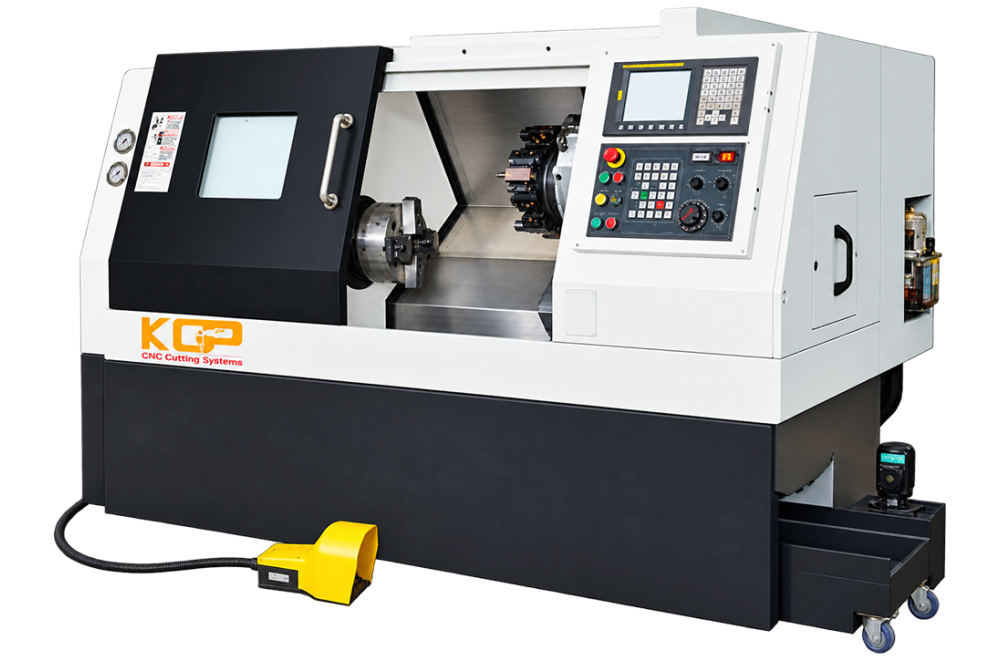
The CNC Lathe Machine KCP 300 is designed for turning rotational components and producing faces, diameters, bores, or threads. Typical users include machine shops, repair workshops, tool rooms, and component plants, where rigid workholding with controlled tool travel is valuable. Programmed motion supports repeatable positioning and cycle control.
Shipping Information Usually dispatched With In business days
The CNC Lathe Machine KCP 300 provides a dedicated method of turning rotational components and producing faces, diameters, bores, or threads. Rather than acting as unrelated general equipment, it brings the working elements together around shafts, bushes, sleeves, discs, and other title-specific round parts.
In operation, it rotates a securely held workpiece while a guided tool removes material. The practical focus is rigid workholding with controlled tool travel. Correct workholding, tooling, supervision, and routine inspection remain important because results depend on the material and setup. Programmed motion supports repeatable positioning and cycle control.
The machine is applicable to machine shops, repair workshops, tool rooms, and component plants. It can support individual jobs, recurring batches, or a dedicated station between earlier preparation and later inspection.
When comparing versions of the CNC Lathe Machine KCP 300, buyers should review the work envelope, tooling, control method, loading, and service access. Numerical capacity, speed, accuracy, or power must be confirmed from the selected model’s documented specification.
Pathak is a Manufacturer, Supplier and Exporter offering this machine with application-based product guidance.
|
CAPACITY
|
KCP TURN 165 | KCP TURN 200 | KCP TURN 230 | KCP 230L | |
| Swing over Bed | mm | 475 | 500 | 500 | 500 |
| Maximum Turning Dia. | mm | 275 | 300 | 350 | 350 |
| Standard Turning Dia. | mm | 165 | 200 | 230 | 230 |
| Max.Turning Length (with chuck) | mm | 280 | 300 | 500 | 500 |
| Admit Between Centres | mm | 350 | 350 | 600 | 1200 |
| Chuck Size | mm | 170 | 200 | 210 | 210 |
|
TRAVERSES
|
|||||
| Cross (X-Axis) Travel | mm | 175 | 175 | 175 | 175 |
| Longitudinal (Z-Axis) Travel | mm | 350 | 550 | 550 | 1120 |
| Rapid Feed (X & Z Axis) | m/min | 30/30 | 30/30 | 30/30 | 30/30 |
|
MAIN SPINDLE
|
|||||
| Spindle Motor Power | cont/30 min. | 5.5/75KW | 5.5/75KW | 5.5/75KW | 5.5/75KW |
| Spindle Bore | mm | 45 | 45 | 56 | 56 |
| Spindle Nose | A2-5 | A2-5 | A2-6 | A2-6 | |
| Max.Bar Capacity | mm | 38 | 38 | 48 | 48 |
| Spindle Speed Range | rpm | 50-4500 | 50-4000 | 50-3500 | 50-3500 |
| Full Power Speed Range | rpm | 100-3300 | 1000-3300 | 1000-3000 | 1000-3000 |
|
TAIL STOCK
|
|||||
| Quill Dia. | mm | 80 | 80 | 80 | 80 |
| Quill Taper | mm | MT4 | MT4 | MT4 | MT4 |
| Quill Stroke | mm | 100 | 100 | 100 | 100 |
| Base Travel | mm | 250 | 250 | 400 | 400 |
|
TURRET
|
|||||
| No. of Tool Position | No. | 8 | 8 | 8 | 8 |
| Tool Shank Size | mm | 25x25 | 25x25 | 25x25 | 25x25 |
| Max Boring Bar Dia. | mm | 40 | 40 | 40 | 40 |
| Positioning Uncertainty | 0.007 | 0.007 | 0.007 | 0.007 | |
| Repeatability | mm | 0.003 | 0.003 | 0.003 | 0.003 |
|
OTHER
|
|||||
| Weight ( Approx.) | kgs. | 3400 | 3500 | 3900 | 4300 |
| Dimension (Approx.) | (L x W x H) | 2600x1450x1800 | 2600x1450x1800 | 2600x1450x1800 | 2600x1450x1800 |