Head Office
117, Grand Trunk Road, Salkia Howrah-700013, Kolkata, India
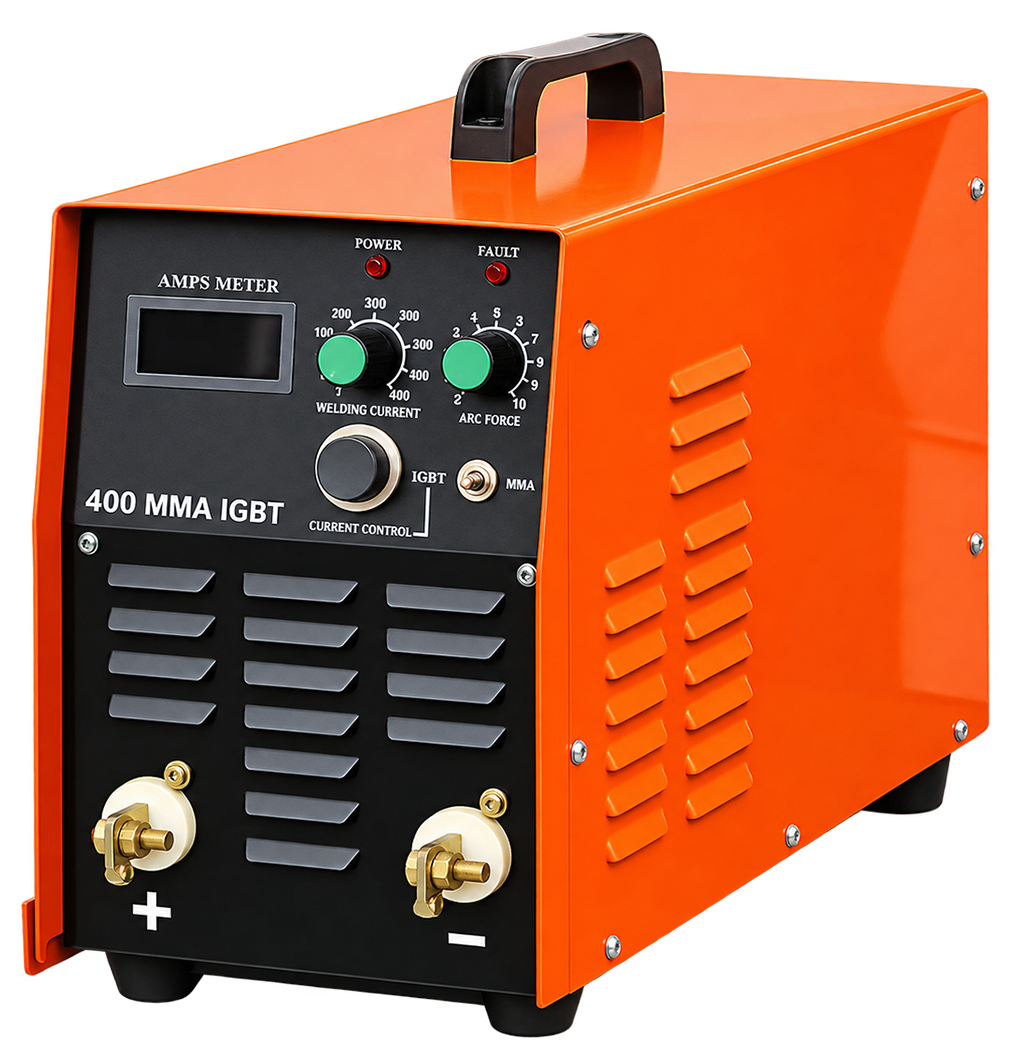
A forced-air-cooled STICK welding range for workshop, fabrication and maintenance applications. Six models cover listed welding currents from 20 A up to 630 A with electrode capacities from 1.6 to 6.0 mm.
Shipping Information Usually dispatched With In business days
The ARC Welding range is designed for shielded metal arc welding, commonly known as STICK or MMA welding. An electric arc between a flux-coated electrode and the workpiece melts the joint area and electrode, while the flux provides shielding and slag protection during solidification.
Six models cover different production and portability needs. The range begins with the compact STICK 200 and extends through 250 A variants to STICK 400 and STICK 600. Listed minimum welding current is 20 A across all models, while maximum output ranges from 160 to 630 A.
Input configurations vary by model. STICK 200 and STICK 250S list 195–240 V single-phase input; STICK 250MV lists 195–240/370–440 V single/two-phase input; and the STICK 2503P, STICK 400 and STICK 600 group lists 370–440 V, three-phase, 50/60 Hz input. All models use forced-air cooling and Class H insulation.
Typical applications include fabrication, erection, repair, maintenance and general workshop welding of suitable ferrous materials with compatible electrodes and procedures. Select the model by electrode diameter, required current, duty requirements, base material, joint design, site supply and portability. Welding procedure qualification, ventilation, electrical protection and operator PPE remain essential.
| Parameter | STICK 200 | STICK 250S | STICK 250MV | STICK 2503P | STICK 400 | STICK 600 |
|---|---|---|---|---|---|---|
| Input Voltage | 195–240 V, single phase | 195–240 V, single phase | 195–240/370–440 V, single/two phase | 370–440 V, 3-phase, 50/60 Hz | 370–440 V, 3-phase, 50/60 Hz | 370–440 V, 3-phase, 50/60 Hz |
| Open-Circuit Voltage | 60 V | 62 V | 62 V | 77 V | 74 V | 80 V |
| Max. Input | 5.3 kVA | 10.7 kVA | 9.5 kVA | 9.4 kVA | 17.5 kVA | 32 kVA |
| Maximum Input Current | 28 A | 41 A | 37 A | 15 A | 32 A | 51 A |
| Minimum Welding Current | 20 A | 20 A | 20 A | 20 A | 20 A | 20 A |
| Maximum Welding Current | 160 A | 250 A | 250 A | 250 A | 400 A | 630 A |
| Maximum Arc Voltage | 26 V | 29 V | 29 V | 29 V | 36 V | 44 V |
| Insulation Class | H | H | H | H | H | H |
| Electrode Size | 1.6–3.15 mm | 1.6–4.0 mm | 1.6–4.0 mm | 1.6–4.0 mm | 1.6–6.0 mm | 2.5–6.0 mm |
| Cooling | Forced air | Forced air | Forced air | Forced air | Forced air | Forced air |
| Approx. Size | 290 x 130 x 200 mm | 420 x 190 x 310 mm | 420 x 190 x 310 mm | 480 x 200 x 300 mm | 525 x 230 x 440 mm | 650 x 355 x 624 mm |
| Approx. Weight | 4.6 kg | 11 kg | 12 kg | 12 kg | 19.0 kg | 52.0 kg |