
Head Office
117, Grand Trunk Road, Salkia Howrah-700013, Kolkata, India
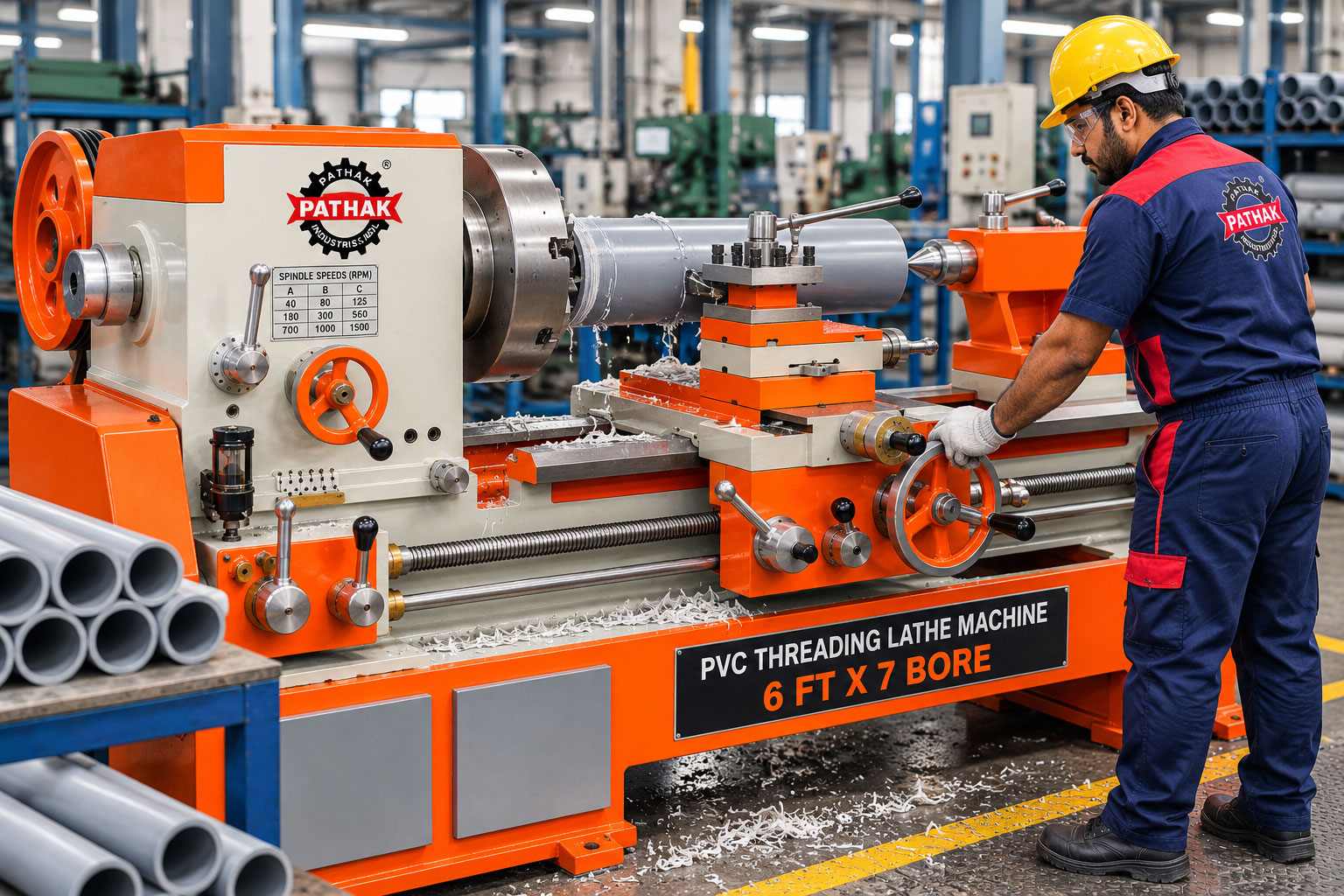
PVC, UPVC and CPVC pipes are widely used across water distribution, plumbing, agriculture, irrigation, industrial piping, drainage and other fluid-handling applications. While many pipe systems use solvent-welded, socketed or mechanically joined fittings, certain products and specialized applications require accurately machined external or internal threads.
PVC, UPVC and CPVC pipes are widely used across water distribution, plumbing, agriculture, irrigation, industrial piping, drainage and other fluid-handling applications. While many pipe systems use solvent-welded, socketed or mechanically joined fittings, certain products and specialized applications require accurately machined external or internal threads.
A PVC Threading Bore Lathe Machine is a specialized industrial lathe designed to hold and machine plastic pipes and other suitable hollow cylindrical components. A key feature is its large spindle bore, which allows comparatively large-diameter pipe to pass through the spindle while the required end section remains accessible for machining.
This makes the machine particularly useful for manufacturers that need to perform operations such as external threading, internal threading, facing, chamfering, end preparation, boring and other compatible turning operations on PVC, UPVC and CPVC pipes.
This guide covers:
The correct machine should be selected according to actual pipe diameter, length, thread specification, material, required operations, production volume and machine capacity.
A PVC threading bore lathe is a specialized form of lathe designed primarily for machining hollow plastic pipes and similar tubular workpieces.
Unlike a general-purpose lathe with a relatively limited spindle passage, a large-bore pipe-threading lathe provides a larger opening through the spindle. This allows long pipe sections to extend through the headstock rather than requiring the entire workpiece to remain between the headstock and tailstock.
The workpiece rotates while a cutting tool removes material in a controlled manner.
Depending on the machine configuration and tooling, operations can include:
For plastic pipe manufacturers, this provides a dedicated machining solution for applications where conventional pipe joining or molded features are insufficient.
The spindle bore is one of the most important specifications of a PVC pipe threading lathe.
Consider a long section of large-diameter pipe. On a conventional lathe, accommodating the complete length can be difficult because the workpiece may exceed the practical capacity of the machine.
A large hollow spindle allows the pipe to pass through the headstock.
This provides several advantages:
Any pipe projecting from the rear of the spindle must be properly guarded and supported according to the machine manufacturer's requirements. Unsupported rotating stock can create a serious safety hazard.
The fundamental machining principle is similar to other lathes: the workpiece rotates while a cutting tool is fed against it.
For pipe threading, the process can generally be divided into the following stages.
The operator first identifies the pipe material, outside diameter, inside diameter, wall thickness, length and required thread.
This information determines the appropriate workholding, cutting tool and machining parameters.
The pipe is inserted through the large spindle bore where the machine configuration permits.
The required end is positioned in the machining area. Long pipe projecting outside the machine requires suitable support and safeguarding.
The pipe is securely held using the machine's appropriate workholding system.
This step is especially important with PVC, UPVC and CPVC because excessive clamping pressure can deform or damage a plastic pipe.
The objective is to achieve secure, concentric holding without crushing or distorting the workpiece.
The pipe end can be faced to establish a clean, square reference surface.
Correct facing is useful before subsequent threading or end preparation.
A controlled chamfer can be machined where required by the component or thread specification.
Chamfering can facilitate assembly and remove sharp edges.
A suitable threading tool is fed relative to the rotating pipe at the required relationship between spindle rotation and tool travel.
Depending on the requirement, the machine may produce external or internal threads.
Thread form, pitch, depth, taper where applicable, and dimensional requirements must be based on the actual product specification.
The finished component should be checked for applicable characteristics such as:
Suitable gauges or mating components should be used where required by the applicable specification.
Although commonly described as a PVC threading machine, the equipment may be suitable for different thermoplastic pipe materials when machine capacity, tooling and cutting conditions permit.
PVC pipe is widely used for drainage, water handling, conduit and various industrial applications.
Machining requires suitable cutting geometry and controlled parameters to avoid excessive heat or poor surface quality.
Unplasticized PVC is commonly used for rigid pipe systems.
UPVC components can be turned and threaded using suitable machine settings and tooling.
CPVC is used in applications where its particular temperature and chemical-resistance properties are appropriate.
Machining parameters should be chosen for the actual material grade and component design.
The manufacturer of the pipe material should be consulted where machining could affect product certification, wall thickness, pressure rating or joint performance.
The PVC Threading 6 ft 7 Bore Lathe Machine provides a specialized solution for pipe manufacturers and processing workshops requiring a large spindle passage and dedicated PVC threading capability.
The designation should be interpreted according to the manufacturer's actual specification. If "7 Bore" represents a nominal spindle-bore dimension, the exact usable through-bore and maximum permissible workpiece diameter should be confirmed from the technical data rather than assumed from the product name.
A machine in this category may be suitable where the manufacturer's regular component range can be accommodated within its specified dimensions and capacity.
It can provide a practical balance between machine footprint, workpiece accommodation and production requirements.
The PVC Threading 8 ft 10 Inch Bore Lathe Machine is intended for manufacturers requiring greater pipe-handling capability and a larger spindle passage, subject to its actual technical specification.
A larger bore can be particularly valuable when processing larger-diameter hollow components that cannot pass through smaller spindle bores.
The principal advantage is the ability to accommodate larger hollow workpieces through the spindle, provided the actual pipe dimensions fall within the machine's rated capacity.
Manufacturers handling a broad range of pipe diameters may benefit from the increased flexibility.
| Requirement | 6 ft 7 Bore Machine | 8 ft 10 Inch Bore Machine |
|---|---|---|
| PVC pipe threading | Suitable | Suitable |
| UPVC/CPVC applications | Suitable when specified | Suitable when specified |
| External threading | Yes, with appropriate tooling | Yes, with appropriate tooling |
| Internal threading | Configuration dependent | Configuration dependent |
| Facing & chamfering | Suitable | Suitable |
| Larger-diameter pipe | Moderate capacity | Greater potential capacity |
| Workshop footprint | Relatively more compact | Typically larger |
| Large spindle passage | Yes | Larger bore configuration |
| General pipe production | Suitable | Suitable |
| Large-pipe production | Capacity dependent | Better suited where capacity permits |
Actual specifications should always be checked before selecting either machine.
Where the pipe-system design calls for machined threaded connections, a PVC threading lathe can prepare suitable pipe ends according to the required specification.
Agriculture uses extensive networks of pipes for water distribution and irrigation.
Specialized threaded plastic components may be required for certain irrigation assemblies, pumps, connectors and distribution systems.
Pipe-processing manufacturers can use threading lathes for appropriate plumbing products requiring machined ends or threaded connections.
Industrial facilities sometimes require custom plastic pipe components with specialized end preparations.
Large-bore lathes can provide flexibility for low- and medium-volume custom production.
Suitable plastic blanks or tubular components can be machined into threaded adapters, sleeves and connectors where the design permits.
The machine can also support specialized cylindrical plastic components requiring turning, boring, facing or threading.
External threads are cut on the outside surface of a pipe or tubular component.
The cutting tool and machine feed must correspond to the required thread specification.
Where wall thickness, component design and machine configuration permit, internal threads can be machined inside a pipe end or suitable fitting blank.
Facing creates a square end surface and establishes a dimensional reference.
Chamfering produces an angled edge that can improve assembly and remove sharp corners.
Boring enlarges or finishes an existing internal diameter.
Where required, the outside diameter can be machined to produce a controlled cylindrical surface.
Grooves can be produced where specified for seals, retaining features or specialized connection systems.
The large hollow spindle is the defining advantage of this machine type.
Long tubular components can pass through the headstock, making pipe-end machining more practical.
A correctly set up machine can produce controlled thread pitch, depth and geometry according to the required specification.
Depending on machine configuration, a manufacturer can perform facing, chamfering, boring, turning and threading without moving the component to several different machines.
The machine can be useful for different pipe diameters and lengths within its rated capacity.
Manufacturers can produce special threaded pipe ends, adapters and custom components that may not be economical to manufacture through dedicated molding processes at low volumes.
Standardized tooling, setup procedures and inspection can help achieve consistent production across batches.
Thermoplastics can soften or distort if excessive heat develops during cutting.
Tool geometry, cutting speed, feed, tool sharpness and chip evacuation should therefore be optimized to avoid unnecessary heat buildup.
Sharp tools generally help produce cleaner cuts and reduce cutting forces.
A dull tool can generate additional heat and may produce poor surface quality.
Plastic pipe is hollow and may have relatively thin walls.
Excessive chuck pressure can deform the pipe, which can affect concentricity and thread quality.
Workholding must provide sufficient grip without crushing the component.
Plastic machining can produce long, continuous chips depending on material and cutting conditions.
Chip management should be considered in the tooling and operating procedure.
Long pipes require appropriate support to prevent excessive movement, vibration or whipping.
Identify the largest pipe that will be regularly processed.
Do not select the machine solely according to today's most common size if larger pipe production is expected in the future.
The pipe must fit safely through the spindle when through-spindle processing is required.
Do not assume that a nominal "7-inch" or "10-inch" description equals the maximum practical pipe diameter. Confirm the manufacturer's actual spindle through-bore and recommended workpiece capacity.
Consider the longest pipe sections to be processed.
Long pipes may require external supports and adequate clear space behind the headstock.
Determine:
The machine must be capable of generating the required thread specification.
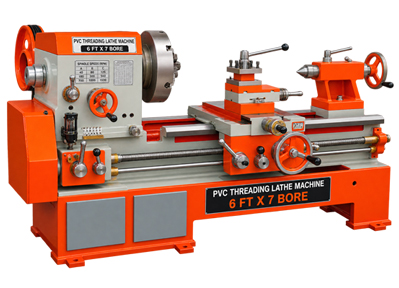
The primary role of the PVC Threading 6 ft 7 Bore Lathe Machine is producing external threads on rods, pipes, or components....
View Product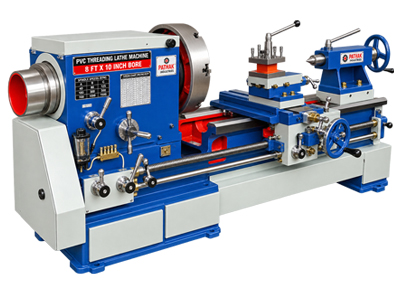
The PVC Threading 8 ft 10 Inch Bore Lathe Machine is designed for producing external threads on rods, pipes, or components. T...
View ProductConfirm whether production involves PVC, UPVC, CPVC or other plastics.
Cutting parameters and tooling should be selected accordingly.
If you need more than threading, verify whether the machine can efficiently perform:
For occasional custom work, flexibility may be more important than cycle time.
For continuous pipe production, consider setup time, loading, clamping, tooling, cutting time and inspection requirements.
The workholding system should accommodate the required pipe diameters while minimizing distortion.
Plastic machining requires appropriate spindle speeds.
A suitable speed range provides flexibility for different diameters, materials and operations.
Long stock and large rotating pipes require careful safeguarding.
Machine selection should consider chuck guarding, emergency stops, rear spindle guarding, pipe-support systems and safe operator access.
Several factors influence finished thread quality.
Regular preventive maintenance helps preserve machine accuracy and reliability.
Maintenance should follow the manufacturer's schedule and include appropriate checks of:
Plastic chips and dust should be removed regularly because accumulated material can interfere with machine movement and housekeeping.
Do not use unsafe hand-cleaning methods around rotating machinery.
Rotating pipe creates significant entanglement, impact and crushing hazards.
Particular attention must be given to any pipe extending through the rear of the spindle. Unsupported or unguarded rotating stock can create a serious hazard to operators and other personnel.
Operators should:
Machine guarding should protect operators from rotating parts, points of operation and flying material while not creating additional hazards.